Beyond Analogy and Betrayal: Understanding the Assault on Rojava as Counter-Revolution
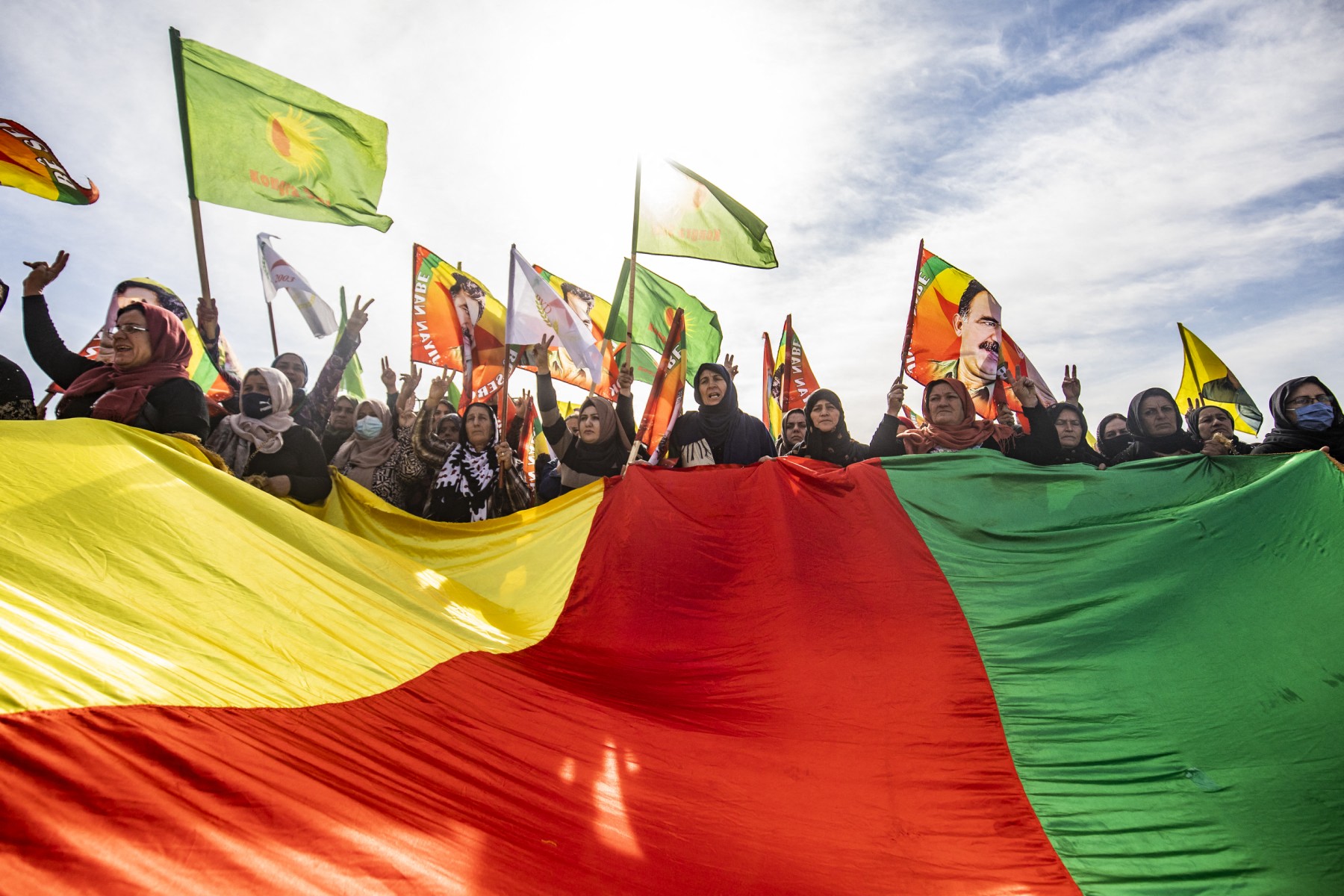
Kurdish Syrians protest the death of victims reportedly killed in a Turkish drone bombing on November 10, 2021 in the Syrian Kurdish-majority city of Qamishli. (Photo by Delil souleiman / AFP)
Among current analyses of the assault on Rojava, one recurring narrative frames the situation as a repetition of earlier moments in which Kurdish political projects were abandoned by imperial powers. The collapse of the Kurdish movement under Mullah Mustafa Barzani in 1975, the reversal of the Kurdistan Regional Government (KRG)’s gains after the 2017 independence referendum in Iraq, and the present pressure on Rojava are thus treated as variations of the same story. This reading is grounded in mainstream International Relations (IR) frameworks, in which ideology is treated as secondary and political outcomes are explained primarily through shifting state interests, power balances, and strategic calculations. Kurdish setbacks are accordingly interpreted as the result of changes in imperial priorities, while political projects are reduced to their capacity to adapt to these geopolitical constraints.
What is at stake here is not only an empirical disagreement but a conceptual one. Analogy operates by collapsing distinct historical moments into a single explanatory pattern. Betrayal, in turn, functions as a moral category that personalizes structural processes, shifting attention from how imperial power operates to whether it has violated expectations. Yet Rojava cannot be understood within these frameworks. It can only appear as a miscalculating non-state actor that failed to read the geopolitical game correctly or to secure recognition in time. What disappears from view is precisely what made Rojava historically significant: its character as a radical social revolution. Understanding Rojava requires socialist perspectives attentive to accumulation, imperial restructuring, and historical conjunctures, as well as non-Eurocentric approaches open to communal, women’s liberatory, ecological, and non-statist political forms. Without these perspectives, Rojava is inevitably misread by perspectives that continue to treat ideology as discourse rather than as a material force. In this reading, Rojava appears not as a transformative social project but merely as a failed strategic actor.
At this point, it becomes necessary to make explicit a further theoretical problem underlying analogical readings. This approach not only collapses distinct historical conjunctures into a single narrative of repetition but also erases the profound differences between the Kurdish political subjects operating within them. Treating 1975, 2017, and the present as equivalent moments of “betrayal” thus obscures both the transformation of imperialism across time and the radically different political projects articulated by Kurdish movements in each period.
This misreading is therefore deeply ahistorical. In 1975, the collapse of the Kurdish movement under Mullah Mustafa Barzani occurred within a Cold War order structured by rigid blocs, relatively stable notions of sovereignty, and inter-state bargaining. The Kurdish movement of that period was a state-oriented nationalist project, embedded in a system of regional rivalries and dependent on external state support, particularly Iran’s strategic positioning vis-à-vis Iraq. Political agency was exercised primarily through alignment with state actors, and the movement’s fate was inseparable from inter-state negotiations. Once regional antagonisms were temporarily resolved through an inter-state settlement, external support was withdrawn and the movement collapsed.
“Rojava is neither a nationalist movement seeking statehood nor a quasi-state attempting to consolidate its position within existing international frameworks. It is a revolutionary social project that explicitly challenges nation-states, patriarchy, capitalist accumulation, and ecological destruction.”
The conjuncture of 2017 was fundamentally different. The KRG functioned as a quasi-state authority within the neoliberal architecture of post-2003 Iraq. It was deeply integrated into global energy markets, security arrangements, and diplomatic frameworks, and its political project did not aim to challenge the international order but to renegotiate its position within it. The independence referendum was an attempt to consolidate sovereignty and secure recognition, not to rupture the prevailing logics of capitalism, statehood, or regional order. The rollback that followed reflected the reassertion of limits on autonomy once the exceptional conditions of the war against ISIS had passed.
The conjuncture in which the current assault on Rojava is unfolding is fundamentally different from both 1975 and 2017 and must be examined through a temporal contrast between a decade ago and the present. Ten years ago, the regional conjuncture was defined by open-ended war, fragmentation, and contingency. Energy corridors, logistics routes, and broader geoeconomic architectures had not yet crystallized. The primary objective of U.S. imperial strategy was containment, above all the defeat of ISIS. In that phase, even a radically democratic movement could acquire temporary strategic value as a military partner. That conjuncture has now closed. In the aftermath of Assad’s fall, U.S. imperialism has entered a new phase of accumulation assembled around energy routes, infrastructure, and logistics. Crucially, this project advances through the logics of fossil capitalism: hydrocarbon corridors, extractive regimes, carbon-intensive reconstruction, and energy-security frameworks that bind regional order-making to global capitalist accumulation. This shift is increasingly articulated in contemporary imperial planning discourses, including those circulating within Davos-style frameworks.
Rojava stands in direct contradiction to this trajectory. It is neither a nationalist movement seeking statehood nor a quasi-state attempting to consolidate its position within existing international frameworks. It is a revolutionary social project that explicitly challenges nation-states, patriarchy, capitalist accumulation, and ecological destruction. Its political agency is rooted in communal self-organization, women’s liberation, social reproduction, and ecological limits, forms of life fundamentally incompatible with fossil-fuel-driven reconstruction. Ideology matters only when it becomes material, and in Rojava it has. For this reason, Rojava is intolerable not merely politically but structurally and ecologically to an imperial order seeking to rebuild the region through carbon-based accumulation.
What is unfolding today is therefore not simply another episode of betrayal, but a counter-revolution, the systematic suppression of a social and ecological revolution at the precise moment of imperial reconstruction. Treating this moment as the repetition of a timeless Kurdish tragedy obscures what is historically specific and politically decisive about the present. Mazloum Kobani is not Mullah Mustafa, and Rojava is not facing another 1975, but a counter-revolutionary assault rooted in a late fascist imperial conjuncture marked by the permanent management of crisis rather than stabilization. For this reason, what Rojava needs is not retrospective advice about earlier accommodation to this order, but concrete forms of revolutionary internationalism and solidarity against it.

Şebnem Oğuz
Şebnem Oğuz is a retired professor of political science and peace academic based in Ankara, Turkey. Her work centers on late fascism, with a particular focus on its articulation with contemporary imperialism and changing state forms.