What Mustafa Barzani’s 1975 Letter to Kissinger Tells Us About the U.S. Abandonment of the SDF
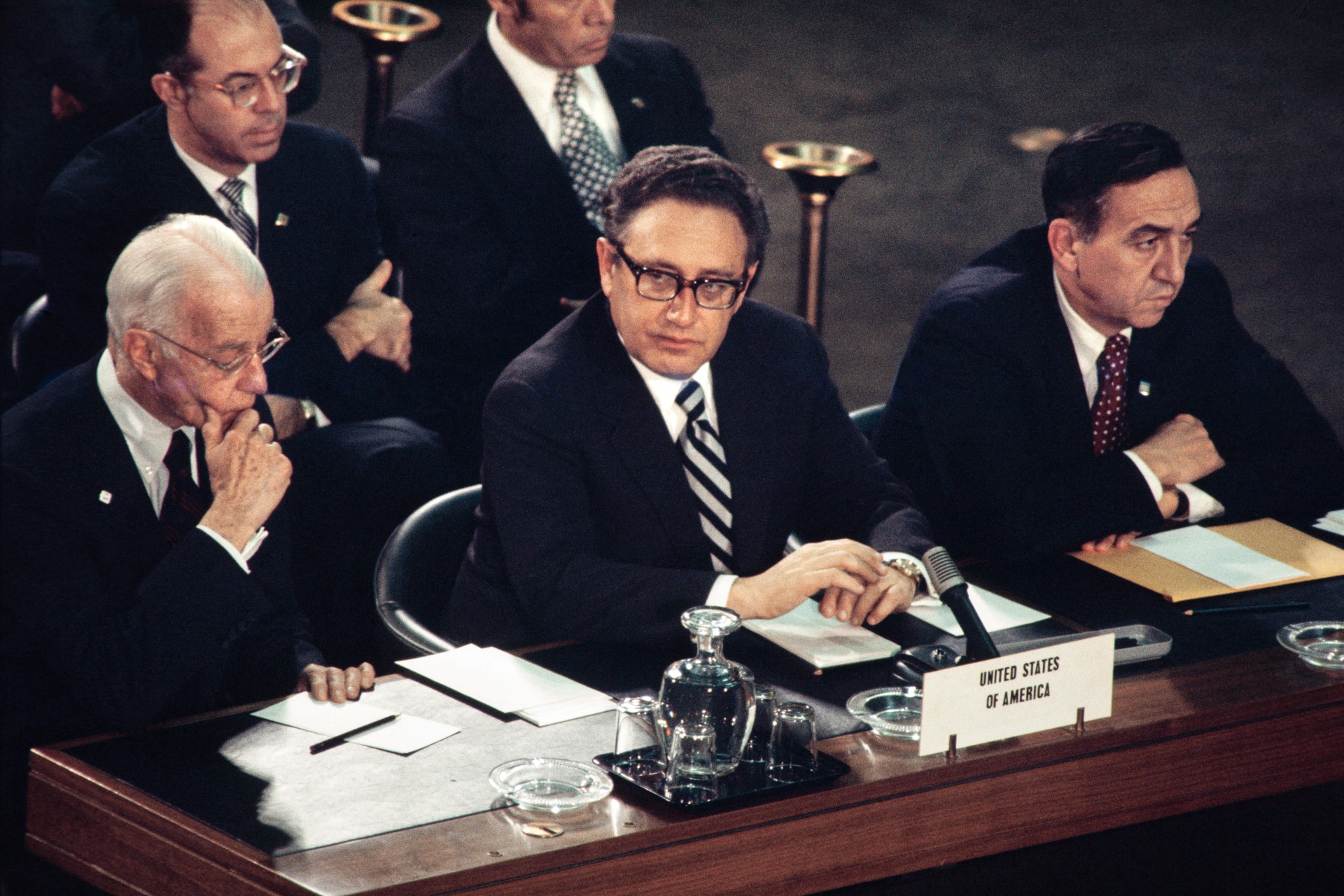
US Secretary of State Henry Kissinger (C) attends the Middle East peace conference, on December 21, 1973 in Geneva. (Photo by AFP)
In 1975, Kurdish leader Mullah Mustafa Barzani wrote to U.S. Secretary of State Henry Kissinger, appealing for protection as a “moral responsibility” of the United States. He never received a response. The Kurds were abandoned. Today, as Washington turns away from its Syrian Democratic Forces allies, the same pattern of support, sacrifice, and abandonment is unfolding once again.
For years, the SDF was Washington’s top ally in the fight against ISIS.
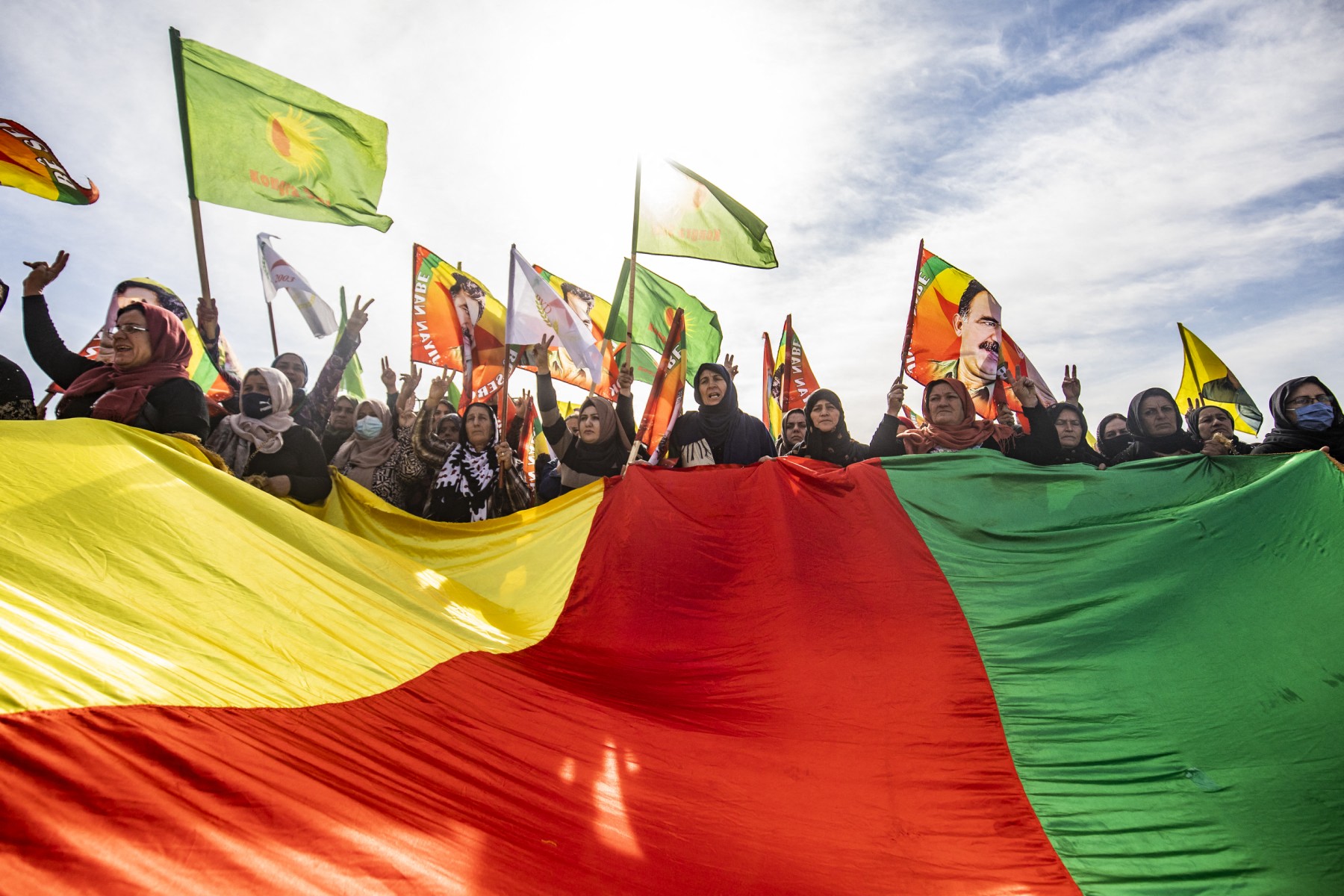
For over a decade, the United States has supported the Syrian Democratic Forces (SDF), a Kurdish-led military alliance that emerged in 2015 to fight the Islamic State. The SDF was primarily composed of the Kurdish People’s Protection Units (YPG) but also included Arab, Assyrian, and other local forces, making it Washington’s most effective partner against the Jihadist group.
For years, the SDF was Washington’s top ally in the fight against ISIS. Washington provided extensive support to the group, including training and equipment, and assistance in guarding detention facilities holding ISIS fighters and affiliates. The SDF lost over 11,000 men and women in the campaign that culminated in ISIS’s territorial defeat in 2019.
American support enabled the SDF to establish an Autonomous Administration in Northeast Syria–commonly known as Rojava–which governed one third of the country. Though not perfect, this self-governing experiment delivered basic services such as education and healthcare, sheltered internally displaced Syrians, and managed the al-Hol camp, which hosted individuals linked to ISIS whose countries refused to repatriate.
The entire project is now unraveling. The Syrian army’s advances, which started a fortnight ago, have dealt a severe blow to the experiment of Kurdish autonomous self-rule in northeast Syria. These advances have also eroded any prospects of meaningful decentralization in the “new Syria,” under which minorities might have enjoyed a measure of autonomy and guaranteed protection.
This week, under Syrian military pressure and clear U.S. indifference, the SDF agreed to a ceasefire and withdrew from the governorates of Deir al-Zoor and Raqqa in the northeast. The interim government, however, is bent on reasserting full control over the entire country, including the Kurdish-majority governorate of Hasaka and the town of Kobane, the iconic symbol of Kurdish resistance against ISIS.
While the Kurds have agreed to a US-brokered agreement, they have demanded to retain their forces to defend their communities. Like other minorities, they remain fearful about what comes next. These fears are not unfounded: the interim government’s forces stand accused of war crimes against Syria’s Alawite and Druze minorities—a grim preview of what the end of Kurdish autonomy may bring.
Meanwhile, the United States has embraced Syrian interim president Ahmed al-Sharaa, whose government joined the anti-ISIS coalition during his White House visit last November. Washington has lifted all sanctions imposed under the Caesar Syria Civilian Protection Act– measures originally designed to hold perpetrators of Assad-era atrocities accountable.
This episode harkens back to a long history of American abandonment.
Justifying the U.S. pivot, the U.S. special envoy for Syria, who also serves as the U.S. Ambassador to Turkey, wrote on X that the original purpose of the SDF has largely expired. The message is unmistakable. American former allies are now expendable.
This episode harkens back to a long history of American abandonment. In 1972, at the Shah of Iran’s request, the United States provided covert arms to Iraq’s Kurdish guerrillas in their rebellion against Saddam Hussein’s Ba’athist regime. The objective was never a Kurdish liberation, but to sustain the insurgency to drain Saddam’s resources.
A subsequent House Intelligence investigation–the Pike Committee- revealed the cynical truth: “The president, Dr. Kissinger, and the foreign head of state hoped that our clients would not prevail. They preferred instead that the insurgents simply continue a level of hostilities sufficient to sap the resources of our ally’s neighboring country.” Kurdish leader Mustafa Barzani knew nothing of this calculation and trusted the Americans implicitly. When the Shah cut off support after reaching a deal with Iraq in 1975, the U.S. simply acquiesced.
Barzani pleaded with Kissinger: “We feel, Your Excellency, that the United States has a moral and political responsibility towards our people.” There was no reply. Thousands of Kurds died, and 200,000 became refugees. When questioned by Congress, Kissinger’s response was chilling: “Covert action should not be confused with missionary work.” Even the investigators were appalled, concluding that “Even in the context of covert action, ours was a cynical enterprise.” The New York Times reported the story under the headline: “…Kurds Betrayed?”
Within weeks, Kurdish people in the north rose up and briefly liberated their cities. And then—nothing.
In 1991, Iraqi Kurds learned this lesson again. On February 15, as coalition bombs fell during Operation Desert Storm, President George H.W. Bush urged the Iraqi people to “take matters into their own hands and force Saddam Hussein, the dictator, to step aside.” Coalition aircraft dropped leaflets calling on Iraqis to “fill the streets and alleys and bring down Saddam Hussein and his aides.” The Kurds took him at his word.
Within weeks, Kurdish people in the north rose up and briefly liberated their cities. And then—nothing. The Bush administration provided no support. Saddam was allowed to use helicopter gunships in violation of the ceasefire agreement and crushed the uprising, killing more than 20,000 Kurds. Over 1.5 million Kurds—including this author, then five years old—fled toward the mountains, where thousands more died from exposure, disease, and land mines. Only after sustained media pressure did the U.S., UK, and France impose a no-fly zone, enabling Iraqi Kurds to establish a semi-autonomous region. Despite this abandonment, Iraqi Kurds became steadfast American allies after 2003.
The Kurds in Syria experienced a prelude to their abandonment in 2019 following President Trump’s surprise decision to withdraw U.S. troops from northeastern Syria. The hasty withdrawal abandoned the SDF, allowed a Turkish invasion, displaced civilians, created a vacuum for ISIS to regroup, while empowering Russia and Iran. The abrupt withdrawal caught military officials and allies off guard, undermining American credibility. The similarities to today’s abandonment could not be more striking.
Now history repeats itself in Syria. Once again, the Kurds fought America’s battles and paid in blood, alongside their American counterparts. The Syrian Kurds—like their fellow Kurds across the border in Iraq—took up arms against ISIS when much of the world hesitated. They established a fragile but functioning autonomous region that, despite its flaws, offered a vision of pluralistic governance in a deeply turbulent region. Western leaders praised Kurdish sacrifices and commitment only to turn away when geopolitical priorities shifted.
The US encourages Kurdish resistance when it serves its interests, benefits from their sacrifices, and then abandons them when the geopolitical winds change. From Kissinger’s cold realpolitik in 1975 to Bush’s unfulfilled promises in 1991 to today’s embrace of Syria’s new leadership, the story remains depressingly consistent.
It is often said that the Kurds are prisoners of geography; alas, so it seems, they are also prisoners of Western indifference of historical proportions.

Shivan Fazil
Shivan Fazil is a Ph.D. student in the Department of Political Science at Boston University, specializing in comparative politics and international relations with substantive focus on the Middle East. He worked with various esteemed institutions including, the American University of Iraq, Sulaimani’s Institute of Regional and International Studies (2024), the Stockholm International Peace Research Institute (2020–2024), the United States Institute of Peace (2019–2020), among others. Shivan holds an MSc in Middle Eastern Politics from SOAS, University of London. He regularly contributes expert analysis on political, social, and economic developments in Iraq and the Kurdistan Region to international news outlets.