How Rojava Underscores the Need for a New Security Paradigm in Europe
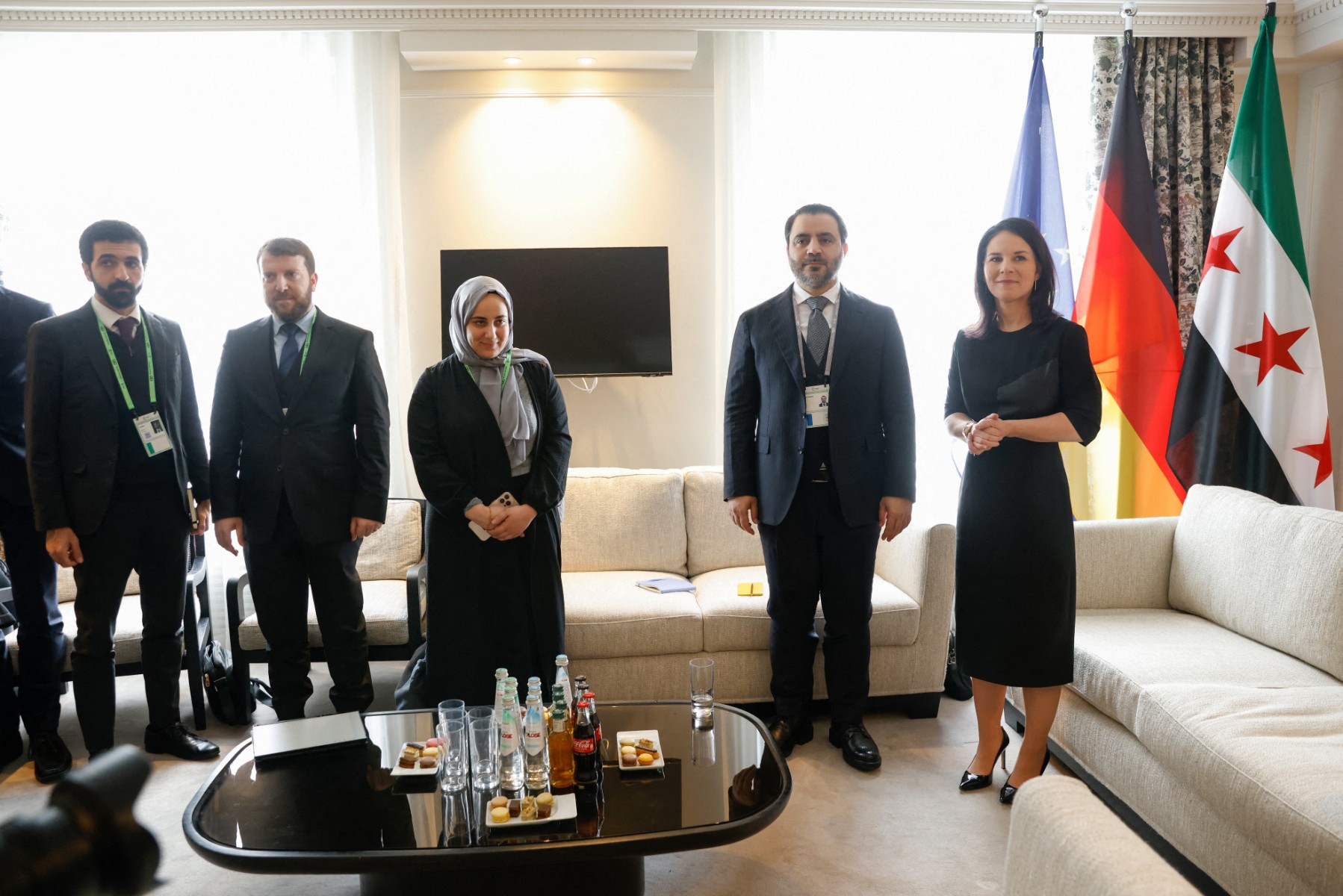
German Foreign Minister Annalena Baerbock (R) poses with Syria’s Minister of Foreign Affairs Asaad Hassan al-Shaibani and their delegations during their meeting on the sidelines of the 61st Munich Security Conference (MSC) in Munich, southern Germany on February 15, 2025. (Photo by Michaela STACHE / POOL / AFP)
This is a short response to a very important contribution in The Amargi, penned by Kamran Matin, titled ‘Are the Kurds facing another 1975?’, and it intends to add some historical depth and context to the broader Kurdish case. I think many of us who are outsiders to the field of Kurdish studies or related areas of expertise lack some essential knowledge of Kurdish history and Kurdistan as a political project. I would hold this gap partly responsible for the relative silence with which the ongoing destruction of Rojava is faced. Indeed, little attention is being paid to the humanitarian disaster in northeastern Syria, as compared with Gaza, or even Iran.
Once again, disproportionate public outrage and attention are dismantling the trap of massive mobilization and exploitation of political emotions, as philosopher Martha Nussbaum put it. This is not to say that we shouldn’t pay – or pay less – attention. As the collective The Friends of Attention stress in their recently published manifesto Attensity!, attention is not to be confused with the ongoing human fracking in today’s widespread exploitation of attention by opinion platforms. Our attention is rather seen as “our essential ability to give our minds and senses to the world.”
I agree with the author’s position proposed in the article in The Amargi. I don’t think either the political elite in Rojava or any political thinkers supportive of their project got international politics wrong or fundamentally misunderstood the arithmetic of the left/right binary. I posit that they are simply trapped between selective (“fracked”) attention, autocratic and Islamist malice, and deformations of the outdated, traditional security paradigm of the nation-state.
Germany, home to the largest Kurdish communities in Europe, does not and did not play a constructive role in recent years, at least not on the level of state politics.
There is very little they can do. The Kurdish experiment of Rojava is seemingly in a death spiral, fueled by the disintegration of the USA and by European cowardice. Germany, home to the largest Kurdish communities in Europe, does not and did not play a constructive role in recent years, at least not on the level of state politics. Just remember that awkward moment when Annalena Baerbock, then the country’s maladroit foreign minister, loudly advised the Kurds of Syria to lay down their arms, guided by the premise of (false) security and stability of Syria’s fresh interim leader and previous jihadist Al-Sharaa.
Apropos arms: Whenever Germany was in a position to do so, it strengthened the Turkish AKP regime and its allies through arms trade, and it always did so in the name of security. Nobody needs a serious, renewed discussion of Erdoğan’s convoluted mindset and what his regime perceives as “Turkish interests” that are served by these arms. Just follow the trail of blood back to 2014-2015, and the Turkish Government’s involvement with the so-called Islamic State (IS). German-Turkish journalist Deniz Yücel did so and eventually ended up in Turkish captivity. Remember the bloody and brutal attacks on Turkey’s civil society, leaving hundreds dead and characterised as “the bloodiest terror movement in Turkey’s history” by the Turkish online news portal, Diken, after at least 95 persons were killed in the Ankara bombings. Remember Erdoğan’s words: “Kobanî will fall, is falling now”, recall the Suruç massacre, and revisit the regime-stabilizing chain of bloody events that subsequently unfolded. But the AKP regime isn’t alone with an extreme anti-Kurdish stance. A sober discussion with Turkish nationalists of any political orientation is neither possible nor does it lead anywhere but the same alleged “Turkish interests”.
Both Turkey and Israel, as contradictory as can be, are supported by handshakes, symbolic speech acts, the ominous refugee deal (in the Turkish case), and, most importantly, by tons of weapons, regardless of the German politicians’ party affiliation
Proponents of Turkish nationalism know very well how to mobilize and to exploit pop-Islamist, anti-Israel emotions, while simultaneously sharing the mindset of Israel’s allegedly criminal, anti-democratic Netanyahu regime. There is no contradiction in naming both regimes and the similarities they share. In that sense, the article in The Amargi is drawing an important line between the axis of Turkish-Israeli interests and the de facto partition of Syria into interest zones, including the quasi-colonization of Afrîn by Turkey. Critical voices and positions on colonialism and imperialism, otherwise reliable interventions in Israel’s destructive war-mongering against Palestinians, rarely resonate when it comes to the Kurds and/or Kurdistan. And if we were to revisit Germany’s stance on Israel, the so-called Staatsräson – or its deformation, as Hong Kong-based author Daniel Marwecki has traced in his historical, fact-based evaluation of Germany’s default pro-Israel position – who cannot see the parallels– the repeated mistakes by leading German politicians in wholeheartedly supporting both regimes? Both Turkey and Israel, as contradictory as can be, are supported by handshakes, symbolic speech acts, the ominous refugee deal (in the Turkish case), and, most importantly, by tons of weapons, regardless of the German politicians’ party affiliation.
Lurking behind these mistakes is a structural problem: the cognitive scheme of traditional security that focuses on the (own) state while enabling the insecurity of other states and peoples. I still dare to think that another paradigm of security is needed and possible, since its absence is precisely why no adequate answers are ever given to the domino effect of political failure upon failure. This new paradigm, as I argue in my research project on cross-border neopopulism and autocratization in the Anthropocene, needs to embrace Human Security, a non-traditional security concept developed by farsighted thinkers within the UN in the 1990s.
Human Security, first drafted in the UN Human Development Report of 1994, can be seen as a response to the desperate genocidal developments in Rwanda and Bosnia. The progress made by humanity in the last 50 years, as the Pakistani economist and chief author of the Human Development Report Office, Mahbub ul-Haq, stated in 1995, was to be reviewed, and a new architecture of peace and development for the next 50 years was to be constructed, with limited achievements (United Nations Trust for Human Security, 2014).
What is at stake in northeastern Syria is not primarily identity or nation, but resources.
Human Security has never achieved the same level of success and popularity as its follow-up, the 17 SDGs (Sustainable Development Goals), have, probably because the latter fully and explicitly embrace the dominant capitalist paradigm of linear growth, as in sustainable or green growth (a leading trope among German Greens). While the sustainability of linear growth is highly debatable, the attribute ‘green’ hints at a crucial aspect, not only with regard to Mesopotamia and the water distress across the whole Middle East. In light of the progressive climate catastrophe of our days, any security concept that puts human beings at its center – and not states, autocrats, or oligarchs – must be extended by the aspect of inter-specific security. What is at stake in northeastern Syria is not primarily identity or nation, but resources. And by the way: Multiethnicity, however debatable its successful implementation may be, is one of the principles of Rojava, very much unlike Turkey’s or Israel’s leading ideologies. It is not by accident that the battlefields of northeastern Syria / Rojava are traversed by the river Euphrates and, at its border, the river Tigris. We are primarily witnessing a fight over the (scarce) natural resources of Mesopotamia, I would argue – a fact which is, for many participants of the discourse on the opinion platforms, clearly overshadowed by the parlance of identity politics.
We – as Europeans, direct neighbors and home to large diasporas from many peoples in the Middle East – should know by now that a combination of identity politics and autocratization leads to the abyss. Whoever in Europe hopes, either blindly, guided by wrong assumptions of anachronistic security concepts, or in good earnest, that autocrats and Islamists will offer them security, is wrong. Supporters of autocratic and Islamist leaders will reap more conflict, more violence, and more trouble at home.
Recommended further Reading
Ogata, Sadako. „Human Security: Theory and Practice“. St Antony’s International Review 1, Nr. 2 (2005): 11–23.
Redclift, M. R., und Marco Grasso, Hrsg. Handbook on climate change and human security. Edward Elgar, 2013.

Dr. Thomas Schad
Dr Thomas Schad received his doctorate in 2020 as a historian at the Chair of Southeast European History at Humboldt University Berlin (HU) and is an alumnus of the Berlin Graduate School Muslim Cultures and Societies (BGSMCS).