The Islamic Republic of Iran: A Struggle Between War and Submission
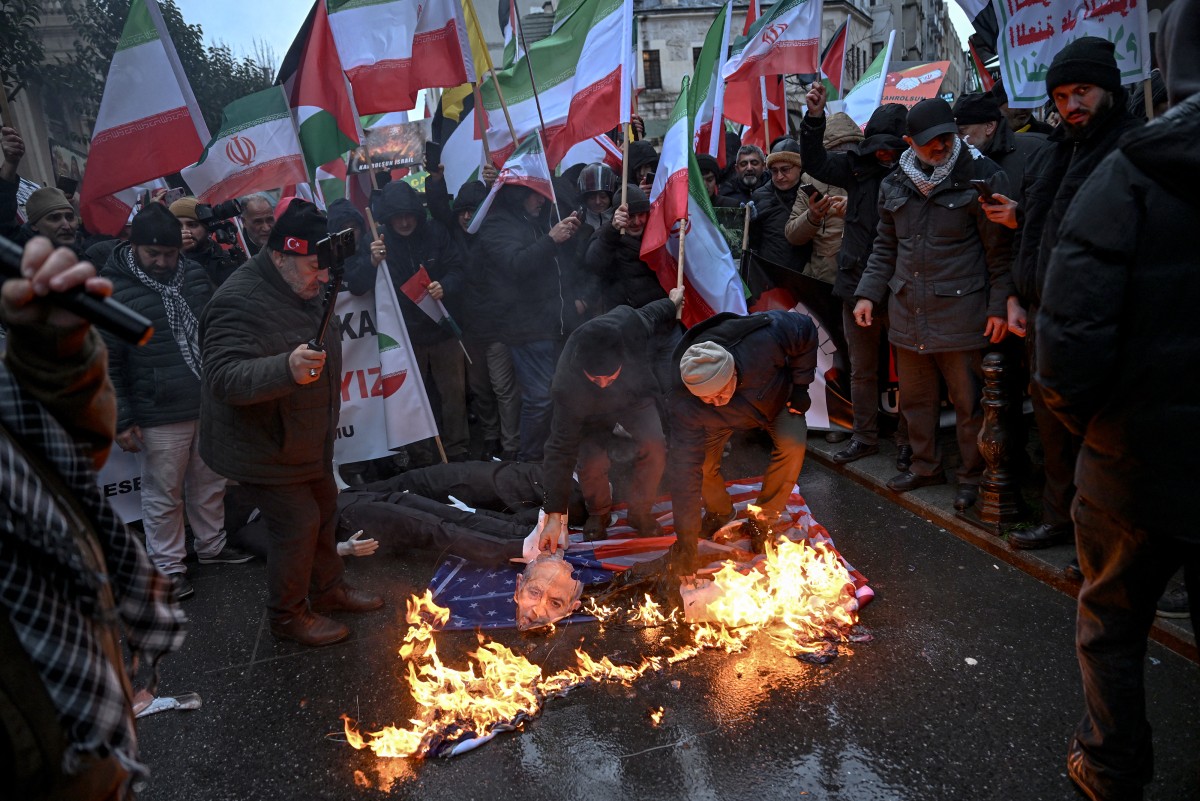
Protesters set afire portraits of US President Donald Trump and Israeli Prime Minister Benjamin Netanyahu during a pro-Iranian regime demonstration in front of the Iranian consulate in Istanbul, on January 18, 2026. (Photo by Ozan KOSE / AFP)
After weeks of lethal crackdowns that have emptied Iran’s streets of dissent, the Islamic Republic now confronts one of the most consequential choices in its 45-year history: yield under mounting international pressure or risk a direct military confrontation with the United States. It is a choice that Iranian officials privately acknowledge could threaten the survival of the regime itself.
Human rights groups and opposition networks report that thousands of protesters have been killed in recent weeks as security forces moved decisively to suppress demonstrations that erupted across major cities and commercial centers, including Tehran’s historic bazaar. While the government has not released official figures, estimates range from more than 6,000 deaths to significantly higher numbers, underscoring the scale of the unrest and the ferocity of the response.
At the same time, tensions between Washington and Tehran have escalated sharply. The United States has surged military assets into the region, deploying the USS Abraham Lincoln carrier strike group alongside advanced missile-defence systems, including THAAD and Patriot batteries, squadrons of combat aircraft, and additional naval forces. American officials say the buildup is defensive, but the concentration of firepower has dramatically expanded President Trump’s military options should diplomacy fail.
President Trump has increasingly paired this show of force with stark public warnings. On 2 January, as protests spread across Iran, he issued an unusually blunt message on hisTruth Social platform, cautioning Tehran against using lethal force against demonstrators. “If Iran shoots and violently kills peaceful protesters, which is their custom, the United States of America will come to their rescue,” he wrote. “We are locked and loaded and ready to go.”
“Close the nuclear file first. If everything is presented at once, it may be too difficult for our Iranian friends to digest.”
Nearly a month later, reports of mass casualties have continued, yet Washington has stopped short of direct military intervention. Instead, the administration has intensified its rhetoric. On January 28, Mr. Trump declared that a “massive armada” was moving toward Iran, describing it as larger and more prepared than the naval force previously deployed near Venezuela. “Time is running out,” he warned, adding that any future strike would be “far worse.”
Regional powers have scrambled to defuse the standoff. Qatar, Saudi Arabia, Oman, Egypt, and Turkey have all urged restraint and renewed negotiations, but so far their mediation efforts have yielded little fruit. Turkey’s foreign minister, Hakan Fidan, told Al Jazeera that Washington should pursue a phased approach. “Close the nuclear file first,” he said. “If everything is presented at once, it may be too difficult for our Iranian friends to digest.”
Iranian leaders, however, have responded with defiance. Abbas Araghchi, Iran’s foreign minister, said on social media that the country’s armed forces stood ready to respond “immediately and powerfully” to any attack, while insisting that Tehran remained open to a nuclear agreement “on equal footing” and free of coercion. Mohammad Bagher Qalibaf, the speaker of parliament, told CNN that negotiations conducted “under the shadow of war” would only inflame regional instability.
Despite the heated rhetoric, Iran’s negotiating position has remained largely unchanged
President Masoud Pezeshkian echoed this message in phone calls with regional leaders, saying Iran sought “dignified diplomacy” but would not hesitate to defend itself. Others were more explicit. Ali Shamkhani, a senior adviser to Iran’s supreme leader, dismissed reports of a limited U.S. strike as an “illusion,” warning that any aggression would trigger a swift and wide-ranging retaliation, including against Israel and countries supporting Washington.
Despite the heated rhetoric, Iran’s negotiating position has remained largely unchanged. Officials insist they will not suspend domestic uranium enrichment, reject talks whose outcomes are predetermined by the United States, and refuse to place limits on their ballistic missile program. These red lines stand in direct opposition to American demands for zero enrichment, the removal of Iran’s enriched uranium stockpile, restrictions on missile development, and curbs on Tehran’s regional allies.
From Washington’s perspective, time appears to be working in its Favor. Iran’s economy is under severe strain, its regional proxy network has been weakened, and its domestic legitimacy has eroded amid sustained unrest. The European Union further tightened the pressure on January 29 by moving to designate Iran’s Revolutionary Guards as a terrorist organization, prompting sharp protests from Tehran.
Abbas Araghchi, en route to a formal meeting in Turkey, wrote on X: “Europe is busy fanning the flames. After pursuing ‘snapback’ at the behest of the United States, it is now making another major strategic mistake by designating our national military as a so-called terrorist organization.”
Yet Iran is far from powerless. According to U.S. and European intelligence assessments cited by The Wall Street Journal, Tehran possesses roughly 2,000 medium-range ballistic missiles capable of reaching Israel, along with large stockpiles of short-range missiles that could strike U.S. bases and shipping in the Persian Gulf. It also fields anti-ship cruise missiles, fast-attack boats, and a growing arsenal of drones that could disrupt global energy flows through the Strait of Hormuz.
That threat looms large for American planners. In a testimony before the Senate, Secretary of State Marco Rubio said the United States has between 30,000 and 40,000 troops stationed at eight or nine facilities across the region, all within range of Iranian missiles and drones. Missile defences have been reinforced, but the recent 12-Day Israel-Iran war has demonstrated that even the most advanced systems can be overwhelmed, and interceptors are costly and difficult to replenish.
During the conflict, Iran launched approximately 550 missiles at Israel, of which about 86 percent were intercepted, while 14 percent reached their targets. Nevertheless, Israel destroyed roughly 70 percent of Iran’s missile launchers during the June fighting, and it remains unclear whether the Iranian regime can recover or rebuild additional launch capabilities.
Some analysts argue that the U.S. buildup may be intended less towards triggering a war than tightening economic pressure, enforcing sanctions, and choking off Iran’s oil exports in a strategy reminiscent of the pressure campaign used against Venezuela.
Building up a substantial military presence in the Gulf, President Trump has sidelined humanitarian intervention talks and reverted to a strategy centred on nuclear negotiations. The United States’ special envoy for the Middle East, Steve Witkoff, alongside Trump’s son-in-law, Jared Kushner, is scheduled to resume nuclear talks with Iran in Istanbul on Friday. Regional powers invited to participate in the Istanbul talks at the level of foreign ministers include Pakistan, Saudi Arabia, Qatar, Egypt, Oman, and the United Arab Emirates. The seniority of the participants, many observers suggest, underscores both the sensitivity and the strategic importance of the negotiations.
For Tehran, however, the choices appear increasingly stark. Accept an agreement that strikes at the ideological and strategic foundations of the Islamic Republic, or face the risk of confrontation with a far stronger adversary at a moment of profound internal weakness. Whether Iran can navigate a path between war and submission may determine not only the future of its nuclear program but the fate of the regime itself.

Rojin Mukriyan
Rojin Mukriyan has PhD in the Department of Government and Politics at University College Cork, Ireland. Rojin’s main research areas are in political theory, feminist and decolonial theory, and Middle Eastern politics, especially Kurdish politics. She has published articles in the Journal of International Political Theory, Philosophy and Social Criticism, and Theoria. Her research has thus far focused on the areas of Kurdish liberty, Kurdish statehood, and Kurdish political friendship. She has published many think tank commentaries and reports on recent political developments in eastern Kurdistan (Rojhelat), or north-western Iran. She has also frequently appeared on a variety of Kurdish and Persian language news channels. X account: @RojinMukriyan