Turkey Opens Investigations Over Solidarity with Kurdish Women
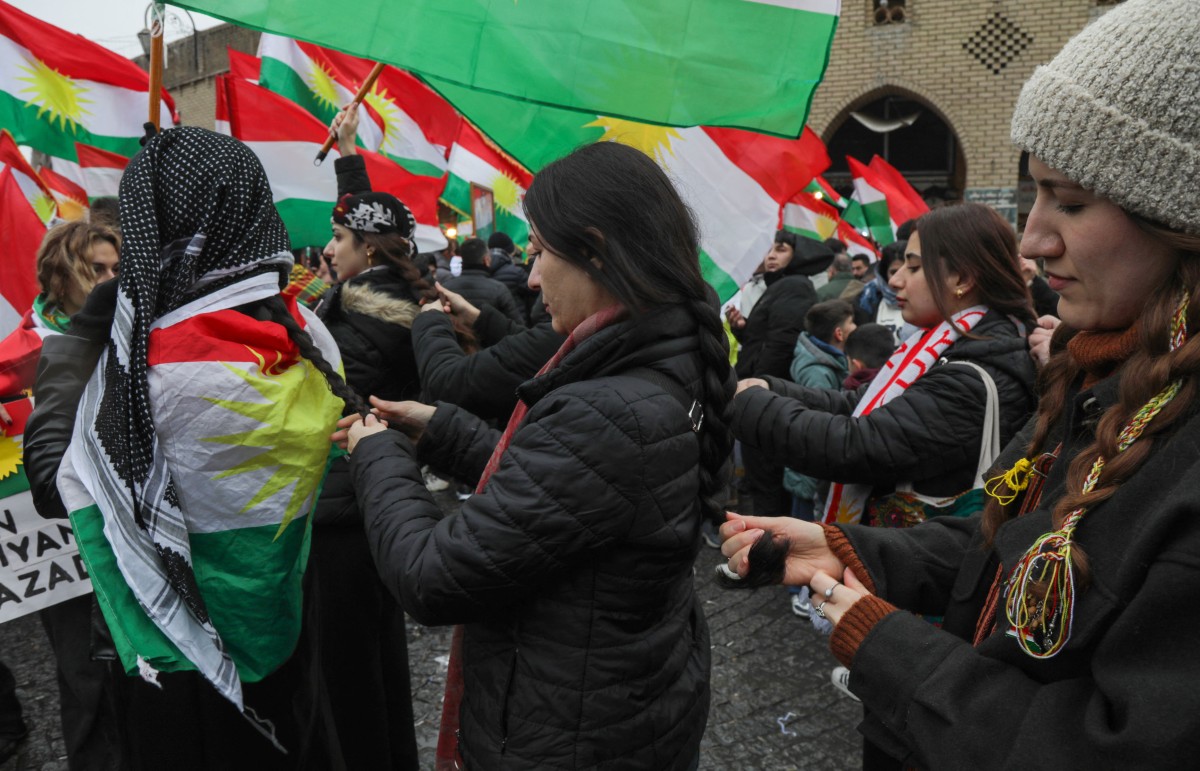
Kurdish women braid their hair during a demonstration in Erbil, the capital of Iraq’s northern autonomous Kurdish region as a symbolic gesture of solidarity with Kurdish female fighters in Syria on January 23, 2026. (Photo by Safin HAMID / AFP)
Those who have shown solidarity with Syrian-Kurdish women in Turkey are being targeted by Turkish authorities and accused of creating “terrorist propaganda”.
The video in question emerged during the Damascus government’s attacks against Rojava, which began in early January but is now expected to subside following a ceasefire announced on the morning of January 30.
The widely shared clip shows a man identified as Rami al-Dahash – allegedly a former ISIS member – holding a severed braid said to belong to a member of the Kurdish Women’s Protection Units (YPJ) and the Syrian Democratic Forces (SDF), the same forces that defeated ISIS.
In Kurdish and Yazidi communities, long hair – often worn in braids – has long represented strength, dignity, and honor. Within this context, the public display of severed braids was interpreted by Kurdish activists as well as Yazidi survivors as an act of revenge by jihadist forces, and as a message that was intended to erase the legacy of women’s resistance, which had pushed back ISIS and its ideological successors.
The Turkish government’s response framed the hair-braiding campaign as support for groups Ankara designates as “terrorist organizations”
Following the circulation of the video, Kurdish women and their supporters in Turkey and around the world began sharing videos of themselves braiding their hair as an expression of solidarity, mourning, and resistance.
The campaign quickly spread across social media platforms. Hundreds of thousands of Kurdish and Yazidi women, and their allies, have since posted videos and photos of themselves braiding hair, with hashtags like #kezî, #KeziyênMeTirsaWe (Our Braids Are Your Fear), among others.
The Turkish government’s response framed the hair-braiding campaign as support for groups Ankara designates as “terrorist organizations”, and in some cases launched investigations against participants. This approach mirrors Turkey’s broader stance on Kurds and Kurdish-related developments in Syria.
The most widely cited case involved a nurse publicly identified by her initials, İ.A., who was detained after sharing a hair-braiding video. She was taken into custody in Istanbul and later transferred to the northwestern province of Kocaeli, where police questioned her on allegations of creating “terrorist propaganda”, and authorities launched both judicial and administrative investigations. Although she was released afterward, she was placed under judicial supervision, which includes a ban on international travel. The Kocaeli Provincial Health Directorate also reportedly launched a separate administrative inquiry.
Human rights organizations reported that other women were also subjected to police raids and detentions for participating in the hair-braiding campaign. Among the reported cases were two young Kurdish women, one of them 17 years old, who were detained after police raided their homes.
The Turkish state’s response also targeted institutions that have expressed symbolic solidarity with women. The Turkish Football Federation (TFF) opened disciplinary proceedings against Amedspor, a club from the predominantly Kurdish city of Amed (Diyarbakir). The club, which has long faced racist abuse from rival fans and institutional pressure, was targeted after sharing a video on its social media accounts showing a woman braiding her hair, accompanied by the slogan “Jin, Jiyan, Azadî” (“Woman, Life, Freedom”), a phrase that originates from the Kurdish women’s movement.
The federation labeled the post “ideological propaganda” and referred the case to the Professional Football Disciplinary Board, which imposed a fine of 802,500 TL (15.000 Euros) on Amedspor and a 15-day ban on the club president, Nahit Eren.
Human rights advocates, women’s organizations, and opposition figures strongly criticized these actions. In public statements, they argued that equating a nonviolent, symbolic act of solidarity with terrorism constitutes a violation of freedom of expression. Critics also noted that symbolic expressions linked to the Kurdish issue are increasingly treated through a hardline security lens in Turkey, particularly when developments in Syria intensify political sensitivities at home.
Wider Context
ISIS forces frequently targeted women’s hair as part of a broader pattern of gendered violence against Kurdish and Yazidi women
For Kurdish women who fought and defeated the Islamic State (ISIS) hair carries powerful symbolic meaning, and this is only strengthened by the fact that the deeply entrenched religious extremist mentality present in the region frames the visibility of women’s hair as sinful.
During the fight against ISIS, most notably in the 2014-2015 battle of Kobane, Kurdish women fighters posed a direct challenge to the group’s ideology. In that period, ISIS forces frequently targeted women’s hair as part of a broader pattern of gendered violence against Kurdish and Yazidi women to assert dominance and erase cultural identity.
In Turkey, the gesture was taken up by several prominent political figures. Ayşegül Doğan, spokesperson for the pro-Kurdish Peoples’ Equality and Democracy Party (DEM Party), braided her hair during a session of the Turkish parliament and shared the video online. Pervin Buldan, a member of the DEM Party’s Imrali delegation and a deputy speaker of parliament, posted a similar video on X. DEM Party Erzurum MP and co-spokesperson of the Peoples’ Democratic Congress (HDK), Meral Danış Beştaş, also released a video in support of the campaign.
The reaction was not limited to Kurdish communities in Turkey, with large demonstrations taking place in Iraqi Kurdistan. Protesters braided one another’s hair in the streets and chanted in solidarity with women’s resistance in Rojava. Thousands of Kurdish women – ranging in age from children to elders – took part in the demonstrations.
Across Europe and within the Kurdish diaspora, the response was similar. Kurdish women and their supporters organized street protests in the UK, Germany, and other European cities with widespread participation.
Artists and public figures also joined the campaign. Actors, musicians, and performers – including Belçim Bilgin, Pervin Chakar, Mem Ararat, Dashni Murad, Nur Sürer, Pınar Aydınlar, Füsun Demirel, and Rojda Demirer – shared photos and videos expressing support and amplifying the message of solidarity.

Serap Gunes
Serap Güneş is a freelance translator and writer based in Istanbul. She holds a PhD in International Relations and European Politics from Masaryk University, where her research focused on minority rights and EU–Turkey relations. Her work has appeared in both academic journals and independent media outlets.