Rojava: The Democracy that the West Chose to Sacrifice
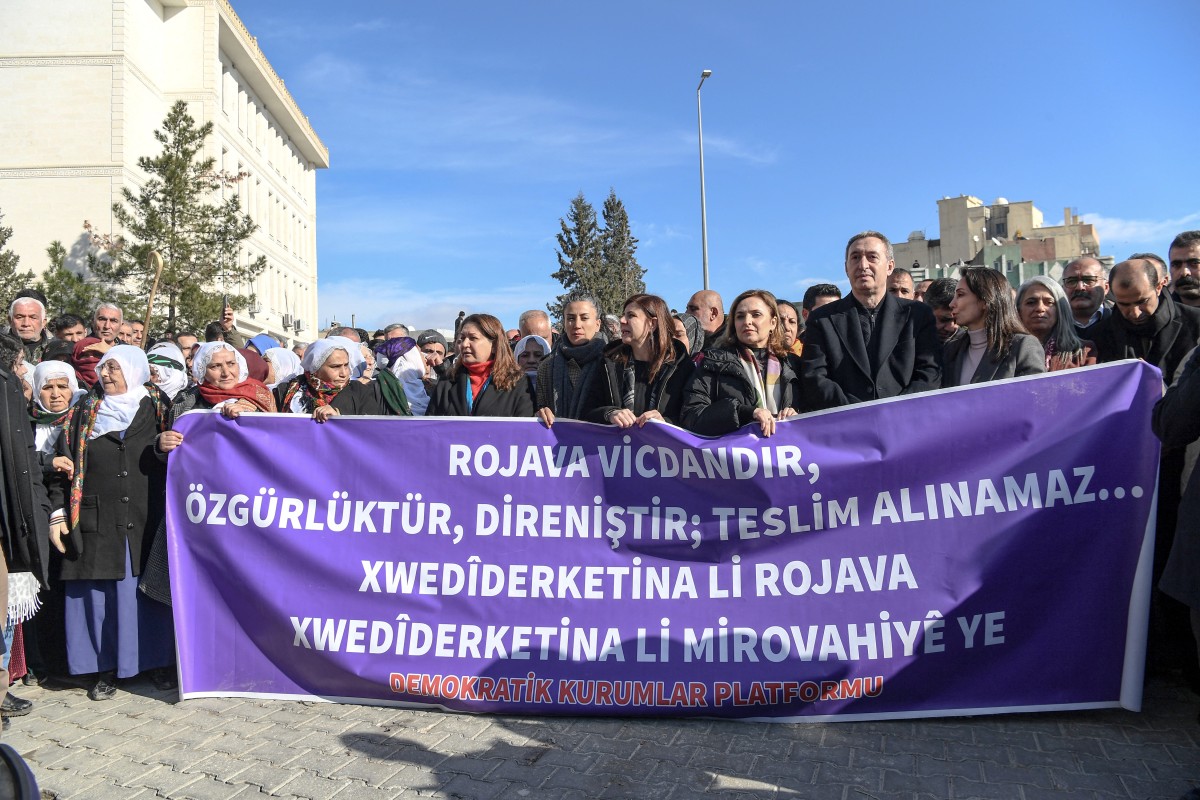
Co-leaders of pro-Kurdish Peoples Equality and Democracy Party (DEM Party) Tuncer Bakirhan (3rd R), Tulay Hatimogullari (2nd R) and supporters holds a banner reading “Rojava is conscience, freedom, resistance. It cannot be taken.” — January 20, 2026. (Photo by Ilyas AKENGIN / AFP)
We would all like to indulge in the comforting fiction that the United States and Europe have a coherent plan for the Middle East. Yet, looking back over decades, what often passes for a ‘strategy’ appears less like design and more like a recurring cycle of misread realities and ill-informed interventions. Indeed, they stand as politics that have repeatedly dragged the West deeper into the Middle Eastern political swamp. At the end of the day, the region has enjoyed no stability, and the West itself has steadily hemorrhaged its credibility. Moreover, this occurs while nurturing the very vicious cycle of global terrorism that has cost Western citizens and taxpayers a huge fortune, let alone the constant fear in which they have been living.
Little did they imagine that this would backfire spectacularly, and that four decades later, the same Regime would be thinking of building a nuclear bomb.
Western complicity in installing the Pahlavi regime in Iran with a coup in 1925 set in motion a century-long project of ethnolinguistic and religious erasure targeting non-Persian peoples. The same mistake reappeared in 1979, when the West supported the Mullahs, allegedly as a counterbalance to communism. Little did they imagine that this would backfire spectacularly, and that four decades later, the same Regime would be thinking of building a nuclear bomb. Nor did the West anticipate that policies annihilating non-Persian cultures and flattening them under Persian-Shia supremacy would intensify rather than stabilize the state. Now that Iran is ablaze with protests, there is little to no serious concern for the fate of non-Persian communities, even as the West directly and indirectly turns a blind eye to the son of the toppled Shah hijacking the uprising abroad, a maneuver that has cost thousands of lives.
As the Iranian regime massacres protesters, it simultaneously entertains the West with its nuclear negotiations to buy time for survival while threatening regional war. Meanwhile, the West, particularly the United States, has effectively given a green light to the Syrian regime led by Syrian interim president Ahmed alSharaa(himself a former jihadist militant known as Al-Jolani) to devastate the Kurdish community in the north of Syria, known as Rojava, and suppress Kurdish democratic forces. This is not strategic brilliance, regardless of what label it receives. Kurds learned this lesson painfully in 2017, when they were backstabbed by the United States and thrown at the mercy of a brutal Turkish invasion. This came about despite Kurdish forces serving as the only reliable force on the ground against ISIS, defeating it at the cost of roughly 15,000 Kurdish lives.
Since 2011, and the so-called Arab Spring that quickly curdled into an Arab Winter, Kurds in Syria have tirelessly built a niche, a rare and stellar safe haven for people of different ethnic groups and religions: Arabs, Christians, and others. They established an exemplary model for the region, demonstrating that an ecumenical coexistence grounded in peace, prosperity, and equality is not a utopian fantasy but an achievable reality. Yet this experiment has been repeatedly invaded by Turkish and Syrian forces, all in full view of the United States and Europe.
Kurdish forces in Rojava stopped thousands of jihadists from flowing into Europe by capturing and containing them. They negotiated, often in bad faith by their counterparts, with the Syrian government of the time, with Turkey, with the West, and with every relevant actor, simply to preserve the only genuinely progressive model of governance in the region.
The role of Turkey and Arab states has been one of calculated duplicity. Domestically, they invest heavily in anti-imperialist posturing and performative outrage against so-called “Zionism.” In practice, Turkey, Qatar, and Saudi Arabia have been the major sources of financial and logistical support for ISIS and its various mutations across the region.
Turkey, the second-largest army in NATO, has perfected the art of double-dealing. On the one hand, it loudly champions the Palestinian cause, but on the other hand, it exhausts every measure to uproot a peaceful Kurdish democratic system, engineering demographic change in northern Syria, and attempting to rebrand the former jihadist militant al-Jolani as a pro-Western angel of “stability” in Syria. Disturbingly, Europe and the United States appear to have been successfully deceived by this narrative with no resistance.
The West would do well to recognize the simple fact that Kurds are and will remain the only force confronting Sunni extremist ideology in the western Middle East and Shia extremism in the east.
In the long run, this will help no one. It undermines Western foreign policy in the region, poses direct security threats to Israel, sabotages any meaningful peace project, and ultimately emboldens and globalizes jihadism. The West would do well to recognize the simple fact that Kurds are and will remain the only force confronting Sunni extremist ideology in the western Middle East and Shia extremism in the east. They are also the only progressive political project on the ground that has never threatened its neighbors, and they have always been on good terms with Israel and the Jewish people.
One thing is clear. The West will not survive the continued spread of Islamic extremism and jihadism in the region that is backed by Turkey and a majority of Arab states. By the time it comes to its senses, it may already be too late.

Ahmad Mohammadpour
Ahmad Mohammadpour is a sociologist and anthropologist from Eastern Iranian Kurdistan, also known as Rojhelat. He holds a Ph.D. in Sociology from Shiraz University and a Ph.D. in Anthropology from the University of Massachusetts-Amherst. His research has thus far appeared in various international peer-reviewed journals, including American Anthropologist, Current Anthropology, Critical Sociology, and the British Journal of Sociology, among others.