Press Freedom Under Strain in Iraq Amid Arrests and Intimidation
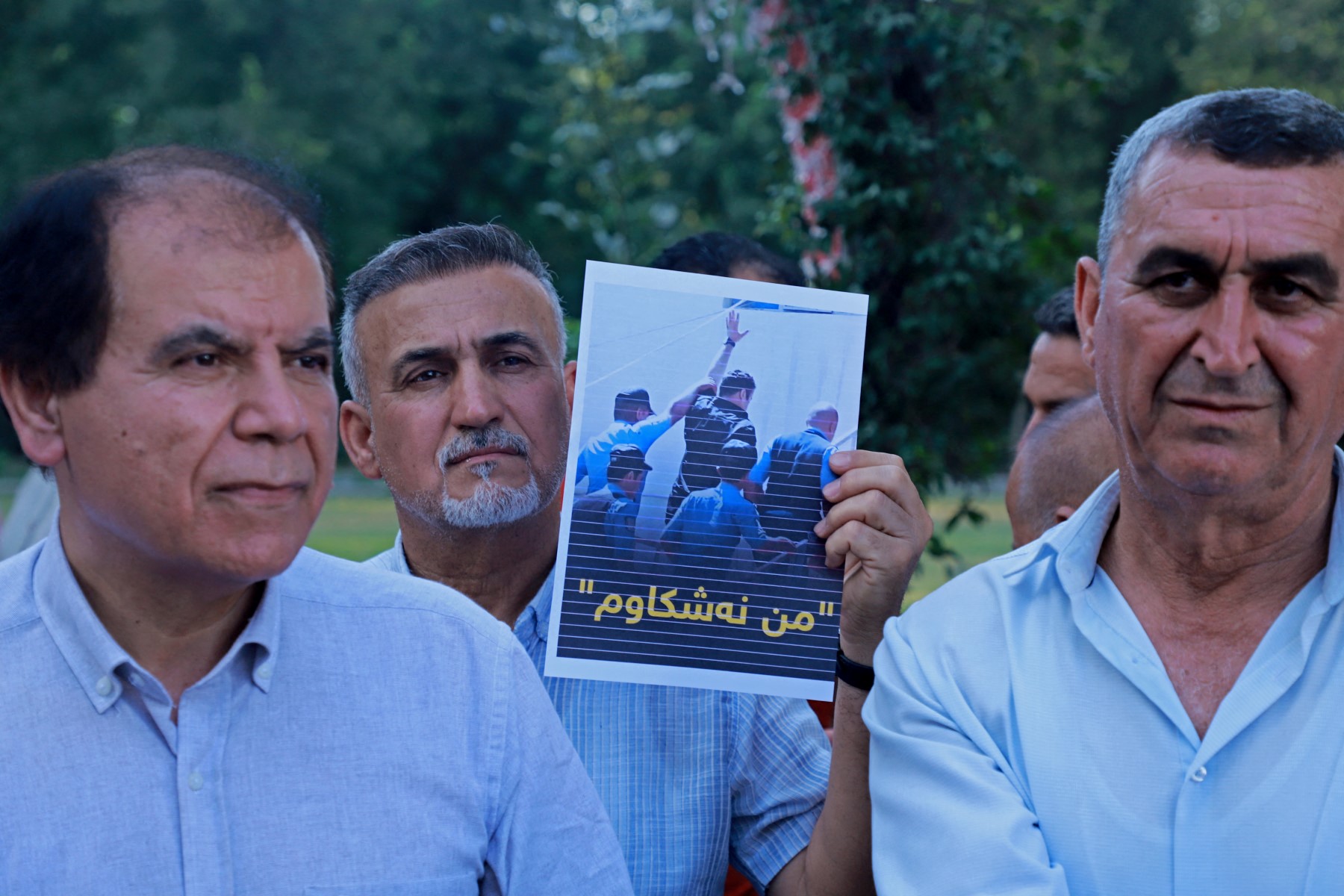
A demonstrator holds placard during a protest in support of jailed journalist Sherwan Sherwani, who was hit with a new sentence before he was due to be released, in Sulaimaniyah in the autonomous Kurdish region of northern Iraq on July 23, 2023. (Photo by Shwan MOHAMMED / AFP)
SULAYMANIYAH, Iraq – The consequences for journalists investigating corruption and abuses of power in Iraq and the Kurdistan Region of Iraq (KRI) are becoming increasingly swift and personal: harassment, detention, or prison.
Although Article 38 of the Iraqi 2005 constitution guarantees freedom of expression and the press, as well as protects the right to express opinions, authorities have intensified efforts to target individuals who expose corruption and government misconduct, through both legal and illegal means.
Sherwan Amin Sherwani, a Kurdish journalist imprisoned since October 2020 for criticising the ruling parties in the Kurdistan region, continues to endure harsh prison conditions. He was imprisoned following trials, whose fairness has been questioned by a wide range of human rights organizations, including the United Nations and several diplomatic missions in Erbil. “Sherwani’s cell is very narrow, lacks heating, and necessary carpet and blankets. His prison conditions are bad,” his lawyer, Mohammed Abdullah, told The Amargi. “Sherwani is expected to be freed by 27 September 2026.”
Abdullah stated that his client now faces an additional complaint from a fellow inmate, who, after being accused of harassing Sherwani, filed a counter-complaint against him.
The Kurdistan region, once claimed to be a beacon of press freedom in the Middle East, has experienced a deteriorating press landscape in recent years
Sherwani was first arrested in October 2020 along with other activists and teachers from the Badinan area in Duhok. Subsequently, in February 2021, he received a six-year prison sentence for “endangering national security.”
In July 2023, a court sentenced him to an additional four years in prison after authorities accused him of forging other inmates’ signatures, in violation of Article 295 of the Iraqi Penal Code. Further, on August 19, 2025, while Sherwani was still serving his prior sentences, a court in Erbil handed down an additional four years and five months after he was accused of threatening a prison officer.
Amnesty International characterises Sherwani’s ordeal as indicative of an entrenched pattern of authorities punishing critics through intimidation, arbitrary detention, and unfair trials. It also stressed that the sentence demonstrates a clear disregard for press freedom and reinforces repression of journalists who report on corruption and human rights.
The Kurdistan region, once claimed to be a beacon of press freedom in the Middle East, has experienced a deteriorating press landscape in recent years as the two main ruling parties, the Kurdistan Democratic Party (KDP) and the Patriotic Union of Kurdistan (PUK), employ increasingly harsh tactics to silence journalists, activists, and protesters.
Even journalists tied to Kurdish ruling parties are no longer immune from intimidation. Late on 20 December, Miran Bakr Abdulrahman, a ministry employee and former media secretary to the Kurdistan Region’s Peshmerga minister, was beaten and dragged to the PUK’s headquarters in Erbil before being released after several hours of detention.
“If there were true freedom of expression and the media could operate freely, on what legal basis could a partisan armed force raid two of our offices?”
Abdulrahman was targeted after publicly criticising party officials. This raised fears about how independent, and therefore more vulnerable, journalists will be treated if even partisan journalists face brutal intimidation. A PUK military raid on the Lalezar Hotel in Sulaimaniyah left four dead, two of whom were PUK security members and the other two were men loyal to Lahur Sheikh Jangi, the head of the People’s Front party. PUK forces also raided two offices of Zoom TV, a television channel funded by Sheikh Jangi.
“Zoom channel is one of the main victims of the lack of free press and freedom of expression in the Kurdistan region. If there were true freedom of expression and the media could operate freely, on what legal basis could a partisan armed force raid two of our offices? They caused significant damage to equipment and seized other assets,” Hemn Mahmoud, director of Zoom Channel, told The Amargi. “After more than three months since the tensions, one of our main offices remains occupied by an armed force. Zoom has legal licenses from both the Iraqi government and the KRG. It has operated professionally and will continue to do so.”
Mahmoud reported losses approaching $1 million, with significant equipment still unaccounted for. Journalists currently face a persistent threat, particularly in conflict zones. During recent violence, one reporter was handcuffed, another detained for over a day, and a third questioned by security forces. Late in November last year, security forces in Erbil, under KDP control, prevented media coverage of protests in Lajan village, where demonstrators demanded jobs at the Lanaz refinery, owned by a son of KDP leader Masoud Barzani.
Media outlets aligned with Iraq’s ruling parties contribute to societal divisions by shaping narratives and minimising reports of unrest. The Association for the Defence of Press Freedom warned that, in 2025, government actions, restrictive laws, and judicial decisions resulted in Iraq’s press freedom reaching ‘alarming’ lows, further undermining constitutional guarantees.
Although the number of violations recorded by the association decreased slightly from 2024, their severity and impact increased, further eroding constitutional protections.
The association recorded 182 violations in 2025, including arrests, bans on news coverage, attacks, lawsuits, threats, broadcast interruptions, and two cases involving the killing or attempted killing of journalists. February saw the highest number of violations, followed by July.
Critics accused the Iraqi Government’s Communications and Media Commission of exceeding its mandate by banning and blocking critical media platforms and journalists.
“If you ask a journalist today about independent media outlets, you might find only three or four, whereas there are dozens of partisan channels.”
Saman Nuh, head of the Network of Iraqi Reporters for Investigative Journalism (NIRIJ), told The Amargi that press freedom in Iraq and the Kurdistan region is worsening across all areas.
“Press freedom in Iraq faces many threats, such as lawsuits against journalists like those filed by the office of Prime Minister Mohammed Shia Al-Sudani. Even when these cases are dropped, they create significant pressure and hinder journalists’ ability to work freely,” Nuh told The Amargi by phone.
“The same issues are present in Kurdistan, where journalists face imprisonment, lawsuits, and security forces are preventing coverage at demonstrations or major events,” he said.
He added that independent media outlets are rare in the Kurdistan region, as most channels and social media platforms are affiliated with political parties.
“If you ask a journalist today about independent media outlets, you might find only three or four, whereas there are dozens of partisan channels.”
He also noted that the Kurdistan region has lacked an active parliament for nearly three years. Formal institutions and syndicates, including the Kurdistan Journalists Syndicate (KSJ) and the region’s independent human rights board, are perceived as biased in favour of the ruling parties and unable to defend independent journalists and activists.
He pointed out that although the KRG is intended to govern the entire Kurdistan region, it is divided: the KDP controls Erbil and Duhok, whereas the PUK controls Sulaimaniyah and Halabja. Each area enforces its own regulations for journalists. Although some media outlets report on corruption, a lack of accountability restricts investigative journalism.
“The persistence of these violations in the Kurdistan Region exposes a deep gap between legal texts and their implementation. Laws such as the Journalism Law No. 35 of 2007 are supposed to protect journalists. Law No. 11 of 2013 on the Right of Access to Information guarantees the public’s right to know. These laws exist on paper but are not enforced,” Rahman Gharib, head of the Metro Centre, a local NGO defending press freedom, told The Amargi. “This raises a fundamental question: are these laws enacted merely to polish the image of our semi-democratic authority, or to serve the public interest and protect and expand freedoms genuinely?”
He also emphasized, “We need an environment that respects the constitution and specific laws, not arbitrary instructions or vague general regulations. We need an environment that guarantees access to government information, respects pluralism, avoids discrimination, and protects journalists from violence, threats, and detention without court orders. Media outlets should not be shut down, and journalists should not be treated as enemies.”

The Amargi
Amargi Columnist