Abbas Vali Warns: Without a Democratic Alternative, “Anti-Democratic Forces” Could Hijack the Uprising in Iran
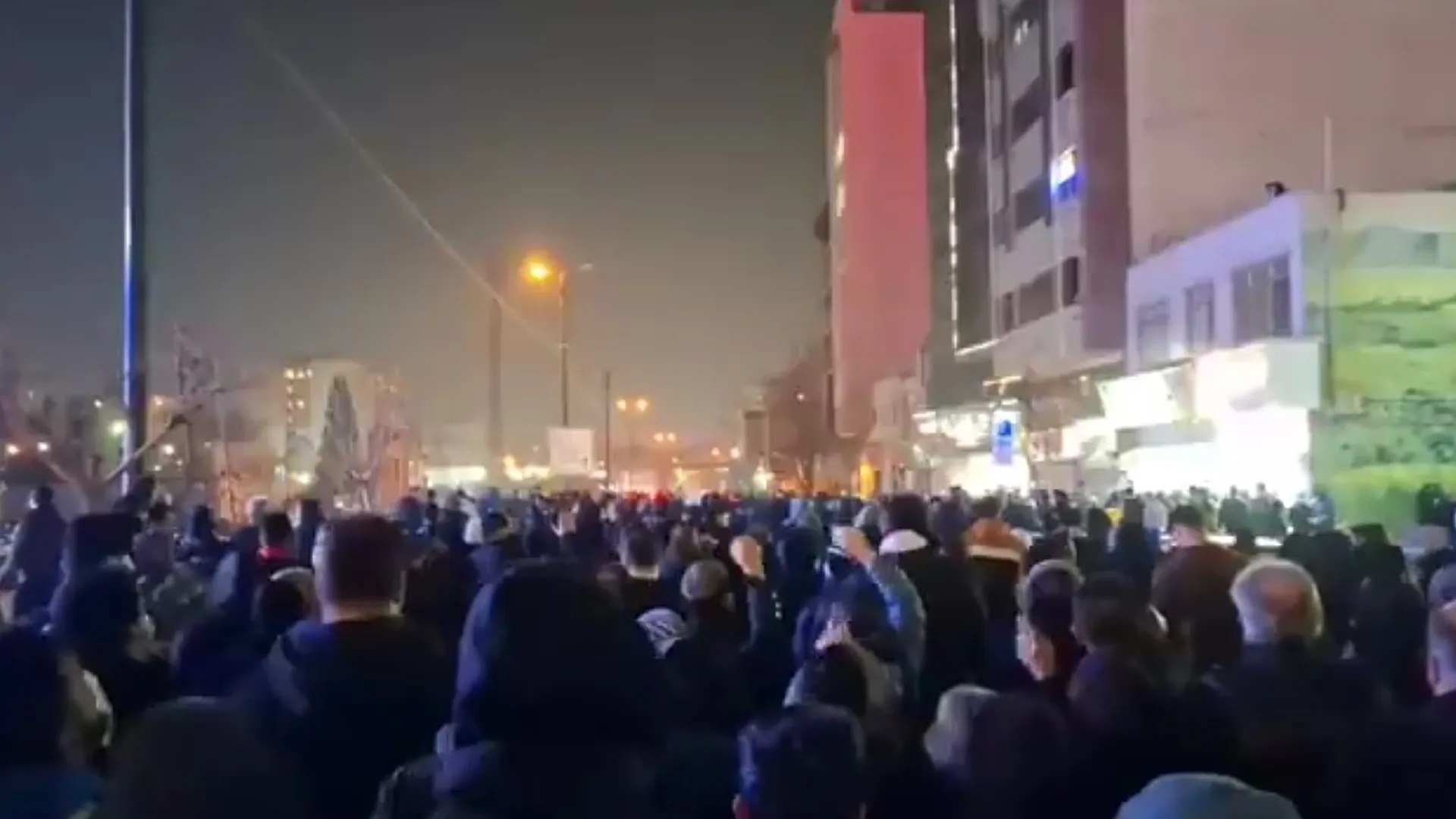
Hundreds of thousands participated in protests that continued throughout the night in Iran, where the protests entered their 13th day | Picture Credits: Mezopotamya Ajansı
For 13 days, the protests that began in Tehran’s Grand Bazaar, initially as an economic revolt against the plunging currency and relentless price shocks, have been spreading outward, toward Iran’s western provinces and the country’s political fault lines.
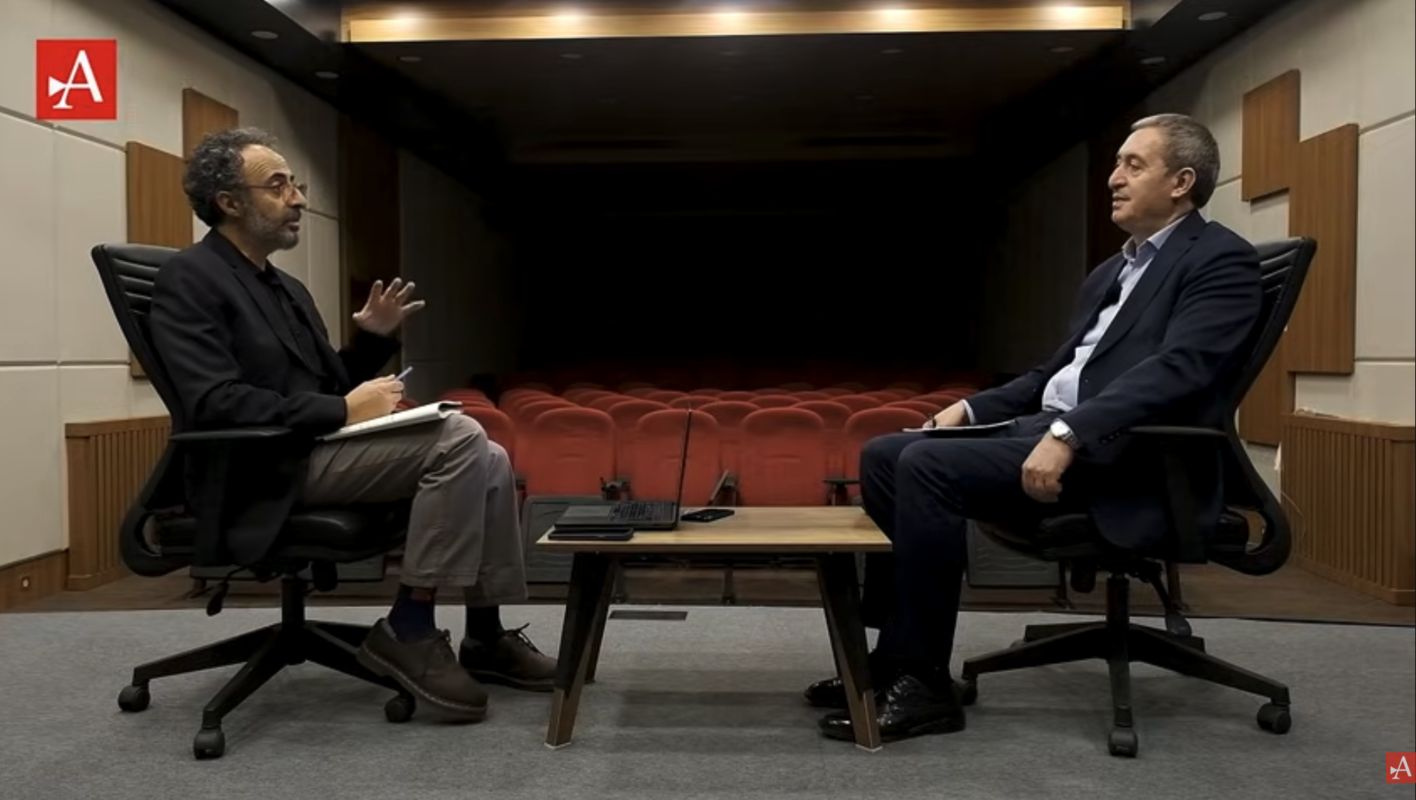
In an interview with The Amargi, the political and social theorist Professor Dr. Abbas Vali described the current unrest as both a continuation of Iran’s 2022 Woman, Life, Freedom (Jin, Jiyan, Azadî) uprising and a sign that something fundamental has changed. “This is a continuation of it,” he said, “but this is not the same as the Jin, Jiyan, Azadî one.”
In Professor Vali’s reading, the most important feature of the present moment is not its scale, but the break that followed the suppression of the 2022 movement and the political vacuum that, he argues, emerged afterward.
A Movement That Returned, but in a Different Shape
The protests began in Tehran’s bazaar after the Iranian currency fell to its lowest ever level against the U.S. dollar – shopkeepers complained that constant fluctuations made business “unstable and unprofitable.” In the days that followed, demonstrations spread to other cities, including western regions, where protesters chanted anti-government slogans.
After initially signaling tolerance for protest, Iran’s leadership shifted tone. Supreme Leader Ayatollah Ali Khamenei emphasized the bazaar’s loyalty to the Islamic Republic and warned that “rioters must be put in their place.”
More than 30 people have been reported killed – including five minors – and over 1,500 are arrested. Most casualties belong to minority communities, including Kurds and Lors in western Iran – a pattern Professor Vali treated not as incidental, but structural.
If the 2022 uprising forged an “intersectional democratic identity”, as he said, the current protests look narrower and more vulnerable.
According to Vali, back then, the movement brought about an “intersectional democratic identity, which I call it ‘Jina identity’,” uniting resistance against “three forms of apartheid”: “gender and sexual apartheid”, “national/ethnic/linguistic apartheid”, and “religious/cultural apartheid.”
He argued that democratic breadth mattered because it connected personal freedoms and minority rights to the political economy of the state, and to an “aggressive, completely unregulated neoliberal capitalist economy,” dominated by a rent-based system that “plunders.”
Now, by contrast, he sees a retreat in both language and organization, “Discursively, it’s a step back.” Where the earlier uprising carried “very clear democratic content,” the dominant slogans today are simpler and more personalized: “Death to the Dictator,” and “Down with the Islamic Regime.”
In his view, the danger is that the target has become the leader – the household – rather than the institutional architecture of repression, “It has completely left aside the anti-democratic, repressive, institutional structure of this regime.” He argued that a movement that does not name institutions risks failing to transform them
The “Periphery,” and the Wounds Left by Repression
Vali placed particular emphasis on the relationship between Iran’s center and its peripheral regions, including Kurdish areas, which, he argued, bore the brunt of repression in 2022. He said the regime targeted “the peripheral communities, Kurdistan being one of them,” and over time, “that interrelationship between the center and the peripheral communities was weakened and eventually cut off.”
He also criticized what he described as a segment of the Iranian opposition – especially monarchists – for undermining the 2022 uprising because they could not control it.
That rupture helps explain why minorities may now watch the protest wave with caution: they remember paying the highest price while the center absorbed a lower share of the repression and, in Vali’s view, then failed to defend the movement’s democratic substance afterward.
He also criticized what he described as a segment of the Iranian opposition – especially monarchists – for undermining the 2022 uprising because they could not control it. He claimed during Woman, Life, Freedom protests, monarchist forces realized “they do not have the force to dominate and lead,” and “above all, were completely fearful of its growing democratic content.” That created conditions for an implicit convergence between the state and anti-democratic opposition forces: “an objective and subjective condition for the alliance of the regime and […] anti-democratic opposition.”
An oligarchy inside the state
Asked who he refers to as “oligarchs” inside the regime, Vali traced their rise to the post–Iran-Iraq War period, when security and military institutions entered the economy in the name of reconstruction. Over time, and especially under the pressure of sanctions, he said, a “large-scale rent and rental economy” emerged, “structured around patron-client relationship from top to the bottom.”
The result is a consolidated power bloc: “A huge economic oligarchy” centered in “security, military, political persons and institutions,” operating through “parallel governmental organization under the auspices of the ruler’s household.” As he argued, this oligarchy now dominates even the formal top of the state: “Even the Supreme Leader and his household are largely dominated by this oligarchy.”
This group, he said, is “open to change, but not democratic change,” and is prepared to form alliances to preserve its interests if collapse becomes imminent. “If the collapse of the regime becomes unavoidable,” he said, the oligarchy may “form an active alliance with the monarchist [opposition]” to protect wealth and power.
I challenged the logic: if monarchists lack popular support, why would the oligarchy need them?
Vali said Pahlavi may be weak, but the democratic opposition – inside and outside Iran – is fragmented. “They are stronger socially and numerically,” he said of democratic forces, “but they’re tactically very weak.” The absence of a coherent alternative, he argued, creates political space for right-wing forces to project themselves anyway. “People are all saying ‘Down with the Islamic Regime,’ but there is no talk as to what alternative might take its place.”
External Shock, and the Dear of War as Counter-revolution
Vali warned that in a moment of regime collapse, without a prepared democratic transition, external strikes could devastate the country’s infrastructure
The interview also covered a volatile external dimension: the risk that Israel-Iran escalation could change the calculus of protest.
Vali warned that in a moment of regime collapse, without a prepared democratic transition, external strikes could devastate the country’s infrastructure and cripple any future administration – including those in peripheral regions. “If there is no such a thing” as a pluralist transitional authority, he said, he “wouldn’t be surprised if Israel makes a massive air attack on Iran to destroy economic and military security structures.”
At the same time, he suggested the Iranian regime might consider military escalation for its own survival – not because it is strong, but precisely because it is weak and desperate. In his framing, both Israel and Iran operate with siege mentalities: “We are looking at two blocs that are very paranoid.” And while he called a pre-emptive Iranian strike “far-fetched,” he said he wouldn’t disregard it entirely: war could serve as a tool to fracture protests, and an external attack might rally “the gray zone” behind nationalism, at least temporarily, and kill this uprising.
A Regime in “Disintegration” and the Democratic Danger
Vali did not dispute the scale of crisis, when I listed Iran’s overlapping issues: inflation, environmental stress, energy shortages, rising taxes, weakening deterrence, and the surprising participation of bazaar merchants long considered loyal.
“The possibility of the collapse of the regime now is more than any time in the last 47 years,” he said. “The economy of Iran has disintegrated,” and politically, “there is a disintegration of the hegemony.”
But his key warning was not about the regime’s desperation and fragility, rather it was about what could come after: the danger is that “the democratic opposition from below […] is not strong enough now.” Without sufficient democratic organization, he warned, cracks inside the ruling bloc may not widen in ways that benefit democratic transformation. Instead, they may invite anti-democratic intervention from within the state, from right-wing opposition networks, or from external shocks.
The Kurdish Call for Strike and Demand for Unity
The interview ended with Kurdistan. Kurdish-majority provinces like Kermanshah and Ilam joined the protests early, suffering heavy casualties, and on Thursday, January 8, seven Kurdish political parties issued a joint call for a general strike
Vali welcomed the statement but called it insufficient. The Kurdish parties “are lacking the confidence to come up with a very clear-cut position,” Vali said. A statement “is good, but this statement is not enough.”
He argued that what is needed is institutional unity and a “non-ideological minimum program” that convinces society the parties act for public interest rather than “singular party interests.” “They have to form a coalition,” not integration, to build a democratic front in Kurdistan, link with other peripheral communities, and then seek alliances with democratic forces across Iran, particularly those “inside Iran.”
He went further, outlining what sounded like a blueprint for readiness in the event of sudden state collapse: a unified decision-making structure, unified discourse, stronger civil society organization, mobilization of women and youth, and even “a united military center” among Kurdish forces.
Throughout the interview, Professor Vali returned to one strategic imperative: the protests must be deepened democratically, not just spread geographically.
The reason being the situation’s urgency: “What happens if the regime collapses?” He warned that without unity, Kurds could face the decisive moment divided – politically, socially, and militarily – in a country where anti-democratic forces may be poised to shape the transition.
Throughout the interview, Professor Vali returned to one strategic imperative: the protests must be deepened democratically, not just spread geographically. “The strategic question of the day,” he said, is “to develop and deepen this movement democratically, quantitatively and qualitatively.”
In Iran’s streets, bazaar alleys, and western provinces, the protests are already expanding. Whether they also develop the language, organization, and alliances that can survive both repression and opportunistic takeover is the unanswered question hanging over the eleventh day of protests.
To watch the full video of the interview, click here.

Rojin Mukriyan
Rojin Mukriyan has PhD in the Department of Government and Politics at University College Cork, Ireland. Rojin’s main research areas are in political theory, feminist and decolonial theory, and Middle Eastern politics, especially Kurdish politics. She has published articles in the Journal of International Political Theory, Philosophy and Social Criticism, and Theoria. Her research has thus far focused on the areas of Kurdish liberty, Kurdish statehood, and Kurdish political friendship. She has published many think tank commentaries and reports on recent political developments in eastern Kurdistan (Rojhelat), or north-western Iran. She has also frequently appeared on a variety of Kurdish and Persian language news channels. X account: @RojinMukriyan