ISIS Resurgence Looms as Syria Transitions Away from SDF Partnership
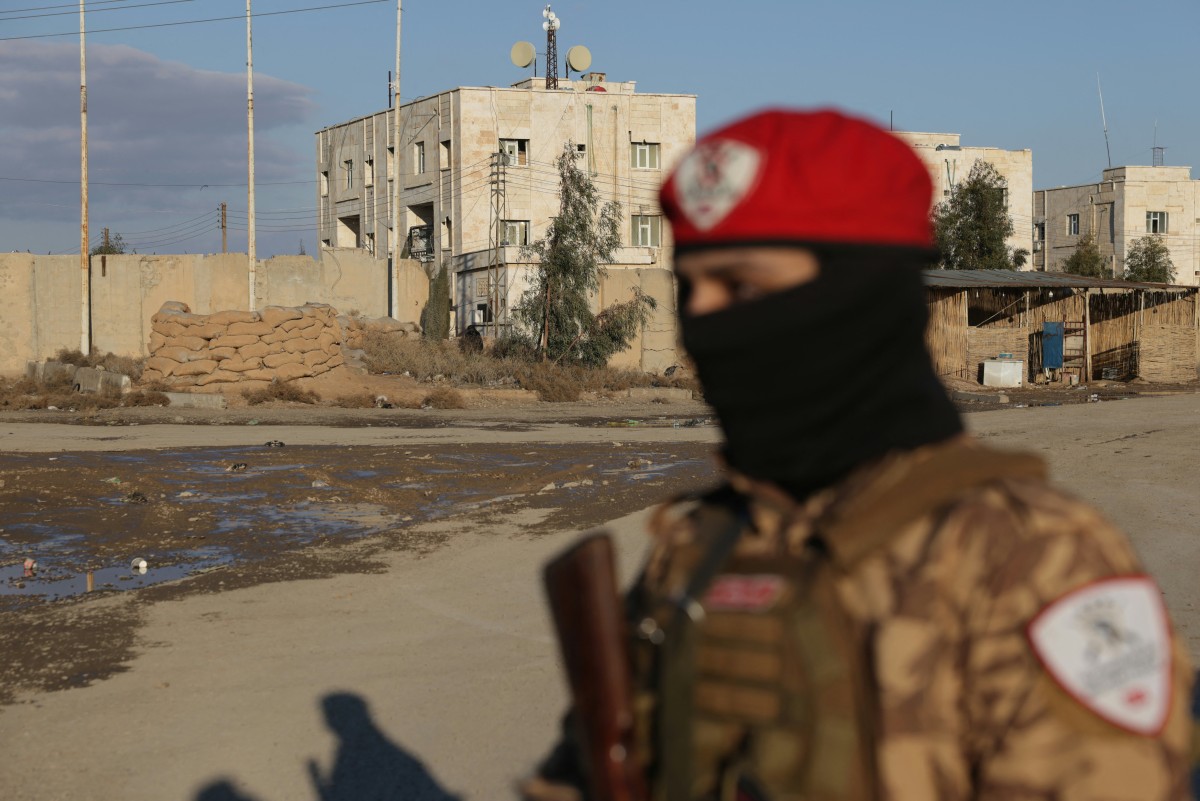
A Syrian government soldier stands outside SDF controlled Al Aktan prison which holds ISIS detainees in the city of Raqa on January 19, 2026. (Photo by Bakr ALkasem / AFP)
As the United States accelerates its military withdrawal from Syria and the international community pivots toward embracing the new Islamist-led Syrian Transitional Government (STG), a critical question emerges: Will abandoning the Syrian Democratic Forces (SDF) as the Global Coalition’s primary counter-terrorism partner in Syria create the conditions for an ISIS resurgence?
Recent developments suggest the threat is far from theoretical. According to a new UN report, Syria’s Transitional President Ahmad al-Sharaa, the former Hayat Tahrir al-Sham (HTS) leader who now heads the Damascus government, has survived multiple ISIS-linked assassination attempts since taking power. In July, Saraya Ansar al-Sunnah, assessed by UN experts to be an ISIS front organisation, bombed a church in Damascus, killing 25 people.
Al-Sharaa, in his former HTS incarnation as Abu Mohammed al-Jolani, led an organisation that evolved from al-Qaeda’s Syrian affiliate. While al-Sharaa has publicly distanced himself from transnational jihadism and provided intelligence to the US-led Coalition against ISIS operatives in Idlib province, ideological links remain, and the fundamentalist Salafi-jihadi worldview that animates both HTS and ISIS remains a source of concern for regional stability.
Dangerous Security Transitions
The transition from SDF to STG control in northern Syria has triggered alarming security breaches, most notably at al-Hol Camp, a detention facility near the Iraqi border housing families of ISIS members. Despite a population decrease from 74,000 to below 30,000 over six years, more than 6,000 foreign nationals and their children remain.
After the SDF withdrew on January 20 and the camp was handed to Damascus’ Ministry of Defence, security rapidly deteriorated. An OSINT investigation by The Amargi revealed the camp’s perimeter was breached by local villagers and Damascus-linked militants, forcing SDF security forces to withdraw.
A humanitarian source told AFP that the high-security annex, housing ISIS-affiliated women and children from Russia, the Caucasus, and Central Asia, was nearly empty, with some moved to the main camp. An eyewitness reported armed men taking women from the camp in vehicles after government forces took control.
Anne Speckhard of the International Centre for the Study of Violent Extremism noted that at least some of these families may have been smuggled to Idlib, though it remains unclear if the move was authorised by the STG. Al-Modon reported ongoing smuggling networks linked to foreign ISIS fighters. A Syrian foreign ministry source told AFP that authorities were conducting a census, blaming any escapes on the SDF’s improper handover.
On February 11, camp residents attacked UN facilities, pelting a meeting centre with stones and threatening to burn aid vehicles, prompting the UN High Commissioner for Refugees and other agencies to withdraw personnel and suspend operations, with only UNICEF maintaining minimal water distribution.
In Shaddadi, around 200 ISIS detainees escaped during the STG’s takeover, though the government later claimed to have recaptured 82. Qutaiba Idlibi, a Damascus Ministry of Foreign Affairs official, stated all ISIS prisoners would be prosecuted in court.
Sleeper Cells Exploit the Vacuum
…some Damascus delegation members made gestures invoking ISIS symbols when they entered Hasakah
ISIS operatives have wasted no time capitalising on the chaos. Dilar Temo, commander of the Asayish, the SDF-affiliated internal Kurdish security force, told The Amargi that during the arrival of the Damascus General Security Forces delegation in Hasakah last week, where they had come for security integration discussions, sleeper cells launched rogue attacks. Asayish responded by arresting those involved, but Temo warily noted that some Damascus delegation members made gestures invoking ISIS symbols when they entered Hasakah.
On February 11, Asayish conducted another security operation in Hasakah, arresting a cell believed to be affiliated with ISIS and seizing weapons and military equipment. Sleeper cells remain active in northeastern Syria, poised to exploit any weakness in security architecture. The UN estimates that ISIS maintains approximately 3,000 militants across Syria and Iraq, with the majority operating inside Syrian territory. On Thursday, the US Central Command stated that in the past two months, US operations had targeted over 100 locations in Syria, capturing or killing over 50 suspected ISIS members, including a reported leader, Bilal Hasan al-Jasim.
Coalition Retreat and Detainee Transfers
The US-led Global Coalition to Defeat Da’esh (ISIS) is withdrawing from Syria, evacuating bases such as al-Tanf and Shaddadi, and handing control to the STG.
According to The Washington Post, the US could hand over its remaining bases in Syria “in the coming days or weeks, as conditions warrant”, which would allow Trump to end the US mission there entirely.
Anticipating a security vacuum, the US has initiated mass transfers of ISIS detainees to Iraq, with 4,583 suspected fighters already moved as part of a broader operation to relocate up to 7,000 prisoners, including foreign nationals.
Turkey, a member of the Global Coalition, has long been accused of ignoring the flow of ISIS fighters and their families across its border into Syria.
While up-to-date statistics on the nationalities of all the detainees are not available, Al-Monitor reported that 66 Turkish ISIS fighters were among those transferred from SDF custody to the Global Coalition for transfer to Iraq.
The Autonomous Administration in northeastern Syria has proposed establishing an international tribunal within its territory to prosecute ISIS detainees. However, international powers have shown no interest, citing concerns about legitimising a non-state actor that has been designated a terrorist group by NATO member Turkey.
Turkey, a member of the Global Coalition, has long been accused of ignoring the flow of ISIS fighters and their families across its border into Syria. Ankara denies these allegations, pointing to its ongoing operations against ISIS cells within its borders.
Iraq’s Supreme Judicial Council has announced criminal proceedings for detainees, stating they will be prosecuted under Iraqi law, but rights groups have raised concerns over due process, particularly given Iraq’s continued use of the death penalty.
Riyadh Meeting and Strategic Questions
Against this backdrop, Syrian Foreign Minister Asaad al-Shaibani and intelligence chief Hussein al-Salama joined the Coalition’s recent meeting in Riyadh on February 10. Coalition members professed their readiness to work closely with the STG, with Syria having formally joined last November, ahead of al-Sharaa’s landmark White House meeting with US President Donald Trump.
Serious questions remain regarding the new government’s capacity and willingness to serve as an effective counter-terrorism partner. Hardliners within President al-Sharaa’s support base have indicated their opposition to joint action with the United States against fellow Muslims.
Fear remains over a potential ideological overlap between radical Islamists in the STG and ISIS extremists. At a House Foreign Affairs Committee hearing concerning Syria this week, Representative Scott Perry emphasised, “Mr. Jolani rebranded Al-Qaeda, which is not a whole lot different than ISIS,” referring to al-Sharaa by his former nom de guerre.
“Let’s face it,” Perry continued, “If you have the choice between ISIS and Al-Qaeda, is there a whole lot of difference? HTS has said that they renounced global jihad, but they haven’t renounced jihad in Syria at all.”
A risky undertaking
The STG-SDF integration deal will see the SDF merge into the central army as four distinct brigades, yet it is clear that for counter-ISIS purposes, the Global Coalition is opting to rely solely on Damascus. “The original purpose of the SDF as the primary anti-ISIS force on the ground has largely expired,” stated US envoy Tom Barrack last month, describing Damascus as “both willing and positioned to take over security responsibilities”. A previously proposed scheme to create a joint counter-terror force combining SDF and Syrian government forces was abandoned.
…the central question is no longer whether ISIS will attempt a resurgence, but whether the STG can prevent it
The pivot to the STG as the primary counter-terrorism partner represents a calculated but highly risky gamble. While the SDF had demonstrated sustained effectiveness in combating ISIS over nearly a decade, the new security architecture places critical responsibilities in the hands of a government led by former jihadist figures, with forces that include elements sympathetic to extremist ideologies. This structural tension could undermine operational cooperation and weaken the fight against ISIS.
As US troops withdraw and coalition forces hand over bases to Damascus, the central question is no longer whether ISIS will attempt a resurgence, but whether the STG can prevent it. The stakes extend far beyond Syria. A ISIS resurgence would destabilise the region, threaten Iraq’s security gains, and pose a transnational threat, including the risk of inspiring attacks in Europe and beyond. The international community’s reliance on the STG may yet succeed, but early signs – assassination attempts, prison escapes, sleeper cell activity, and chaos at al-Hol camp – offer little reassurance.

Justus Johannsen
Justus Johannsen is a German journalist and a member of the editorial board of The Amargi. His work focuses on the Middle East, with a particular interest in Syria, Rojava, and Turkey — regions he has followed closely for several years.