Pahlavism as Postponement: The Afterlife of IRI’s Geopolitical Exceptionalism in a post-October 7 Middle East
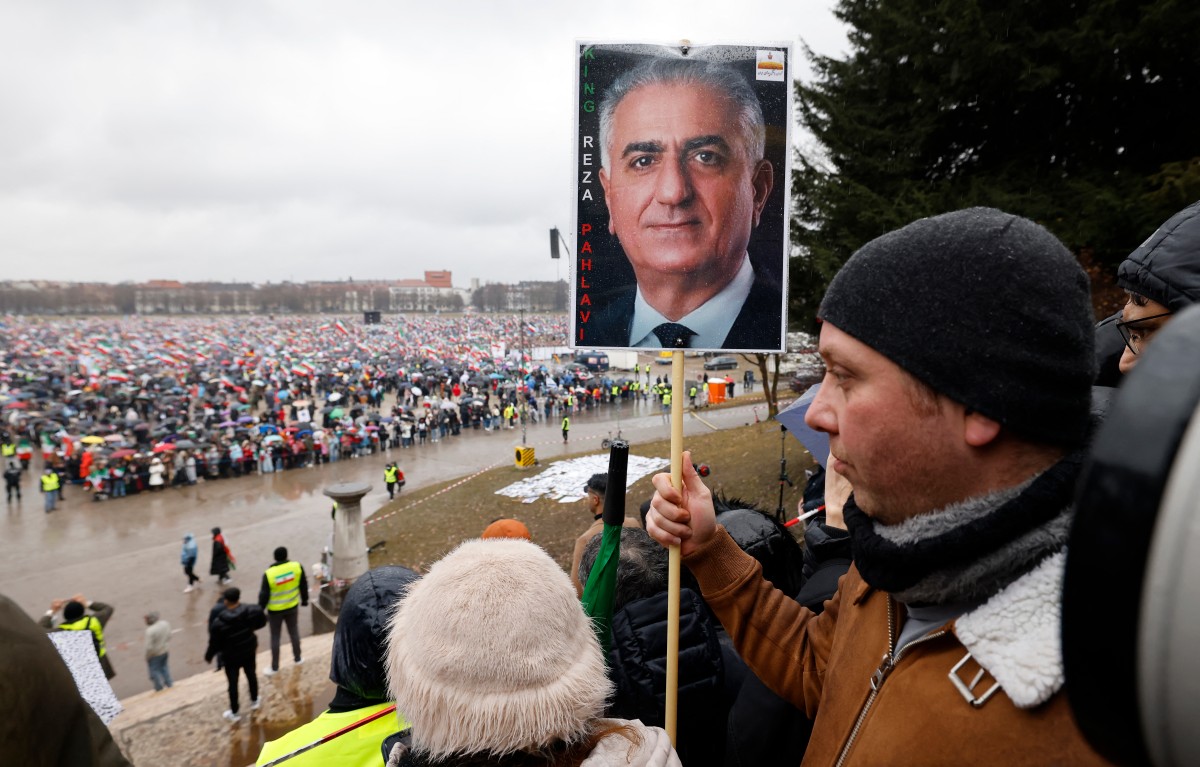
A participant holds a poster depicting Iran’s former crown prince Reza Pahlavi during a demonstration on February 14, 2026 at in Munich, Germany, (Photo by Alexandra BEIER / AFP)
Pahlavism did not emerge in a vacuum, nor is its restorative nostalgia independent of the historical conditions that enabled its rise. Among the factors behind its resurgence, geopolitical ones are decisive. Central here is the Islamic Republic of Iran’s (IRI) discourse of geopolitics of exceptionalism and its entanglement with the contested nature of Iranian nationalism, especially at a moment when this doctrine has reached strategic exhaustion internally and externally. These dynamics have narrowed political imagination to a nostalgia for a “future past” that functions as a strategy of postponement and risk management with both domestic and external purposes. In this sense, Pahlavism is not a solution to Iran’s crisis but a geopolitical and affective shortcut: it promises unity by suppressing plurality, and stability by reproducing fragility, while remaining attractive to external powers precisely because it cannot deliver a stable, democratic Iran.
From the outset of Iran’s modern era, nation‑building has been top‑down, centralised, and patriarchal under both the Pahlavi monarchy and the Islamic Republic. A Persian‑centred state narrated Iran as a single, timeless nation, subsuming diverse languages, peoples, and histories within a unified national story. Within this narrative, the Shah – the father of the nation, and the religious Supreme Leader – the father of the Ummah, were each framed as standing above conflicts between centre and periphery, men and women, Persians and non-Persians. This paternal figure was imagined as capable of bypassing the contested nature of nationhood, reflected in the pluralism it suppressed and the unevenness it normalised. Yet this bypassing produced the very conflicts it claimed to resolve. Forceful unification generated internally colonial relations, marginalised non‑Persian and non-Shia identities, and framed women’s demands as subordinate to nationalist narratives.
IRI’s dualistic imaginary of Iran as a unique, besieged anti‑imperialist state locked in an existential struggle with external enemies.
Crucially, this logic of bypassing contested nationalism has been sustained through a sense of geopolitical exceptionalism that casts Iranianness as distinct and historically, if no longer materially, superior to the rest of the world, organised around a persistent search for greatness. Although this logic did not originate with the Islamic Republic, the IRI’s geopolitical exceptionalism gave it new intensity and durability. IRI’s dualistic imaginary of Iran as a unique, besieged anti‑imperialist state locked in an existential struggle with external enemies. Externally, this imaginary took the form of the axis of resistance, proxy networks, forward defence, and claims to regional leadership against Israel and the United States. Internally, the same us–them logic underwrote a theocratic, authoritarian, patriarchal, and internally colonial order in which minorities, dissidents, feminists, and labour movements could be dismissed as agents of foreign powers.
For decades, this exceptionalism functioned not only as foreign policy but as a technology of postponement, central to Iranian nation-building, through which present contradictions and the histories that produced them were systematically avoided. It enabled the state to defer foundational questions about the nation itself. Kurdistan, Baluchistan, Ahvaz, gender hierarchy, and the violent history of centralisation could all be bracketed in the name of anti-imperialism or national security. Contested nationalism was not resolved; it was reproduced and deepened through its denial.
The “Woman, Life, Freedom” uprising … brought into central politics voices long marginalised by both the Pahlavi monarchy and the Islamic Republic: women, Kurds, Baluchis, and other minoritised communities
Over time, however, the Islamic Republic’s exceptionalism produced deep domestic repression and international and regional policies that imposed severe economic, social, and political pressures. Dissident movements repeatedly emerged, yet often without fully breaking the underlying logic of postponement. At a critical moment, the unrest generated by these pressures disrupted this pattern. The “Woman, Life, Freedom” uprising marked this moment. Sparked by the killing of Jina (Mahsa) Amini, a young Kurdish woman, it brought into central politics voices long marginalised by both the Pahlavi monarchy and the Islamic Republic: women, Kurds, Baluchis, and other minoritised communities. Its slogan—” Jin, Jiyan, Azadi” / “Zan, Zendegi, Azadi”—linked bodily autonomy, anti‑patriarchal revolt, and the right of different peoples to live and decide together. For a brief moment, it opened a horizon beyond exceptionalism, unity through force, and deferred justice.
As the strategic limits of the Islamic Republic’s exceptionalist discourse became more visible, the consequences of its failure redirected unrest away from this opening. Instead of deepening the plural horizons opened by Woman, Life, Freedom, politics snapped back toward an intensified bracketing of contested nationalism. This regression was driven by intertwined internal and international dynamics.
Internally, years of exceptionalism had weakened the capacity of oppositional forces to organise, build coalitions, and institutionalise alternatives. At the same time, the regime’s own narratives—producing discourses of Pahlavi, Israel, and imperialism as intertwined figures—created a symbolic canvas against which coherence could be sought. Even during Woman, Life, Freedom, much of the opposition, particularly in exile, proved unwilling to confront the questions it raised about decentralisation, minority rights, and the violent legacy of top‑down nation‑building. Demands for federalism or recognition were either dismissed as separatist, identity-driven, and potentially violent ethnic distractions or deferred to an indefinite post-regime change future, once again in the name of unity. Within this environment, monarchist voices gained strength by presenting themselves as capable of offering national symbols and a unified front, that is, by positioning themselves as a bypassing tool to avoid confronting contested nationalism, its violent history, and the uncertainties accumulated in the present.
This bracketing of plurality intensified after 7 October and amid the global resurgence of the far right. Exhausted by repression and economic collapse, many Iranians—inside the country and in the diaspora—began seeking simpler solutions: a unifying figure and a unitary nation capable of holding the country together, perceived as under siege. In a world shaped by Donald Trump’s promise to “make America great again,” restorative nostalgia found fertile ground. The search for a paternal centre offered ready‑made symbols—flag, anthem, and royal name—that promised continuity without confronting the contradictions of Iran’s nationhood.
This turn cannot be separated from the post-7 October geopolitical landscape. The weakening of Iran’s strategic tools, Israel’s efforts to diminish Iran’s regional capacity, and the expansion of frameworks such as the Abraham Accords have produced a geopolitical environment in which the Islamic Republic is increasingly framed as a security threat. In this context, and after repeated episodes of suppressed uprisings, Iranian futures are increasingly imagined through alignment with the enemies of the Islamic Republic, with Pahlavi presented as the figure capable of delivering that alignment.
Israel has little incentive to support the emergence of a strong, independent, pluralistic Iranian democracy that would neither legitimise Israeli militarism … nor function as a pliable client state
The role of external actors, particularly Israel, in amplifying Pahlavi narratives, especially within the diaspora, cannot be ignored. This must be read alongside Israel’s complex position after 7 October. Israel seeks to neutralise Iran’s regional manoeuvring capacity and security threats; the United States similarly aims to weaken Iran to preserve its interests and restrict Russia’s and China’s access to Iranian resources and geography. At the same time, Israel has little incentive to support the emergence of a strong, independent, pluralistic Iranian democracy that would neither legitimise Israeli militarism, as the Islamic Republic does, nor function as a pliable client state.
Within this hierarchy of goals, an uncertain democratic transformation in Iran, particularly one empowering feminists, workers, and minorities, appears risky for external powers. What can seem preferable is either a weakened state on the verge of collapse or a centralised but dependent authority aligned externally. Pahlavism can serve this purpose. During Woman, Life, Freedom, Israeli leaders occasionally appropriated its discourse in selective ways to distort its democratic origins, while media ecosystems funded by them often amplified monarchist narratives more than feminist, labour, and minority voices, although systematic evidence is limited. Reports have suggested active external support for campaigns promoting Reza Pahlavi.
Rather than a straightforward commitment to restoring the monarchy, Pahlavism thus functions as a risk‑management tool in a geopolitically uncertain landscape. It capitalises on exhaustion and the desire to cling to an image that brackets contested nationalism while reproducing its fragility. A Pahlavi restoration, as currently articulated by prominent monarchist currents, would likely recentralise power, reassert a Persian‑centred national story, and promise external alignment without addressing the demands raised by Woman, Life, Freedom, or decades of struggle in Kurdistan, Baluchistan, and other marginalised regions. It offers salvation through a new exceptionalism: a normal Iran for global powers that remains exceptional in its refusal to recognise internal plurality.
It is precisely the inability of the Pahlavi option to guarantee a stable, democratic outcome that makes it geopolitically useful. By delaying rather than resolving Iran’s foundational conflicts, it manages risk instead of confronting it. The tragedy is that this repetition forecloses the most transformative political moment Iran has seen in decades. The resurgence of Pahlavism is not the opposite of the Islamic Republic’s exceptionalism; it is its mirror image. It prolongs its life and functions as its afterlife.

Sara Kermanian
Sara Kermanian holds a PhD in International Relations from the University of Sussex, UK. Her work spans international and political theory, post- and decolonial theory, international historical sociology, and gender studies, with a regional focus on the Middle East—particularly Iran, Kurdistan, and Turkey. Her research engages questions of international imaginaries, imaginaries of resistance, patriarchy and intersocietal dynamics, authoritarianism, and democratic forms of coexistence. She has appeared on a range of Persian and English-language news channels. X: @KermanianSara