Rethinking Kurdish Foreign Policy Through the American Experience
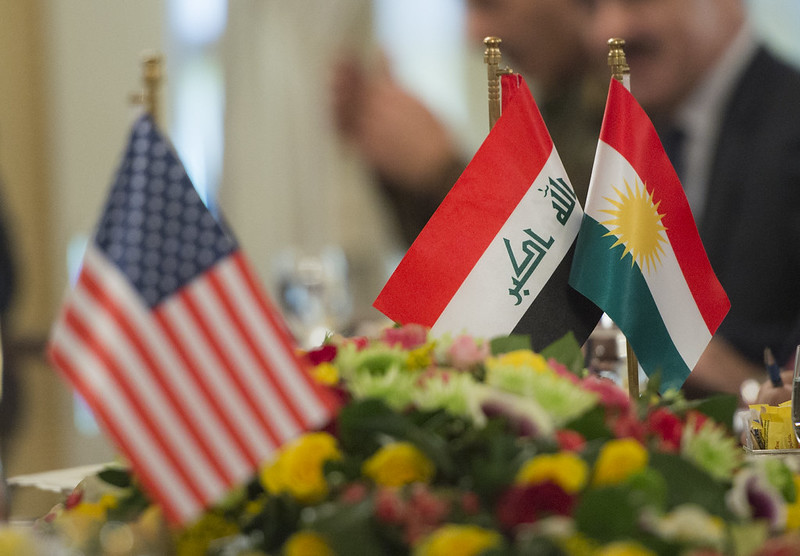
The Flags of the United States, Iraq, and Iraqi Kurdistan are on display during a meeting at the Kurdish White House on April 22nd, 2016. Picture Credits: Dominique A. Pineiro/FLICKR
Licensed under CC BY 2.0
For over a century, Kurdish foreign policy has been shaped less by strategic choice and more by structural vulnerability. Stateless, fragmented, and encircled by hostile powers, Kurdish leaders preferred alignment with external patrons instead of developing a coherent doctrine of power. For decades, this appeared rational; alignment promised protection, recognition, and survival. Yet the assumptions underpinning this approach no longer correspond to the international system the Kurds now inhabit.
The growing pressure from Washington to fold Kurdish forces into centralised state structures should not be read simply as betrayal. It is a structural signal that could intensify – one that exposes how persistently Kurdish elites have misread both the international environment they operate in and the powers they depend upon.
Historically, Kurdish foreign policy functioned less as strategy and more as orientation
More fundamentally, it reveals a foreign policy still premised on an outdated understanding of American power and global order, operating as if neither the world nor the United States has fundamentally changed.
What Kurdish Foreign Policy Has Been
Historically, Kurdish foreign policy functioned less as strategy and more as orientation. Alignment with the U.S. and Western powers became the means to an end and also the end itself, premised on the belief that cooperation and shared values would yield protection. Even the expansive U.S. consulate in Erbil (the largest U.S. Consulate in the world) – often cited as proof of a special relationship – signals American access and influence, not a commitment to Kurdish political agency or self-determination.
This belief endured despite repeated warnings. In 1975, U.S. and Iranian support for the Kurdish revolt in Iraq collapsed overnight after the Algiers Agreement, leaving Kurdish forces exposed and defeated. In 1991, following post–Gulf War uprisings, Washington declined to challenge Saddam’s rule, intervening only to manage humanitarian fallout rather than secure Kurdish political guarantees. After 2003, Kurdish autonomy in Iraq expanded, but always within red lines defined by regional stability and US–Turkish relations, not Kurdish self-determination. In Syria, Kurdish forces became Washington’s most effective partner against ISIS from 2014 onward, yet battlefield cooperation never translated into political recognition – culminating in US acquiescence to Turkish military operations in 2019 and today’s push toward reintegration into centralised state structures.
In practice, Kurdish diplomacy substituted leverage for moral alignment. Loyalty was expected to compensate for structural vulnerability. Kurdish leaders emphasised reliability – hosting US forces, fighting shared enemies, stabilising territory – as if consistency itself could generate obligation. But international relations does not reward virtue; it rewards utility. When Kurdish priorities clashed with broader calculations – NATO relations with Turkey, escalation with Iran, avoidance of long-term regional entanglement, or shifting domestic pressures in Washington – Kurdish claims were sidelined. This pattern spans decades and theatres. It was not accidental, nor merely a failure of leadership, but the predictable outcome of alignment without leverage, trust without contingency, and expectation without power.
Americanism Has Never Been Stable – or Benign
A solid understanding of U.S. foreign policy practice highlights a central weakness in Kurdish foreign policy thinking, which is rooted in a shallow historical understanding of America. U.S. foreign policy cannot be grasped without understanding Americanism – and Americanism has never been fixed, coherent, or morally consistent.
At key moments, Americanism was explicitly racialised. In the early twentieth century, the U.S. was governed domestically through Jim Crow segregation and white supremacy, yet abroad it was celebrated as the architect of liberal internationalism. Woodrow Wilson, revered globally as the father of liberal internationalism, segregated the federal government, defended racial separation, and presided in part over an era in which the Ku Klux Klan marched openly through Washington, showing off their mainstream support. Liberal universalism abroad coexisted comfortably with racial authoritarianism at home.
This version of Americanism did not disappear; it adapted
This contradiction was not accidental but foundational. Early American foreign policy treated race, hierarchy, and ‘civilisational stages’ as legitimate organising principles. Non-white societies were framed as wards to be managed rather than equals to be empowered – shaping who the international order was designed to protect and who could be sacrificed to preserve it.
This version of Americanism did not disappear; it adapted. The New Deal softened its domestic face, the Cold War recast it as anti-communist universalism, and the post-Cold War era repackaged it as democracy promotion and humanitarian intervention. The language changed, the hierarchy largely remained. Kurdish leaders too often mistook these shifts for moral evolution rather than strategic recalibration.
Knowledge as Power: What the United States Understood
What has remained constant across these transformations is not American values, but American methods. The US has always placed knowledge at the centre of power.
From the early twentieth century onwards, elite knowledge networks – funded by the Ford, Carnegie, and Rockefeller foundations – shaped how the world was studied, categorised, and governed. Universities, think tanks, policy journals, exchange programmes, and advisory bodies were not neutral spaces of inquiry. They were mechanisms for producing consensus, legitimising hierarchy, and embedding American preferences into global governance.
Ideas were as important as armies, and consent was as valuable as coercion. American power endured not simply because it could impose outcomes, but because it could define what counted as expertise, realism, and inevitability. This is how hegemony operates.
By contrast, Kurdish foreign policy has rarely invested seriously in non-partisan knowledge production of its own. It has consumed external analysis rather than generating indigenous strategic thought, relied on personal relationships rather than institutional expertise, and in recent years has discredited and disempowered its own institutions to preserve partisan power, and reacted to narratives rather than shaping them. In a system where power flows through ideas as much as force, this asymmetry is decisive.
Integration Without Agency Is Not Security
The current push to integrate Kurdish forces in Syria into centralised state frameworks flows directly from this logic. It reflects a long-standing American preference for state-centric order over non-state autonomy, particularly when managing relations with powerful regional allies.
Integration is framed as pragmatism. In reality, it dilutes Kurdish command structures, weakens political autonomy, and exposes Kurdish populations to the very states from which protection was originally sought. Security without agency is fragile. Identity without institutional power is symbolic. Accepting such arrangements may preserve short-term calm while hollowing out long-term capacity.
The Liberal International Order (LIO) Has Already Collapsed
Perhaps the most damaging miscalculation has been temporal. Kurdish foreign policy still operates as if the LIO remains intact – as if international law, human rights norms, and institutional guarantees meaningfully restrain great powers. They do not.
The LIO has been eroding for over a decade. International law is applied selectively. Sovereignty is conditional. Exceptionalism is normalised. The Iraq War was not a deviation from liberal norms but an early signal of their collapse. Yet Kurdish diplomacy continues to speak the language of an earlier era, appealing to rules and guarantees that no longer anchor outcomes. This leaves Kurdish politics permanently reactive, adjusting to decisions made elsewhere rather than shaping conditions through anticipation and leverage.
A Rare Moment of Unity – and Opportunity
Without internal coherence, foreign policy defaults to reliance. With unity, change becomes possible.
This moment is not only one of danger. Recent protests in Iraqi Kurdistan have produced a level of Kurdish unity not seen in years, perhaps not since the collective mobilisation against ISIS. Across parties and generations, there is a growing recognition that existing political arrangements – domestic and external – have failed to deliver dignity, security, or accountability.
This unity is fragile, but it matters. It offers what Kurdish foreign policy has long lacked: a domestic foundation for strategic recalibration rather than reactive dependency. Without internal coherence, foreign policy defaults to reliance. With unity, change becomes possible.
Knowledge as Strategy in a Post-Liberal World
If Kurdish foreign policy is to survive – let alone succeed – it must be rebuilt with knowledge at its core, not slogans, sentiment, or blind alliances. This requires investing in independent strategic analysis, historical literacy, elite training, and institutional memory; and understanding partners not as friends, but as systems shaped by interests, ideology, and internal contradiction. Expecting Americanism to function as a stable moral compass has always been a strategic error.
The Kurdish tragedy has never been a lack of courage or legitimacy, but the belief that moral alignment could substitute power in a system that never worked that way. As the liberal international order disintegrates, only one path offers agency: strategy grounded in knowledge, realism without illusion, and unity translated into institutional strength. Anything less is simply waiting to be surprised, again.

Bamo Nouri
Bamo Nouri is an award-winning senior lecturer in International Relations at the University of West London, an Honorary Research Fellow at City St George’s, University of London, and a One Young World Ambassador. He is also an independent investigative journalist and writer with interests in American foreign policy and the international and domestic politics of the Middle East. He is the author of Elite Theory and the 2003 Iraq Occupation by the United States.