Fearing Israel’s Regional Hegemony, Turkey Closes Ranks Around Stability in Iran
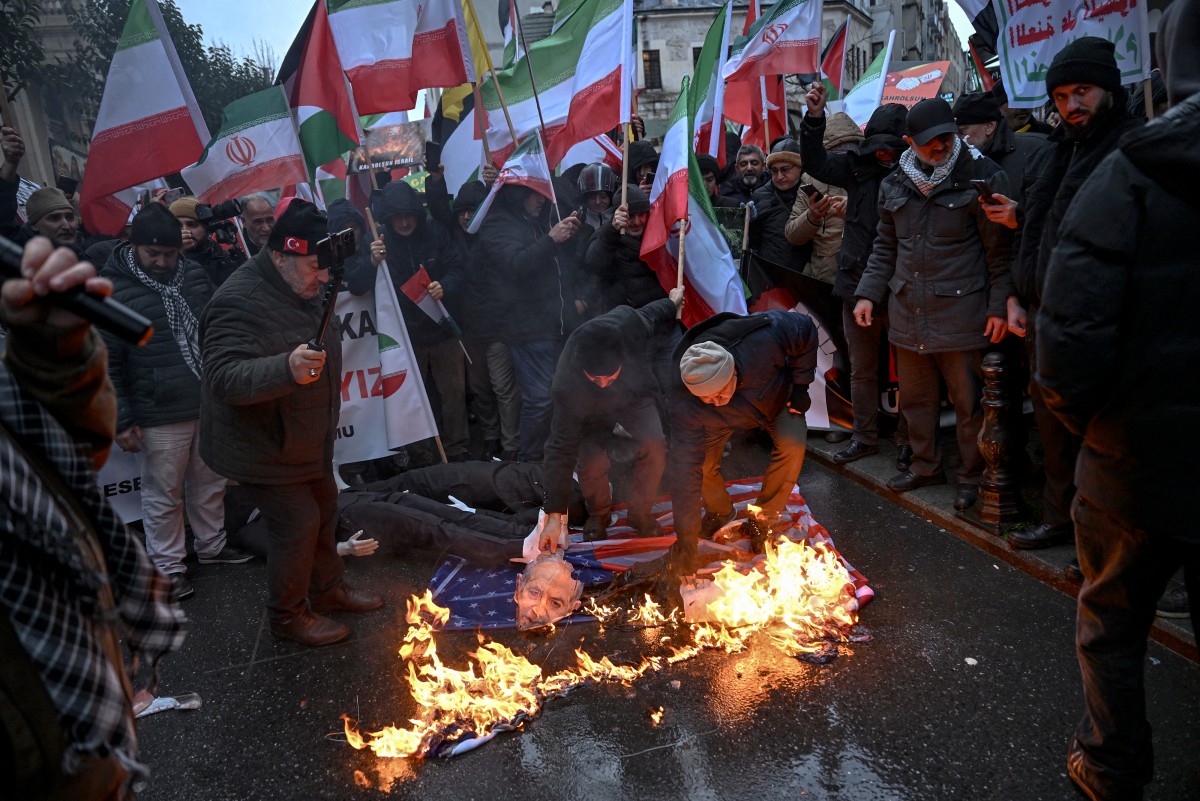
Protesters set afire portraits of US President Donald Trump and Israeli Prime Minister Benjamin Netanyahu during a pro-Iranian regime demonstration in front of the Iranian consulate in Istanbul, on January 18, 2026. (Photo by Ozan KOSE / AFP)
As unrest spread across Iran, raising fears of a US strike over Iran, Turkey is watching with cautious restraint. Ankara’s concern is that a collapse in Tehran could redraw the Middle East’s political map, where Israel and Iran may become allies, strain its western relations, and lead to instability across its borders, and an influx of refugees may enter Turkey.
Since protests erupted, a serious challenge to the Islamic Republic since 1979, Turkish leaders have chosen their words carefully. Hakan Fidan urged Iran’s state to “stop denying certain things to its people,” calling for dialogue rather than confrontation, wary that a sudden power shift in Iran could ignite new sectarian tensions.
President Recep Tayyip Erdoğan and Foreign Minister Hakan Fidan have appealed to Tehran to restore stability through dialogue and diplomacy, rejecting any military intervention in Iran. Fidan keeps lines open with Iranian officials even as Washington signals that strikes remain on the table. Behind the scenes, Ankara embraces “peace diplomacy,” quietly engaging both Tehran and Washington to prevent a wider crisis.
Nationalist leader Devlet Bahçeli, Erdoğan’s coalition partner, has gone further. Framing the unrest as an “organized provocation,” he warned that Iran’s stability and territorial integrity are “a matter of life and death” for Türkiye. He urged Iranian Azeris not to fall prey to what he described as Western plots to divide Iran. For Ankara, the instability next door demands a balance between Washington and Tehran- an effort to keep instability from spilling across its borders.
Why Iran’s Unrest Worries Ankara
For Ankara, the instability in Iran revives an old dilemma: balancing American pressure with regional stability. Officials see more than a domestic crisis; a shift that could undermine border politics decades in the making.
“Ankara has historically favored US pressure over Iran”
Arzu Yilmaz, an associate professor at the University of Kurdistan, told The Amargi that Turkey’s response fits a familiar regional strategy.
“Ankara has historically favored US pressure over Iran,” she said. “Turkey built up its first military bases in Iraqi Kurdistan during the ‘dual containment’ policy in the 1990s, and then tripled the number of bases during the ‘maximum pressure campaign’ in 2018.”
Yet, Yilmaz noted that the situation today is different.
“The situation is different now. Israel is evidently favored more than Turkey, and therefore, I don’t think the latter would back a military operation that aims to topple the regime in Iran,” she said.
“At the same time, a Western-friendly regime in Iran would undermine the strategic significance of Turkey in the eyes of the West and of the US, in particular. At the end of the day, if the regime collapses in Iran, then Turkey would act in the way it has acted in Syria.”
Regional Power Shifts
The unrest in Iran comes as Israel’s regional influence expands and U.S.–Israeli coordination tightens. Experts say the crisis highlights how Ankara views the Middle East through both ideological and strategic lenses.
Political analyst Shamal Bashiri told The Amargi:
“Ankara views Israel’s growing regional power and influence with deep concern. This fear is driven by two main factors: an increasingly ideological orientation in Turkish foreign policy and broader geopolitical considerations related to the regional balance of power.”
“Turkey increasingly perceives itself and the Middle East as targets of a regional order shaped by Israeli supremacy”
He traced this shift to around 2010s.
“Since around 2010, an Islamic–Sunni orientation in foreign policy has gradually gained influence within the AKP and, over time, within the state apparatus more broadly,” he said. “The Arab Spring, especially in Syria, played a decisive role in strengthening this outlook. Under the leadership of Hakan Fidan, first as head of intelligence and later as foreign minister, this approach reached its peak.”
Within that framework, Bashiri added:
“Turkey increasingly perceives itself and the Middle East as targets of a regional order shaped by Israeli supremacy—an order that Ankara believes would undermine the Muslim world in general and Turkey’s regional position in particular.”
According to Bashiri, this perception helps explain Turkey’s cautious stance – offering quiet backing for Tehran’s stability while maintaining ties with groups like Hezbollah and Hamas. Ankara aims to avoid being sidelined in a region it once sought to lead.
Refugee Concerns
Years of war in Syria and the arrival of nearly four million refugees have reshaped Turkey’s domestic politics and security priorities. Those experiences show how officials view unrest in Iran: not only as a geopolitical challenge but also as a potential humanitarian risk.
“Internal security and domestic stability have been top priorities for Ankara, particularly since October 2023,” Bashiri noted. The Syrian conflict, he said, reshaped Turkey through demographic change, jihadist networks, and the rise of far-right politics. Public exhaustion with refugee integration has made the prospect of new displacement deeply sensitive.
The fear is that instability in Iran — particularly in Kurdish or Azeri regions — could trigger new refugee flows, inflaming nationalist backlash and straining the economy.
Yilmaz cautioned:
“If you are specifically interested in refugee flow, I think it is too early to make a judgment of that.”
Still, Ankara’s worries focus on preventing another wave of displacement. Officials fear that renewed conflict in Iran could lead large numbers of refugees toward Turkey’s eastern border, deepening domestic resentment.
Bahçeli’s Call on Iran’s Azaris
Nationalist leader Devlet Bahçeli recently praised Iranian Azaris for resisting Western plans and “not falling prey” to plots that could tear Iran apart. His remarks also hinted at their potential role in countering Kurdish unrest, should instability spread.
So far, Azari’s involvement in the recent protest has remained limited, easing Turkey’s immediate concerns.
“Devlet Bahçeli’s speeches signaled that this time, Azeris in Iran would be Turkey’s potential partner to suppress the Kurds.”
Bashiri explained the complexity:
“The Azeri question is particularly complex. Unlike Turkey’s Sunni constituencies, Iran’s Azeris are predominantly Shi’a and therefore not part of the Sunni Islamic political sphere. Although Azeri nationalism has grown in recent years, Azeri elites remain deeply integrated into Iran’s political, economic, and military establishment.”
He added that, “Turkish soft power has increasingly influenced segments of the Iranian Azeri population. In a scenario involving a severe power vacuum or regime collapse in Iran, Ankara might attempt to instrumentalize Azeri vulnerabilities. Still, Turkey lacks the ideological and operational tools it has used elsewhere; Sunni jihadist networks would be ineffective in a Shi’a Azeri context. This constraint helps explain why Devlet Bahçeli, leader of the MHP, publicly urged Azeris not to participate in the recent protests against the Iranian regime.”
Yilmaz referred to another point: “Actually, Devlet Bahçeli’s speeches signaled that this time, Azeris in Iran would be Turkey’s potential partner to suppress the Kurds.”
These overlapping dynamics explain Ankara’s clear preference for a stable Tehran over chaotic change.
As protests and U.S.-Iran tensions rise, Turkey walks a careful line. It prioritizes stability while quietly signaling understanding toward Tehran, urging restraint to prevent an escalation.
For Erdoğan and Fidan, aligning with either side risks undermining Turkey’s interests is important. Ankara’s cautious diplomacy reflects its central concern, preserving stability along its borders. Iran’s unrest, therefore, tests not only Tehran’s control but also Turkey’s politics in a shifting regional landscape.

Kawe Fatehi
Kawe Fatehi is a journalist and translator, based in Berlin, with a Master's degree in English Literature and Language. He has written for multiple Kurdish and Persian media outlets, covering topics related to the Kurdish community in Iran, Iraq, Turkey, and Syria. In addition to his journalism work, he is a social worker.