Eco-farming initiatives thriving in Syria: “Seeds of Reunion”
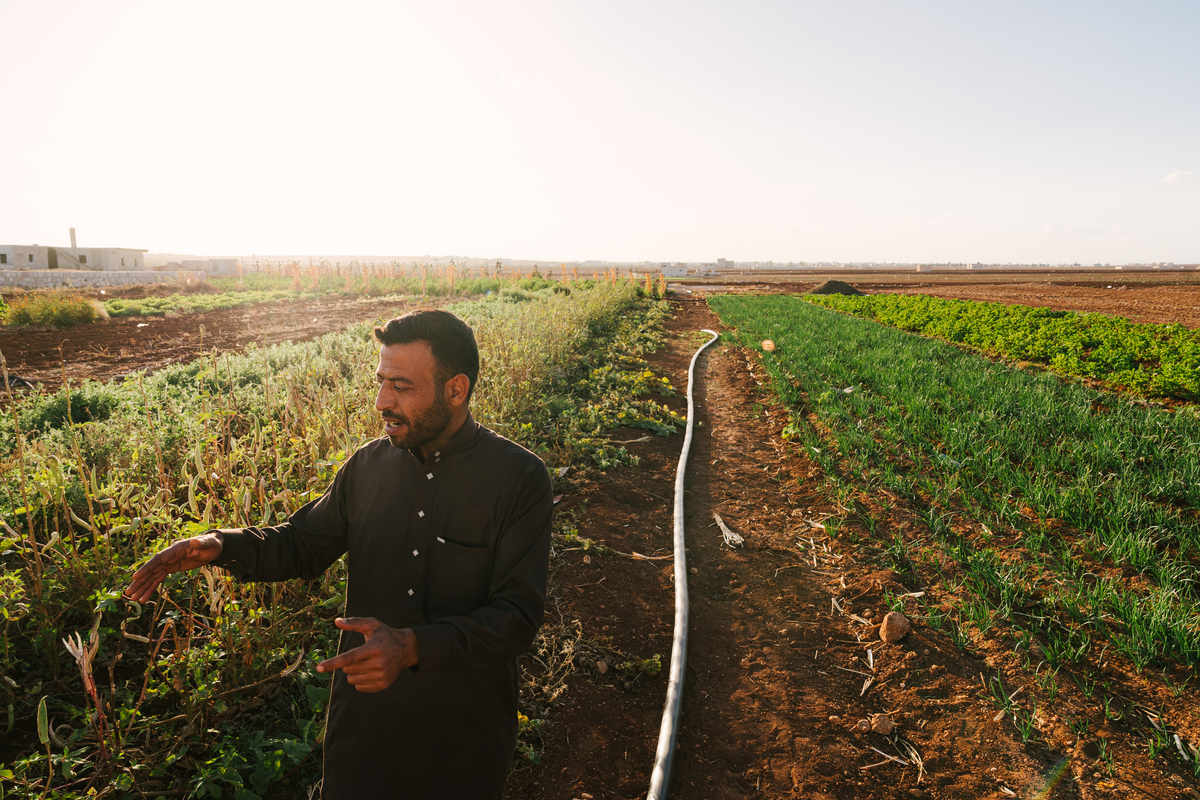
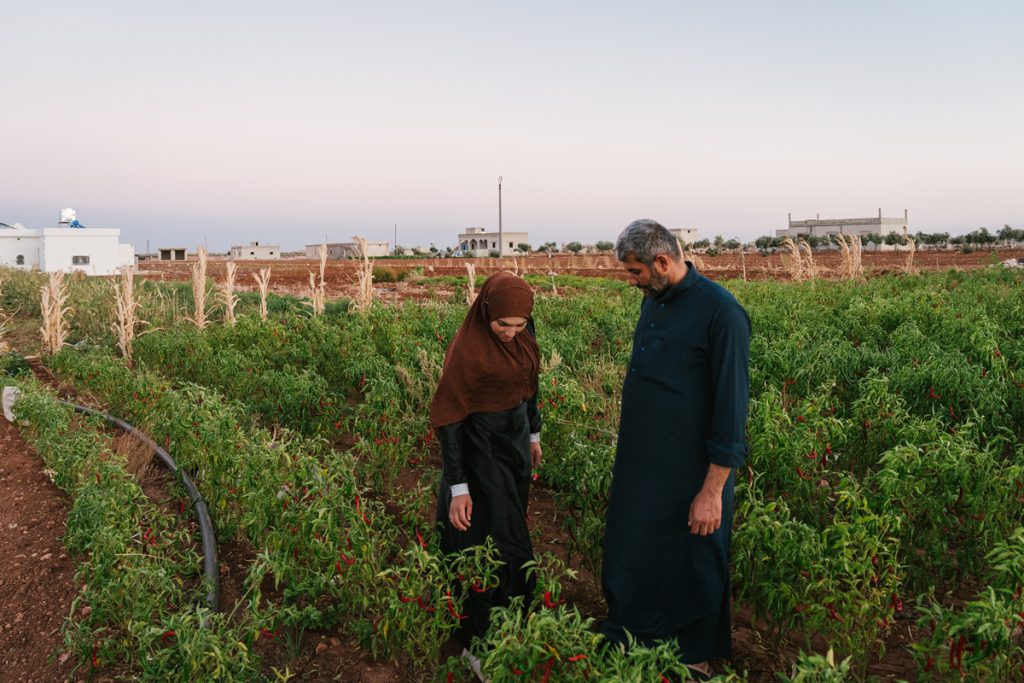
Azzat el Mohamed, 39, stands in his field behind his family home and looks at his okra crop. A farmer and sheep breeder, he is originally from al Dheibeh. After living as a refugee in Lebanon from 2016 to 2017, he returned to Syria as a displaced person in Afrin, where he lives with his wife and six children in a tent. When the regime fell, he returned to his home in al Dheibeh and resumed growing fruit and vegetables from local seeds saved by Buzuruna Juzuruna. Syria, October 25, 2025.
Azzat el Mohamed, 39 ans, dans son champ derrière la maison familiale, regarde sa production de gombo. Agriculteur et éleveur de moutons, il est originaire d’al Dheibeh. Réfugié au Liban de 2016 à 2017, il revient en Syrie en tant que déplacé à Afrin, où il vit avec sa femme et ses six enfants dans une tente. A la chute du régime, il retourne s’installer dans sa maison à al Dheibeh et recommence sa production de fruits et légumes, issus des semences locales sauvées par Buzuruna Juzuruna. Syrie, le 25 octobre 2025.
Azzat el Mohamed, 39, stands in his field behind his family home and looks at his okra crop. October 25, 2025 | Picture Credit: Pauline Gauer
Founded in Lebanon, Buzuruna Juzuruna is more than a seed collective – it helps farmers rebuild what war divided. In Syria, farmers are planting what was once saved from war and exile: the seeds of their autonomy.
Green tracksuit, thin glasses, curly hair – Ali Jato is twenty-seven years old. He is Kurdish, from Syria’s northeast. He admits he was hesitant to attend the farmers’ gathering in Idlib. On October 25, the last day of the meeting, however, there was no trace of self-doubt in his voice. “The war divided us,” he says. “But vegetables bring us together.”
For a week, the village of al-Dheibeh, on the outskirts of the city of Saraqib, became an important meeting point. Once home to around 400 families engaged in livestock and farming, it houses far fewer families after years of war and exile. Until 8 December last year, when the Assad regime fell, al-Dheibeh had remained under Assad’s control, retaken from rebel forces in December 2019 following fierce fighting.
Farmers from across Syria — from Hassakeh to Aleppo, from Suwayda to Ghouta – came to share seeds and stories, reflecting on what peasant autonomy could mean. Druze, Kurds, Alawites, Sunnis, who had been spread across both regime-held and opposition zones during the war, were in attendance- nearly sixty participants in all.
The gathering was organised by the Lebanon-based NGO Buzuruna Juzuruna (Our Seeds, Our Roots). Founded in 2016 in Lebanon’s Bekaa Valley by Syrian refugees and Lebanese, and French farmers, the collective has become synonymous with successful agroecology and seed sovereignty in the Near East. On its two-hectare farm, it preserves hundreds of local and heirloom varieties, becoming a sanctuary for both Levantine and Syrian agricultural heritage during the war. Today, two of its Syrian members are returning home with their seeds and seeking to expand the project.
…the week-long event at al-Dheibeh served as a “bridge”, a way to reopen dialogue
For Lara Beau, 35, who was present at the launch of Buzuruna Juzuruna, the week-long event at al-Dheibeh served as a “bridge”, a way to reopen dialogue. “We started by talking about gardens,” she says, “and then we just kept talking. It turned out to be a kind of collective therapy.”
Ali smiles and says, “People here welcomed me, cooked for me. In both the northwest and the northeast, the guest is sacred. That hospitality touched me deeply.” At home, between Hassakeh and Amudeh in the North-Eastern periphery of Syria, Ali tends a greenhouse of roses. “Planting,” he says, “is a way of staying upright.”
Abdelkader, 38, also lives in the North-East. He is Arab and a member of the association Dar — “tree” in Kurdish, “home” in Arabic — an organization that has worked with both communities. He hadn’t left Raqqa since 2010; it was his first time in both Idlib and Aleppo. He says he is glad to finally see “the borders falling.”
He is taking part in a seed exchange of baladi seeds – scientifically open-pollinated seeds, whose local varieties can be replanted each season (baladi means local or native in Arabic). Unlike industrial hybrids born in laboratories, sterile after one cycle. Each seed envelope passed from hand to hand carries the promise of another season – and of a shared future taking root.
Ibrahim Youssef, a farmer from Aleppo’s countryside in his fifties, pours seeds of mellow yellow melon into plastic cups. Ten years ago, he stopped using chemicals. He admits that hybrid seeds, as they’re called, give abundant harvests – but for him, the taste is different, and baladi is healthier.
For him, the aim has never been charity, but autonomy. He explains that most farmers now depend on industrial hybrid seeds, which sever the link between growers and their land
Among other farmers convinced by the benefits of local seeds is Walid al-Youssef, 41, a founding member of Buzuruna Juzuruna, who returned from Lebanon to his nearby village just three weeks earlier. “I’m a son of this land.” For him, the aim has never been charity, but autonomy. He explains that most farmers now depend on industrial hybrid seeds, which sever the link between growers and their land. What matters to him is restoring this bond and continuing to bring the Buzuruna Juzuruna experience back home to Syria.
Around the room, heads nod as farmers trade experiences of exile and return. Most agree on one thing: true strength doesn’t come from aid, but from the soil itself – from what they can grow, save, and share with their own hands.
The meeting takes place in the home of Azzat al-Mohamed, thirty-nine, a farmer whose life, like his seeds, has crossed borders. When the war forced him to flee in 2017, he carried bags from his village – old baladi varieties he refused to abandon.
He spent a year with Buzuruna Juzuruna in Lebanon, learning to preserve seeds, before displacement pushed him northward to Afrin, where he lived in a tent with his wife and six children, among other families uprooted by the war. There, he replanted what he had – diamond-shaped eggplants, long peppers, and the Jew’s mallow leaves of his childhood. He shared his seeds with those who had lost theirs, or whose seeds no longer germinated because they hadn’t been replanted within a year or two. He reintroduced some of the varieties when he returned to his village in February 2025, after 8 years. He smiles, “My three-branched pepper variety had disappeared from the village!”
That afternoon, the gathering paused for a shared traditional and festive meal – a mandi, rice, and chicken spiced with cloves and cinnamon. Under a tarp, long wooden tables were set, and farmers took their seats side by side. At the village center stands a school whose roof lies torn open following a 2017 airstrike, a reminder of how close the front once was.
Among those who lived through those years was Abu Zoher, a 67-year-old agronomist who once used seeds imported from the United States. It was thanks to his friend Azzat that he says he understood that by introducing foreign seeds, “I was also importing disease into my country.” In nearby Rass el-Ein, he saw his house bombed in 2019, and fled amid strikes at night with his family to central Idlib. He returned only in March 2025, after the regime’s fall, waiting for the White Helmets to clear his land of mines.
Members of Buzuruna Juzuruna helped him recover seeds that had been smuggled from Lebanon. “Just one gram of these seeds gives three hundred tomatoes,” he says, opening his hand. “When I hold these seeds, I hold my heritage – my roots.” Then, looking at the younger farmers around him, he adds, “When I saw what Buzuruna was doing, this solidarity, I realized that some people still protect human heritage.”
He picks up a handful of dried nettles, crumbles them between his fingers, and says: “It’s both a preventive and a cure for my plants.” He has lost many things, but not the certainty that the land can still heal.

Paloma de Dinechin
Paloma de Dinechin is a Franco-Chilean investigative journalist based in Syria. She covers mainly Latin America and the Middle East, focusing on environmental issues, human rights, and organized crime.