Syrian Kurdish–Israeli Relations: Between Strategic Signaling and Silent Pragmatism
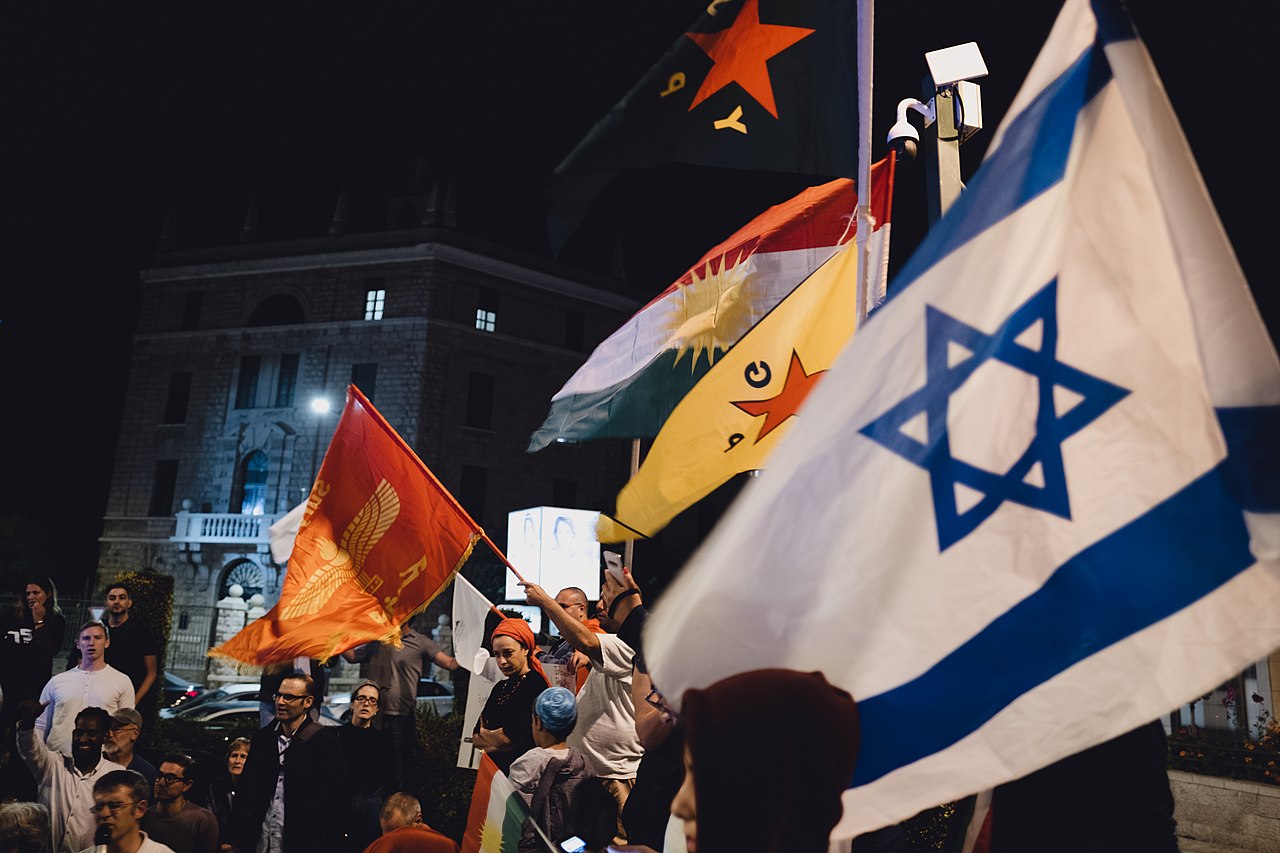
Views of the solidarity protest for Rojava organized by Kurdish Jews on October 12th 2019 in Jerusalem, Israel | Picture Credits: WIkimedia Commons
The relationship between Syrian Kurdish forces and Israel has long lingered in the grey zone between rumor and realpolitik. While no formal alliance exists between the Kurdish-led Autonomous Administration in North and East Syria (AANES) and Israel, the mosaic of indirect contacts, symbolic gestures, and rhetorical sympathy points to a deeper strategic undercurrent. The story is not one of open diplomacy but of cautious signaling, wherein silence, ambiguity, and intermediaries constitute the language of engagement.
For Israel, the Syrian Kurds, principally represented by the Syrian Democratic Forces (SDF) and their Kurdish core, the People’s and Women Protection Units (YPJ & YPG), represent both an opportunity and a dilemma. For the Kurds, Israel is both a potential ally and a political liability. Between these poles lies a sensitive dance of interests, shaped by shifting US policies, Turkey’s assertiveness, and the region’s multipolar realignment.
Recent reports indicate that quiet communication between Kurdish and Israeli figures has occasionally surfaced. In early 2025, Rudaw TV reported that Israeli Foreign Minister Gideon Sa’ar spoke by phone with Ilham Ahmed, the AANES’s top foreign-relations official, expressing support for Kurdish rights and concern over Turkish attacks on Rojava. Israeli media outlets have echoed similar claims, suggesting exploratory outreach from Kurdish representatives seeking humanitarian or political dialogue. Such gestures, however, remain symbolic. On record, the Kurdish leadership maintains that no institutional relationship exists. SDF commander Mazloum Abdi has stated bluntly, “We have no relationship with Israel,” though he leaves open the possibility of peaceful relations “with all who respect our rights.” PYD’s senior official, Aldar Xalil, has gone further, warning that Israeli statements sometimes make the Kurds a “target” without delivering tangible help. Thus, the gap between rhetoric and reality underscores the core dilemma: visibility invites danger, while invisibility limits leverage. In other words, the Syrian Kurds show the Wulf of Israel to Turkey to tell them that if they don’t behave well, Israel is a viable and better choice.
If any link connects the two sides, it should pass through the US, as it has been the SDF’s main external partner since the anti-ISIS campaign, providing logistical, intelligence, and financial support. Israel, for its part, maintains close coordination with the US military and diplomatic structures in the region. Thus, indirect exchanges through conflict-resolution channels, humanitarian coordination, or intelligence sharing may already occur below the radar. For Israel, the Syrian Kurds represent a minor but useful node in the broader effort to constrain not only Iranian but also Turkish influence. Kurdish-held areas sit near Iranian supply routes in eastern Syria. An autonomous Kurdish presence friendly to Western powers serves as a buffer between Turkey, Iran, and Syria. Arguably, Israel’s strategic logic is pragmatic. It does not need an alliance, merely a deterrent foothold that complicates Iranian and Turkish expansion.
Kurdish authorities lack international recognition and must avoid alienating their fragile coalition of allies.
Three motives make Kurdish–Israeli convergence reasonable. First, both regard Turkey and Iran as threats. Israel seeks to weaken Iran’s regional networks; Kurdish forces fear Iranian-backed militias and border pressure. Second, both prioritize intelligence and security. Cooperation on counterterrorism or border surveillance could serve mutual interests. Third, each uses symbolic diplomacy; Israeli public support for Kurdish autonomy sends messages to Turkey and Iran without direct confrontation.
Yet, equally powerful restrictions exist. Kurdish authorities lack international recognition and must avoid alienating their fragile coalition of allies. Public alignment with Israel risks provoking Turkey, a state that already considers the YPG an extension of the PKK, and undermining Kurdish credibility among Arab or Muslim communities. The Kurdish project in Syria frames itself as democratic, pluralist, and locally grounded, not as a Western or Israeli proxy. Thus, any overt tie could undo years of careful political positioning.
Turkey’s hostility toward Kurdish autonomy stems from existential fears of secessionism. Iran, meanwhile, opposes any Kurdish empowerment that might embolden its own Kurdish population. Israel finds itself watching both with a wary eye.
Arguably, Israel must also step carefully. Despite periodic friction with the Turkish state, Turkey remains an essential regional partner in trade, energy, and intelligence. Turkey’s geographic leverage, controlling the northern Syrian frontier and influencing NATO’s position, limits Israel’s freedom to act. Therefore, a visible Israeli-Kurdish alliance would provoke Turkey’s wrath and potentially disrupt wider Israeli strategic calculations.
Therefore, the triangular dynamics among Turkey, Iran, and Israel largely shape this equation. Turkey’s hostility toward Kurdish autonomy stems from existential fears of secessionism. Iran, meanwhile, opposes any Kurdish empowerment that might embolden its own Kurdish population. Israel finds itself watching both with a wary eye. While it shares Turkey’s desire to contain Iran, it diverges on the Kurdish issue. Consequently, Israel’s Kurdish policy remains one of regulated ambiguity. It offers rhetorical backing for Kurdish rights and occasionally humanitarian gestures, while avoiding formal ties that could damage its relations with Turkey or the US. The Kurds, for their part, reciprocate this caution, engaging in polite signals of openness without crossing diplomatic red lines.
The most probable outcome is continued indirect coordination via U.S. channels. Occasional Israeli statements or Kurdish acknowledgments will serve to maintain visibility without formalization. Moreover, intelligence or humanitarian coordination, particularly around ISIS detainees or border monitoring, might deepen discreetly, especially if the USA forces remain stationed in Syria. Should any cooperation become public, however, Turkey or Iran could retaliate militarily or diplomatically, framing the Kurds as agents of Israeli influence. Thus, this could weaken the Kurdish position internally and regionally. Therefore, if Kurdish self-administration solidifies and gains recognition, either within a federal Syria or through de facto autonomy, relations with Israel might normalize, particularly if the USA and EU capitals endorse such engagement.
Whether this tentative dance evolves into a structured partnership depends less on sentiment than on structural change; particularly, the endurance of the USA’s influence in Syria, the evolution of Turkey’s regional policy, and the consolidation of Kurdish self-rule
Nonetheless, at the heart of this relationship lies a paradox familiar to Kurdish history. External sympathy rarely translates into tangible support. Israel, like many Western actors, may see in the Kurds an image of secular resilience and democratic aspiration, yet practical assistance remains minimal. For the Kurds, pragmatic caution has become a survival instinct; they have learned the cost of overexposure. Nevertheless, even rhetorical engagement matters; for Israel, endorsing Kurdish rights signals to regional rivals that it retains influence across multiple theatres, from Gaza and Lebanon to the Syrian steppes. For the Kurds, however, Israeli acknowledgment is symbolic and affirms their international visibility. Thus, both sides extract strategic value without formal commitment.
In the emerging multipolar Middle East, relationships like that between Israel and the Syrian Kurds epitomize a new diplomacy of quiet pragmatism. Grand alliances are replaced by tactical alignments, which are fluid, reversible, and often mediated through third parties. In simpler terms, the Kurdish–Israeli dynamic remains defined by ambiguity: too visible to ignore, too sensitive to formalize. Whether this tentative dance evolves into a structured partnership depends less on sentiment than on structural change; particularly, the endurance of the USA’s influence in Syria, the evolution of Turkey’s regional policy, and the consolidation of Kurdish self-rule. For now, both sides appear content to keep their relationship undefined, signaling when useful, retreating when necessary. In that sense, the Kurdish–Israeli connection is not a secret alliance but a mirror of Middle Eastern geopolitics itself. It is covered, cautious, and continuously in flux, where silence often speaks louder than words.

Seevan Saeed
Seevan Saeed is an Associate Professor in Area Studies at Shaanxi Normal University, China and Lecturer at Rojava University, Syria. He received his BA degree in Sociology and MA in Social Policy at the University of Wolverhampton,UK. He gained a PhD in Middle East Politics at the University of Exeter in 2015. He has delivered lecturers in domestic and international universities since 2015. He published articles and papers in six languages on social and political issues in the Middle East and beyond.