Islamist Authority Closes In on Syrian Women
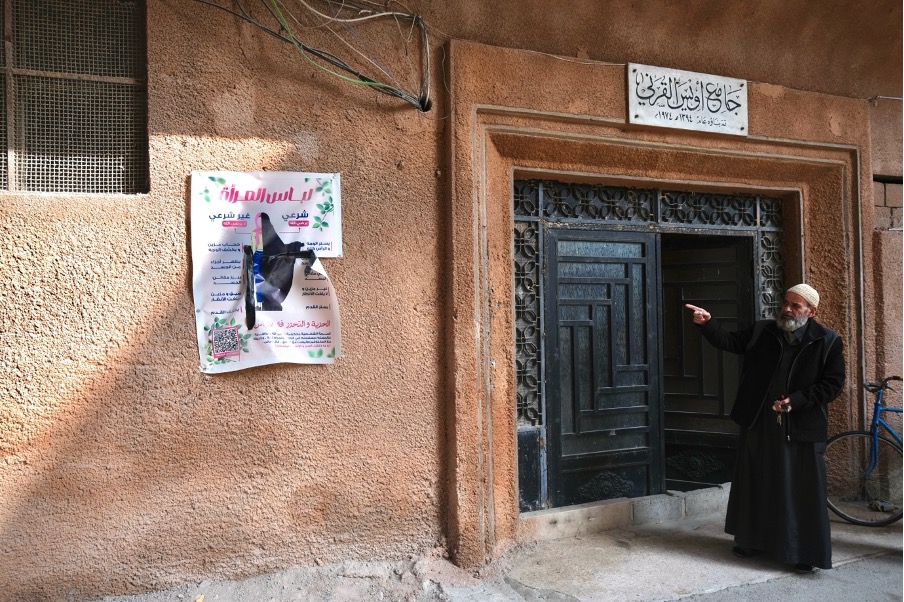
An imam at a mosque in Yarmouk points to a poster outlining rules for women’s dress. Photo by Katrine Houmøller
On a side street near a vegetable stall in Yarmouk, Damascus’ southern subards, a poster hangs next to a mosque. Put up by the Ministry of Religion, it lays out what women in the area are expected to wear – and what they are not. The text on the poster describes clothes that “Islamically lawful” and clothes that are “Islamically unlawful.”
Since the new Syrian regime took power in December 2024, Hayat Tahrir al-Sham (HTS), a group linked al-Qaeda, has reshaped daily life in Yarmouk.
Imad al-Natour, 36, deputy commander of the local authority in Yarmouk, insists the poster does not impose rules: “Women in Yarmouk don’t have to follow what’s written,” he says. “It’s simply advice. Good advice.”
The poster itself leaves little room for interpretation. “Unlawful” clothing, it warns, includes a decorated hijab, a visible face, exposed body parts, garments that are tight or decorative, anything that draws attention, and uncovered feet. “Lawful” clothing, by contrast, must cover the face, head, hands, and body; conceal a woman’s “charms”; remain plain and unobtrusive; and fully cover the feet.
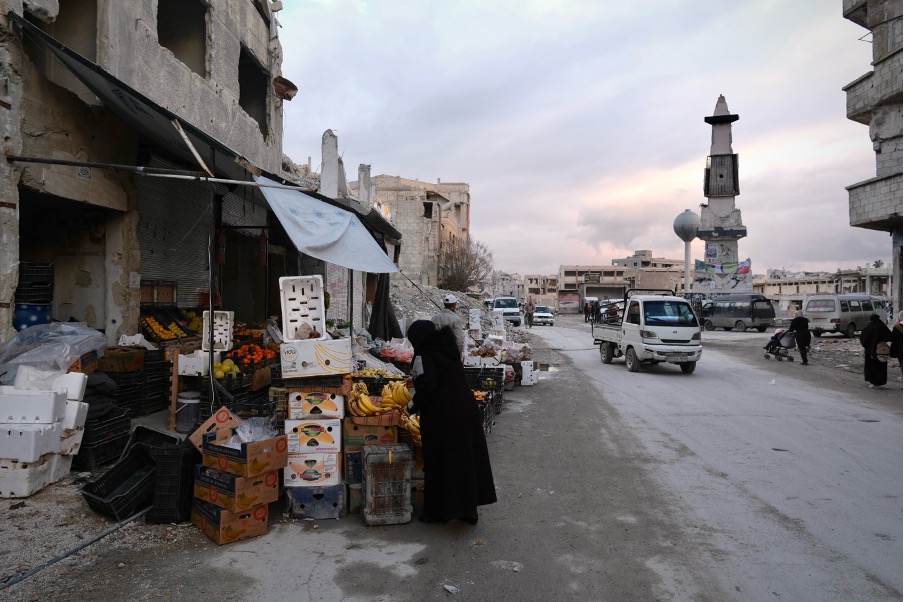
Al-Natour frames women’s clothing as a form of protection. Men, he claims, are jealous, and clothing is meant to shield them from their women getting unwanted attention. In public, the husband decides how she should act and dress, because, according to al-Natour, when she is outside, she represents him. He emphasizes the point, placing the responsibility on women: to be a “good woman,” a woman must dress and behave in particular ways. “If a woman stands out in the street, people don’t talk badly about her. They talk badly about the husband, trust me,” he says.
Beside him, his wife Aya nods in agreement, “If she loves her husband, she will respect him and do what he wants.”
Militarization and Exclusion
Widespread militarization has left women increasingly vulnerable, heightening the risk of violence both in public and at home, which “reinforces” control over women.
For women, life under HTS is governed less by formal laws and more by the values that local authorities quietly impose. These rules dictate behavior, appearance, and freedom in ways both subtle and tangible. Navigating this new reality is far from straightforward.
The challenges extend far beyond street posters or strict dress codes. Even under Bashar al-Assad, their rights were limited, says Zeina Kanawati from Women for Women International. Today, however, under the new regime, control is weaker and the situation far more unpredictable. Widespread militarization has left women increasingly vulnerable, heightening the risk of violence both in public and at home, which “reinforces” control over women, Kanawati says.
This climate also blocks women from engaging politically. Sabiha Khalil, an activist with the Syrian Women’s Political Movement, explains that security concerns are the main barrier. In a regime that treats political activism as a crime and resolves conflicts through force, both women and men are discouraged from speaking out, she says.
Exclusion from politics compounds the struggle for women’s rights. Women have almost no influence at any level of government. Only one of 23 ministers in the current cabinet is female, while local authorities, like in Yarmouk, employ no women at all.
“There’s no need for women at the moment,” says Imad al-Natour.
Khalil from Syrian Women’s Political Movement emphasizes that women are required to provide double proof of their qualifications and competence simply to gain acknowledgment.
Kanawati from Women for Women calls it a “new struggle” for women to be seen and heard. On the ground, the consequences are immediate. With women pushed out of governance, physical violations against women continue. “If the new government does not act on women’s basic rights in Syria, they will continue to be ignored, and more crimes will be committed against them,” she says.
Voices from Yarmouk
For 22-year-old Bessan Awad, life in Yarmouk shifted dramatically when HTS took control in December 2024. She describes the changes as both unsettling and frightening, a daily reality that leaves her cautious and on edge as she navigates the streets of her neighborhood.
Awad recounts a woman being killed by her husband, a member of the new authority, and her body left in the street for all to see. Multiple sources in the camp confirmed the incident.
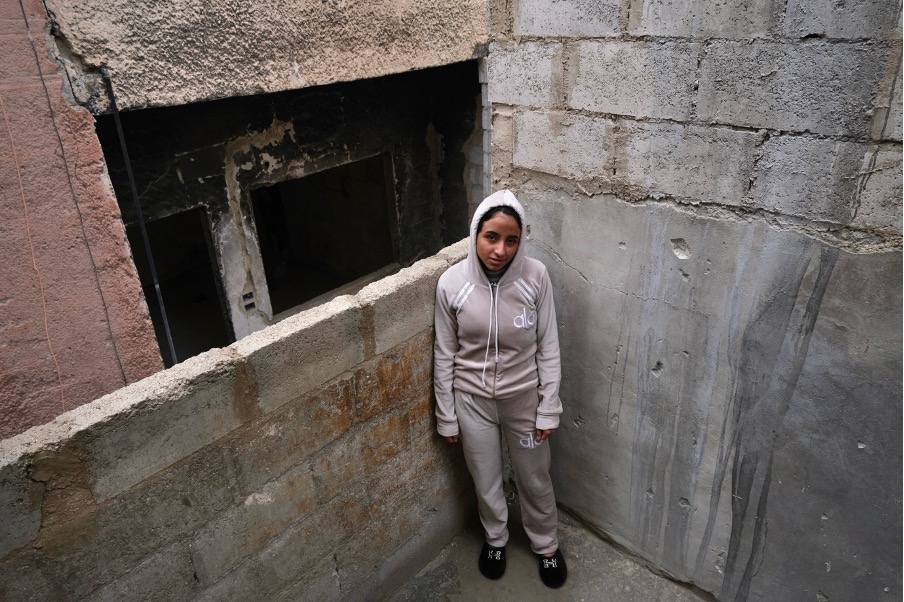
Awad has also witnessed women being pushed in the streets by local soldiers. “What kind of religion is that?” she asks. “Under [Bashar] al-Assad, women weren’t this afraid to go out!”
When 22-year-old Bessan Awad walks through Yarmouk at night, she feels eyes on her – not from neighbors, but from armed men who control the streets
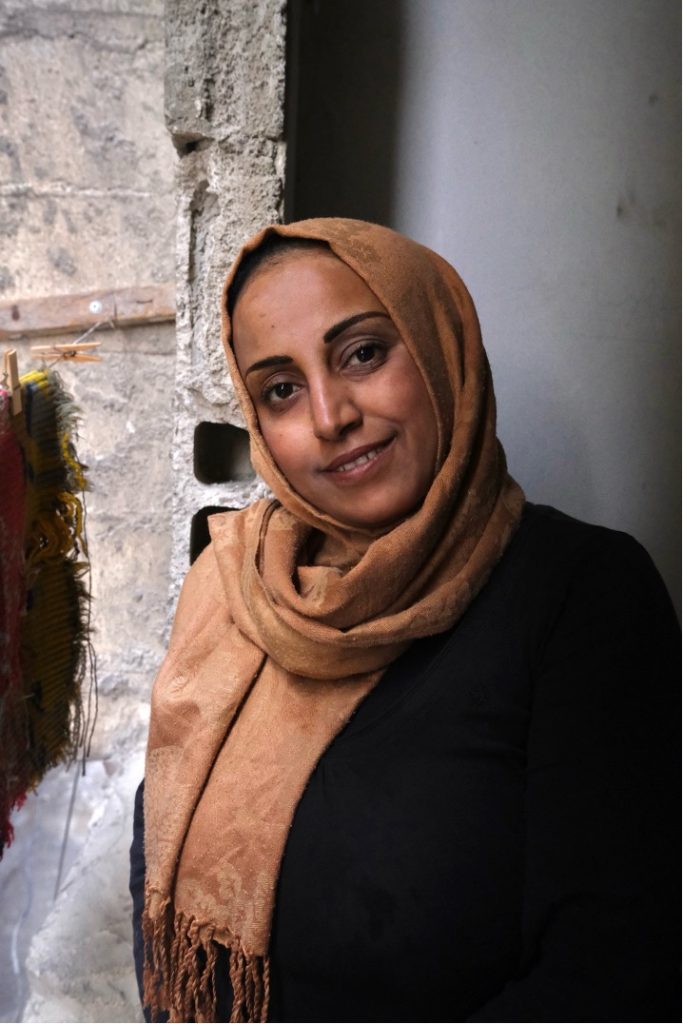
Fatmeh Ahmad al-Natour, 37, another resident of Yarmouk, has a different perspective on life under the two regimes.
During Assad’s rule, checkpoints could be dangerous for unmarried women, she says, as soldiers could assault them if their husbands were not present. For Fatmeh al-Natour, this meant she could not leave Yarmouk safely until she decided to marry the man she is still with today. Under the new regime, these checkpoints no longer exist, and the fear she felt as a woman has diminished.
Voiceless in the Streets
When 22-year-old Bessan Awad walks through Yarmouk at night, she feels eyes on her – not from neighbors, but from armed men who control the streets. She describes a constant sense of being watched, monitored, and exposed.
One evening at around 10 p.m., she was stopped by members of the local authority and questioned endlessly about where she came from, where was going, and why she was out so late. Many locals say they have experienced similar encounters, particularly at night.
Yet when Bessan actually needs help from the authorities, she often feels ignored. Soldiers refuse to speak to her solely because she is a woman. If she wants assistance, she is told to bring a man.
She recalls that in one instance when she asked a soldier from the local authority a question, the soldier initially refused to answer, and only after demanding an explanation, the soldier told her, he won’t speak to her because of she is a woman. “I see it as another way of saying ‘fuck off,’” Bessan says.
Frustrated, she sometimes yells back at the soldiers, accusing them of having no religion and of failing to follow the rules of Islam. “More than half of the population is women,” she says. “So who do they think they are, refusing to talk to us?”
Not everyone agrees with her account. Imad al-Natour strongly rejects claims that his men refuse to speak to women unless they are accompanied by a male guardian. He says he cannot imagine anyone refusing to help a woman simply because she is a woman: “We talk to women,” he says, “I’m taking care of the women.”
Now Bessan keeps her distance from men affiliated with the new regime, slipping away whenever they approach or question her. “The best scenario would be if the soldiers didn’t stay in the streets, spreading fear,” she says.The constant presence of armed men casts a long shadow over the neighborhood, a shadow that hangs heaviest over women and children. For Bessan, life in Yarmouk has fundamentally changed: “I fear it will only get worse from here.”

Katrine Houmøller
Katrine Dige Houmøller is a Danish freelance journalist based in Beirut, Lebanon, specializing in coverage of the Middle East with a focus on war, crises, and human rights. She was nominated for the Danish Kravling Prize for her reporting from Syria following Bashar al-Assad’s fall in 2024, and in 2025 she received the DMJX award for her project on child soldiers in Palestinian refugee camps in Lebanon.