From Ceasefire to Collapse and Back Again: Why the Peace Question Keeps Returning
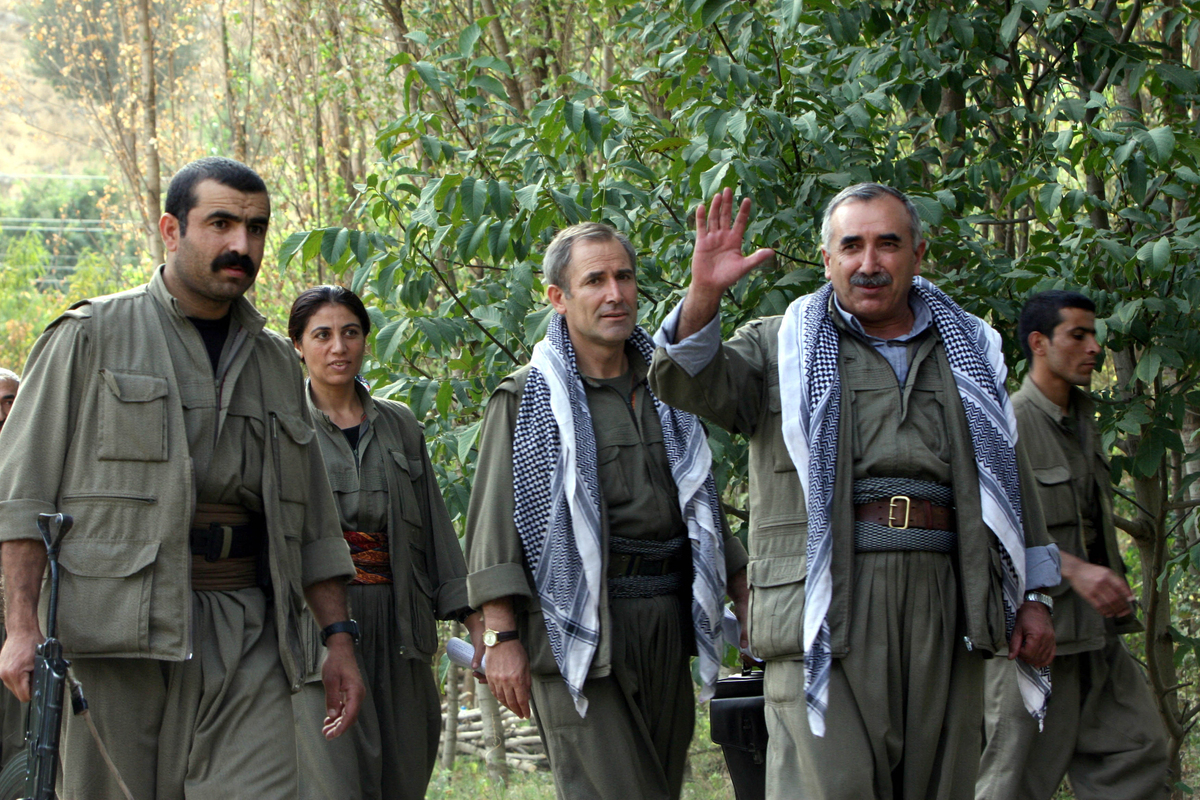
Murad Qiralian, the head of the military wing of the Kurdistan Workers’ Party (PKK), waves upon his arrival to hold a press conference in the area of Qandil Mountains in northern Iraq on September 30, 2010 during which he announced an extension of a temporary ceasefire with Turkey for another month but warned a permanent halt to fighting would not come until Ankara entered talks. (Photo by Safin HAMID / AFP)
For more than five decades, Abdullah Öcalan has advanced a consistent claim: the Kurdish issue in Turkey is not a security problem but a political one, and therefore, demands a political solution. Since the first PKK ceasefire in 1993, he has argued that armed struggle arose not from separatist ambition or historical inevitability, but from the Turkish state’s denial of Kurdish existence and the systematic foreclosure of democratic channels for change. Along these lines, he emphasized that a political solution can bring the armed conflict to an end. When Öcalan once again called for a political settlement on February 27, 2025, the responses to his call exposed a familiar asymmetry: Ankara welcomed a solution almost exclusively in terms of security and disarmament, while the Kurdistan Freedom Movement framed it as a question of rights, recognition, and the democratic reconstitution of the republic.
A Call Heard—Selectively
Öcalan’s February 2025 message was precisely calibrated. It addressed three audiences simultaneously. For the PKK, it was a call for an end to armed struggle and for the organization to convene a congress to dissolve itself and transform into a non-armed political movement. To the Turkish State, it demanded legal and political reforms capable of sustaining a democratic republic inclusive of Kurdish identity. And to the broader populace, it called for political mobilization to build a democratic society. Media coverage, however, focused almost entirely on the first demand. Disarmament dominated headlines; democratization all but disappeared.
This selective hearing was immediately reflected in official responses. President Recep Tayyip Erdoğan welcomed the prospect of the PKK laying down its arms, while pointedly avoiding any reference to Kurdish political rights. Within days, his rhetoric reverted to familiar threats: Turkey’s “iron fist” remained poised, and military operations would continue until “the last terrorist” was eliminated should the state’s outstretched hand be refused. The contradiction was unmistakable. A peace process premised on unilateral surrender—disarmament without democratization—is not a peace process at all.
The PKK’s Response
The PKK’s response to Öcalan’s call was swift and unambiguous. Within twenty-four hours, it declared a ceasefire, endorsed dissolution, and framed Öcalan’s message as a blueprint for democratic transformation. At the same time, it articulated clear political conditions: recognition of Kurdish identity, an end to assimilationist policies, and legal guarantees enabling political participation.
None of this was unprecedented. Comparable gestures in 1999 and 2009 had been met not with negotiations but with arrests and lengthy prison sentences.
In May 2025, the PKK convened its 12th Congress and formally resolved to dissolve its organizational structure and terminate armed struggle, subject to political guarantees. In July, thirty fighters publicly destroyed their weapons in a symbolic ceremony in Iraqi Kurdistan. By October, the organization announced the withdrawal of its guerrilla forces from Turkey.
None of this was unprecedented. Comparable gestures in 1999 and 2009 had been met not with negotiations but with arrests and lengthy prison sentences. The lesson—learned repeatedly—was that goodwill offered unilaterally would not be reciprocated. This historical memory profoundly shaped caution toward state intentions.
Denial as Doctrine
At the core of repeated failure lies a structural constant: the Turkish state’s refusal to acknowledge the Kurdish issue as political in nature. Long before the PKK resorted to arms, Kurdish actors sought redress through elections and legal politics. Those efforts were systematically blocked through party bans, repression, and exclusion, gradually eliminating peaceful channels of representation and normalizing insurgency as a last resort.
Öcalan has long maintained that the PKK did not generate the Kurdish issue but forced it into visibility. Armed struggle made denial untenable, but visibility alone did not produce resolution. Instead, it produced a pattern in which dialogue was tolerated tactically, as a means of de-escalation or intelligence-gathering, but never institutionalized as a path to structural reform. This pattern became particularly pronounced in the early 2000s, when exploratory contacts slowly evolved into more formal talks.
Oslo: Engagement Without Ownership
Between 2008 and 2011, secret meetings in Oslo brought senior PKK figures together with Turkish intelligence officials, facilitated by Norwegian and Swiss mediators. These talks suggested the possibility of a negotiated settlement, yet the absence of political ownership on the Turkish side fatally compromised them. Ankara delegated the process to intelligence services, excluded parliament, and avoided legal frameworks that might bind the state. When Erdoğan withdrew political backing in 2011, the talks collapsed instantly—revealing how shallow the commitment had been.
İmralı: Centralization Without Autonomy
Negotiations resumed after Oslo, but in a markedly different form. Between 2013 and 2015, talks were conducted directly with Öcalan on İmralı Island, with Kurdish MPs acting as intermediaries. This shift consolidated Öcalan’s role as the principal interlocutor, but within clear limits: delegations could meet only with state permission, were time-constrained, and conducted entirely under state supervision.
Still, Öcalan sought to manufacture momentum. His 2013 Newroz message declared the end of armed struggle and the beginning of democratic politics. PKK fighters began withdrawing from Turkey, and for a brief period, the war fell silent.
The logic was elementary: withdrawal was meant to be reciprocal, not a prelude to defeat
The silence did not last. While the PKK withdrew, the state failed to enact meaningful reforms. Military infrastructure expanded, surveillance intensified, and promised democratization packages proved cosmetic. By late 2013, the PKK suspended the withdrawal, citing bad faith. The logic was elementary: withdrawal was meant to be reciprocal, not a prelude to defeat.
The process ended definitively in July 2015. Turkish jets bombed PKK positions in Iraq; urban warfare devastated Kurdish cities; entire neighborhoods were destroyed, and civilians were killed or displaced. The peace process did not merely collapse—it was violently reversed.
Why Peace Failed
Five interlocking dynamics explain the failure.
First, the parties pursued incompatible end states. Öcalan and the Kurdistan Freedom Movement envisioned a democratic republic grounded in plural citizenship, strong civil society, and democratic reforms. The AKP framed the issue as terrorism and regional underdevelopment, reducing negotiations to disarmament and economic management while rejecting structural reform.
The PKK and its Syrian affiliates gained legitimacy through their role in defeating ISIS, alarming Ankara and reinforcing a security-first approach.
Second, electoral calculations proved decisive. Dialogue failed to deliver Kurdish votes to the AKP. Instead, the HDP—closely aligned with Öcalan’s political vision—broke through nationally in June 2015, stripping Erdoğan of his parliamentary majority. Dialogue was reinterpreted as a political risk.
Third, regional dynamics shifted. The PKK and its Syrian affiliates gained legitimacy through their role in defeating ISIS, alarming Ankara and reinforcing a security-first approach. Military containment appeared preferable to political compromise.
Fourth, the process lacked institutional safeguards. It bypassed parliament, rested on executive discretion, and excluded third-party guarantees. When Erdoğan withdrew support, collapse was inevitable.
Finally, the talks functioned as an intelligence conduit. Over time, the state acquired detailed knowledge of political and organizational issues and PKK logistics — knowledge that could later be mobilized in renewed counterinsurgency campaigns.
The Persistence of the Question
Öcalan has long warned that rebellion will recur so long as denial persists. In his account, the PKK “rendered a service” by forcing the Kurdish issue onto Turkey’s political agenda. Yet exposure without transformation merely resets the cycle.
Past experiences suggest that peace will not emerge from ceasefires alone
The 2025 call for peace thus confronts an old dilemma. The Kurdistan Freedom Movement has once again signaled its readiness for a political solution. The unanswered question is whether the Turkish state is prepared to recognize the Kurdish issue as a structural democratic problem rather than a security issue.
Past experiences suggest that peace will not emerge from ceasefires alone. It will require binding political reform, institutional guarantees, the abandonment of denial as the governing doctrine, and a democracy that decenters the state. Until then, the Kurdish question will continue to return—not because democratic peace is unattainable, but because it has never been seriously pursued.

Joost Jongerden
Joost Jongerden (PhD) is an Associate Professor of Rural Sociology at Wageningen University, the Netherlands. His research focuses on forced migration, rural development, and political and violent conflict in the Kurdistan region, with particular attention to dispossession, displacement, and how people actively pursue alternative futures—an approach he describes as Do-it-Yourself Development.