Four times Displaced: A Kurdish Family’s Struggle for Safety in the Wake of War
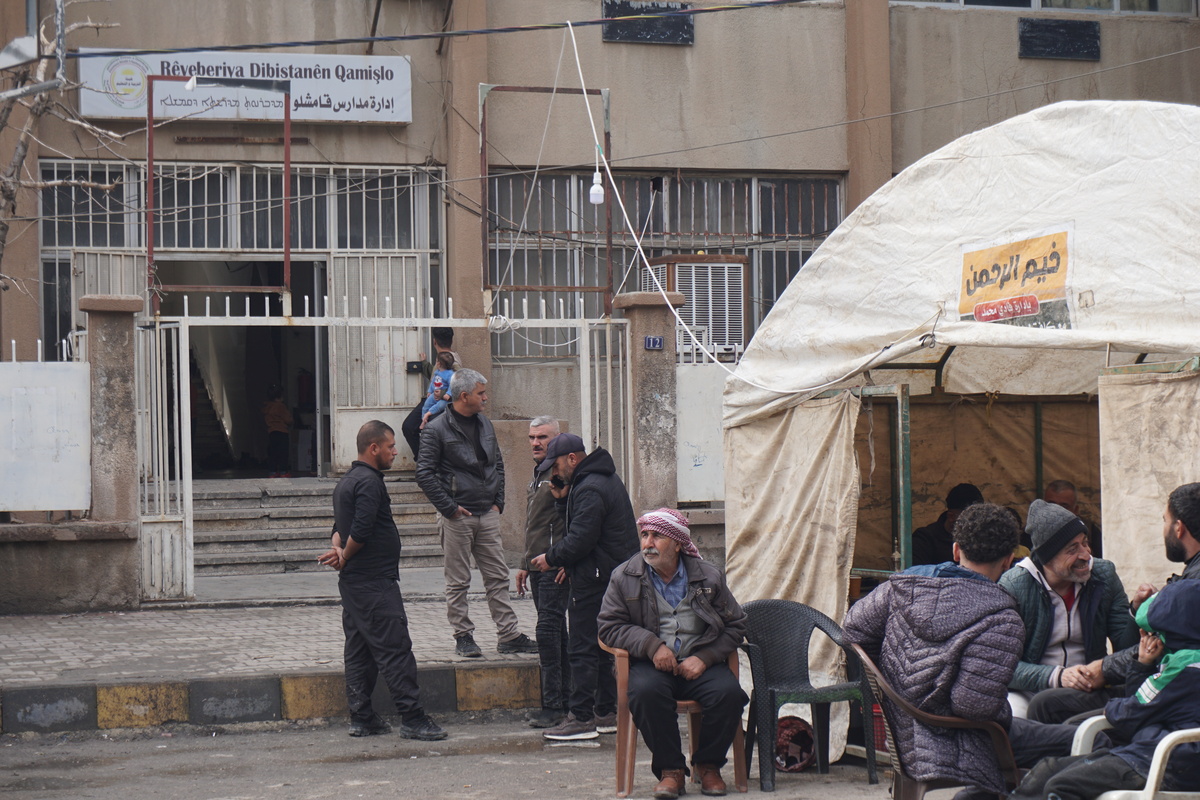
School administration building converted into a shelter for displaced people | Picture Credits: Isabel Krokat
In the heart of Qamishli, directly across from the city library, stands the Reverberiya Dibistanên Qamişlo, the school administration building of the city. Normally, this building would coordinate the daily functioning of schools across the region. Today, however, regular school activities are suspended, and administrative work has largely ceased or been relocated. Instead, like many public buildings across the Jazira Canton, it has been transformed into an emergency shelter for people displaced by ongoing conflict.
Since the escalation of war in northern Syria, more than 170,000 people have been forced to flee their homes. Around 100,000 of them have sought refuge in Qamishli alone. Across the city, almost every available public space – schools, mosques, libraries, and community facilities – has been converted into temporary housing for displaced families.
The building stands on a street lined with other improvised shelters. Here and there tents have been put up along sidewalks and on the street. Residents sit outside on plastic chairs, above them stretches a grey winter sky. This year’s unusually harsh winter in Syria mirrors the atmosphere on the ground: exhaustion, uncertainty, and despair are visible on the faces of people trapped in what feels like an endless cycle of displacement.
“We were forced out of Afrin by Erdogan. We were forced out of Shehba by Erdogan. We were forced out of Tabqa by Erdogan. And now we are here in Qamishli”
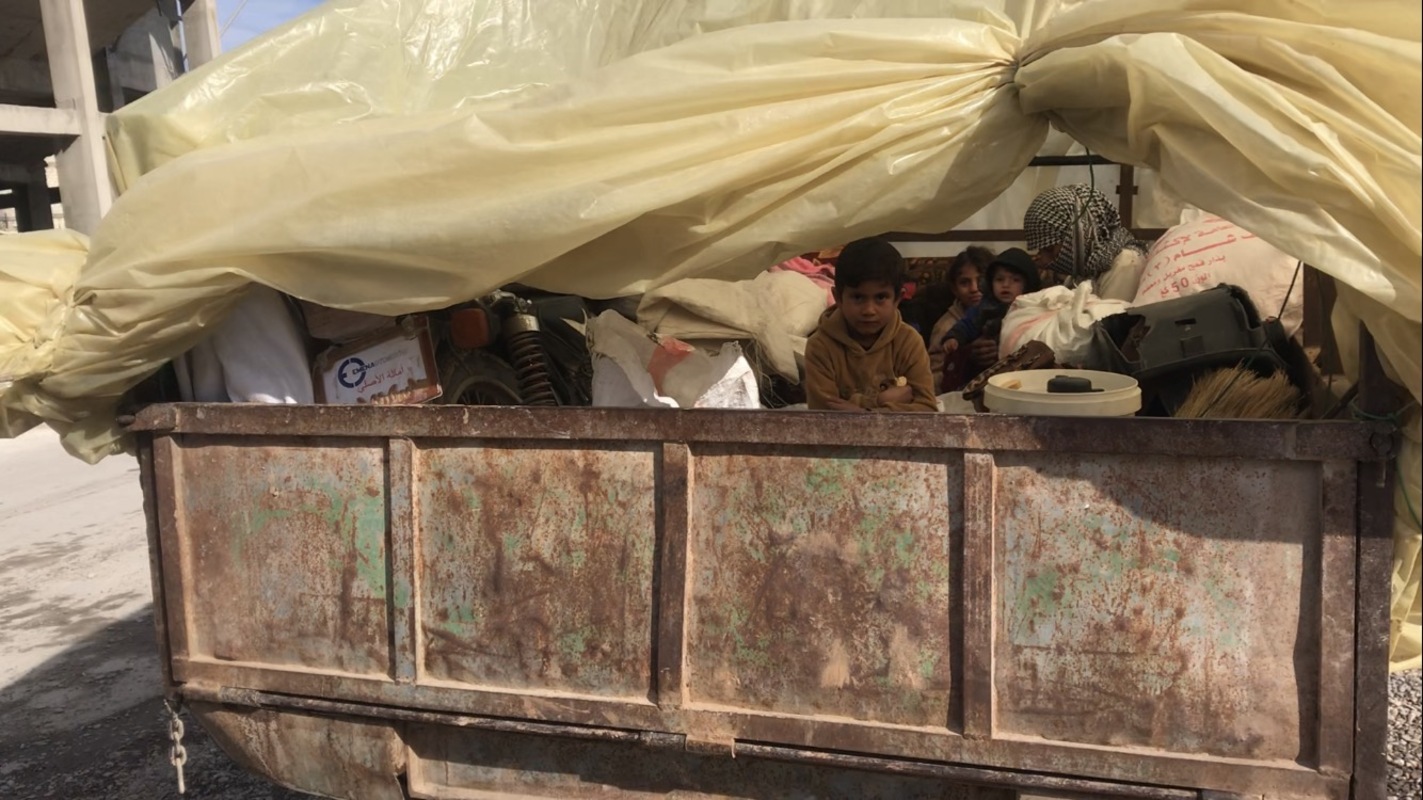
Inside the former school administration building lives 50-year-old Emina Batal. For her, this is already the fourth time she has been forced to flee her home. Like most residents in the building, she comes from Afrin. When Turkish forces and allied Syrian National Army (SNA) factions occupied Afrin in 2018 during Operation Olive Branch, the majority of the Kurdish population was displaced. Since then, many families from Afrin have lived in a constant state of movement, never able to settle permanently. Families have been forced to move repeatedly – from Afrin to Shehba, from Shehba to Aleppo, then to Raqqa, Tabqa, and now to Qamishli.
“We were forced out of Afrin by Erdogan. We were forced out of Shehba by Erdogan. We were forced out of Tabqa by Erdogan. And now we are here in Qamishli,” Emina says. “Everything we had was looted or destroyed. They broke into our houses, smashed the windows, and destroyed our belongings.”
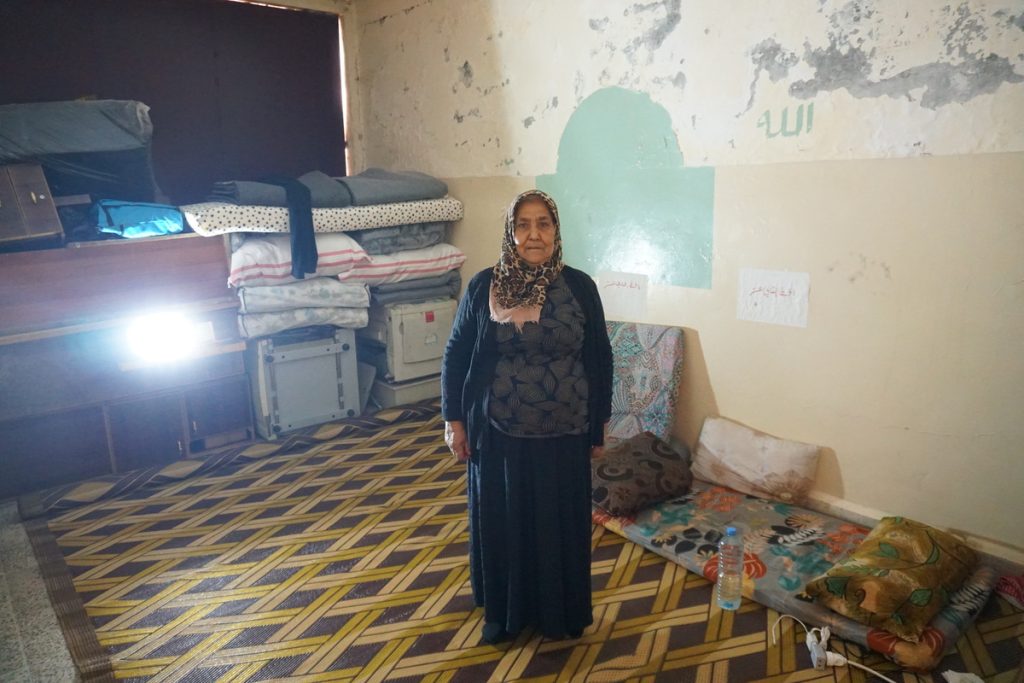
“Before we left, Afrin was good. […] But for five years now, I haven’t even tasted the oil from my own olives.”
Emina’s story is shared by many families in the building. After Turkish-backed Syrian National Army (SNA) forces took control of Afrin, widespread reports emerged of looting, property confiscation, and the forced resettlement of other populations into abandoned Kurdish homes. An estimated 300,000 people were displaced from Afrin following the operation. Since then, many displaced families have been unable to return, while the instability in other parts of Syria has prevented them from establishing a new permanent home.
Despite the immense suffering, memories of Afrin remain vivid and emotional for those who once lived there. “It was beautiful,” Emina recalls. “Before we left, Afrin was good. We had our homes, our land, our gardens. We grew grapes and olives. Afrin has everything. But for five years now, I haven’t even tasted the oil from my own olives.”
Afrin is widely known for its fertile land and vast olive groves, which have historically formed the economic and cultural backbone of the region. For many displaced families, the loss of these lands represents not only economic devastation but also the loss of identity, heritage, and belonging.
“This bond between the people of Afrin and their land exists first and foremost because it is the place of their ancestors. The olive trees were all planted by the hands of the elders and forefathers of Afrin. Furthermore, the livelihood of the people of Afrin depends on the olive season; they sustained their lives through it,” explains Leyla Hisên, a member of the Council of Afrin. She also emphasises the meaning of Afrin’s rich nature and the strong connection to Kurdish culture, that build “this specific bond to the land what allowed the people of Afrin to wage an unparalleled resistance.”
Meanwhile, the humanitarian situation for displaced people in Qamishli and across North and East Syria continues to deteriorate. Winter temperatures regularly fall below freezing, and there have been reports of people dying from cold exposure in overcrowded shelters and camps.
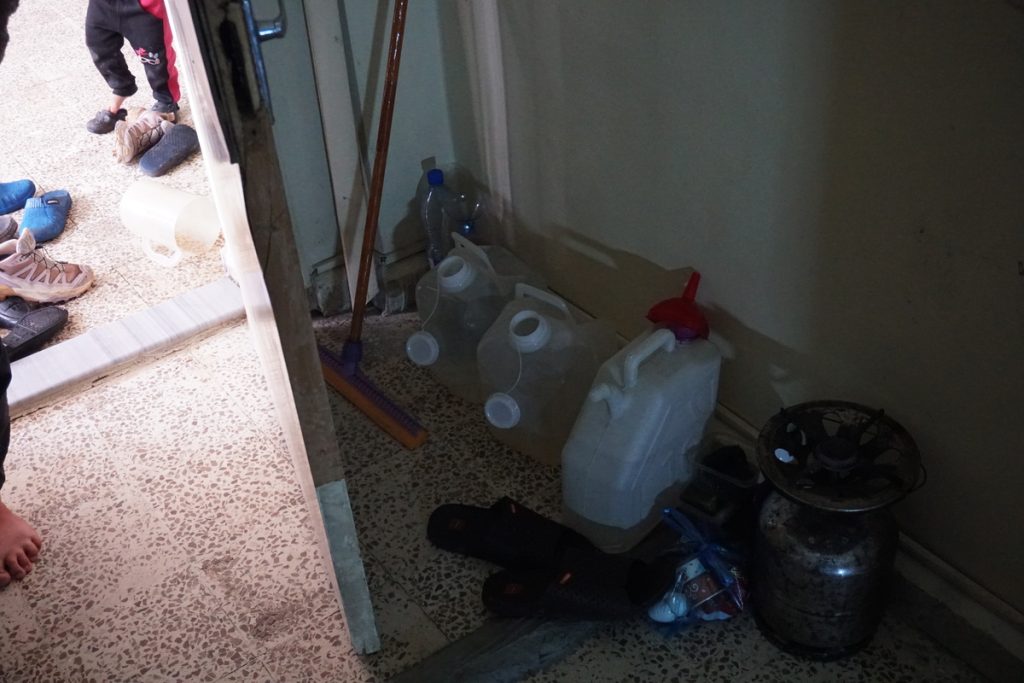
In the building where Emine now lives, basic infrastructure is almost non-existent. There is no functioning shower, electricity is sporadic, and food supplies depend largely on irregular aid deliveries.
“It has been 28 days,” she explains. “In those 28 days, I have only been able to bathe once. It is very difficult.” She points to a corner of the room where three plastic water canisters stand next to a curtain improvised as a divider. “This is our hammam [bathroom],” she says jokingly.
Most children living in this building have not attended school for more than a year since their families fled Shehba.
Emina, a mother of three adult sons, arrived in Qamishli with members of her extended family. Her sons are now scattered across different places. While she worries about all of them, her greatest concern is for the younger generation – the children growing up without stability or education.
“I want my grandchildren to go to school,” she says. “I want them to be educated, to go to university, to become doctors. But Erdogan has deprived them of everything. In the middle of their education, attacks forced schools to close, and the children couldn’t continue learning. Isn’t that a sin? All children should be in school, but there are no schools for them here.”
Most children living in this building have not attended school for more than a year since their families fled Shehba. With thousands of displaced families occupying school buildings across northeast Syria, formal education in many areas has been severely disrupted.
In another room of the same building, a father describes how his family has already been displaced five times.
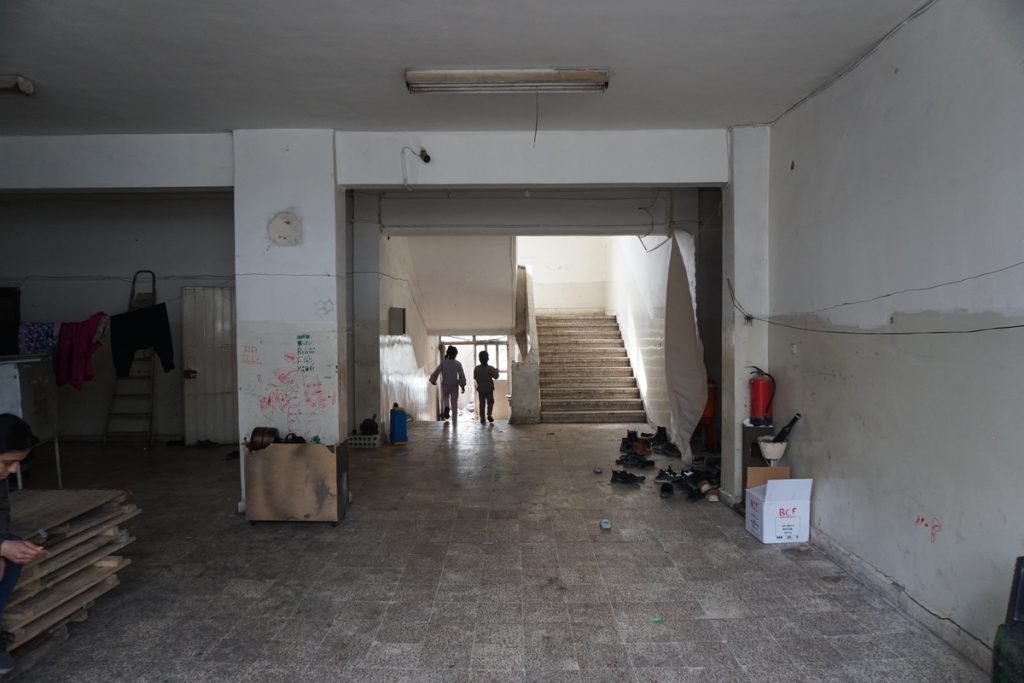
“We are living four or five families together in one tiny room,” he says. “There is no money, no food, and no medicine. As a father, I want to buy even a simple injection or medicine for my sick child, but I have nothing. This poverty and cold are killing us more than the war.”
Yet despite these overwhelming hardships, hope of return remains deeply rooted among many displaced families from Afrin.
When asked whether she believes she will return home, Emina affirms without hesitation. “I just want the road to Afrin to open so we can go back. I don’t care if my house is destroyed — I will go back and rebuild it. We just want to be back on our land and be proud to be Kurds.”
The integration agreement of January 30 stipulated that the return of displaced people to their homes would be guaranteed. However, concrete steps, timelines, and mechanisms for implementing this promise remain unclear, leaving many affected families uncertain about when – or if – they will be able to return.

Isabel Krokat
Isabel Krokat is a freelance journalist whose work focuses on women's rights, the Middle East, and migration. She holds a degree in Arabic and Islamic studies and is currently based in Qamishlo, North and East Syria.