Evren Balta: Trump Is Not an Anomaly, but a Destructive Accelerator
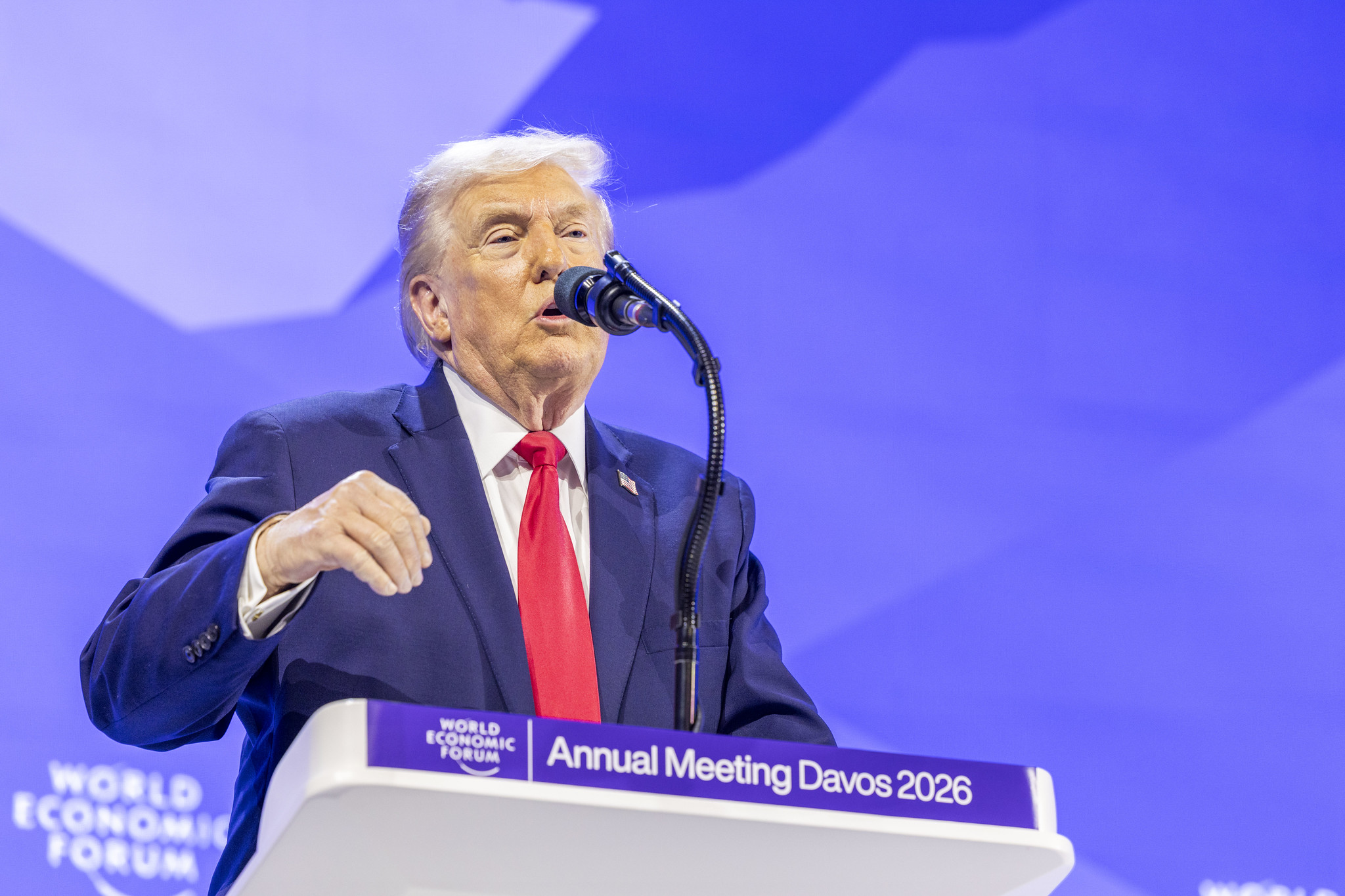
Picture Credits: “World Economic Forum Annual Meeting” by World Economic Forum, CC BY-NC-SA 4.0
This year’s Davos Summit has become a stage showcasing the contradictions between the US and Europe, the disintegration of the Western Alliance, and the destructiveness of Trumpism.
Professor Evren Balta, one of Turkey’s leading political scientists and a 2024-2025 visiting scholar at Harvard University’s Weatherhead Center for International Affairs, says that Trump will intensify his conflict with institutions in the face of the Epstein scandal and try to manage the agenda with other crises.
On the other hand, Professor Balta positions Trump not as an anomaly, but as the accelerating spokesperson of a broad coalition that is pushing the US towards lawlessness in domestic and international relations. Evren Balta analyzes the continuities in US politics, the new coalition of Trump supporters who have transformed deregulation into a power strategy, and the disruptive consequences of this transformation in the Middle East within an analytical framework.
This year at the World Economic Forum in Davos, Trump’s remarks about Greenland dominated the headlines. Looking at the Davos Summit, what kind of future are global elites envisioning?
Looking at Davos, we see a deepening fragmentation in the global imagination. Previously, the global elites who gathered in Davos formed a more homogeneous bloc in terms of their vision of the world. One of the distinguishing features of this year’s Davos was the surfacing of tensions and differing agendas within the Transatlantic Alliance. This tension came to a head with Trump’s second term in office and his desire for Greenland, but the fundamental issue is much deeper.
The different responses of the US and the European Union to the climate crisis, different energy policies, divergences in technological regulations, tensions over tariffs and economic protectionism, differing views on NATO, and disagreements over Ukraine – all these issues are deepening the crisis in the Western Alliance. We were actually expecting a major line of tension between the US and China, but the first year of the Trump administration was marked by tension within the Transatlantic Alliance, and I think the Western Alliance has now dissolved. The 2026 Davos Summit was the culmination of this dissolution.
The belief – that the global system established after World War II would survive despite all the cracks – was abandoned. And the main actors of the established order stated that what is happening is an irreversible break. Trump directed all his criticism towards France, European countries, and NATO. It was also Trump who, in his speech at Davos, said that he found NATO “useless” and “unnecessary” from the perspective of US interests. There is also a serious divergence on energy policies.
The Trump approach positions energy as a tool for geopolitical power and industrial competition. The priority is to increase fossil fuel production, manage energy prices for domestic political purposes, and create foreign policy leverage through oil and gas. This approach relies on slowing down climate goals, loosening regulations, and avoiding short-term cost increases. For the European Union, the same area operates in the opposite direction. For the EU, the priority is to accelerate the energy transition, transform carbon-intensive sectors, and reduce energy dependence. This approach means higher regulation, a longer investment horizon, and restructuring industrial policy around clean technologies. The divergence lies precisely here: while the US sees fossil fuel abundance as a strategic advantage, the European Union defines fossil fuel dependence as a strategic vulnerability.
Why did the Western alliance start operating through direct negotiations rather than through institutions?
Trump wants to use power to achieve direct results, rather than sharing it through institutional commitments. He is saying that he has the military and financial capacity, and he will use this capacity through shorter routes, with fewer intermediaries, and more bilateral negotiations, rather than limiting it with binding rules.
This preference is consistent not only with his foreign policy but also with his desire for less restraint domestically. Trump’s tendency to narrow the scope of checks and balances, such as the legislative and the judicial branches of government, translates into a reflex of not wanting any checks and balances externally either. International agreements, procedures, and institutional oversight are seen as a waste of time and a constraint on action from this perspective.
Is it possible to explain the rift in the Western Alliance solely by Trump’s character and his way of doing politics?
Of course not! First of all, it’s very misleading to think that authoritarian leaders make and implement decisions alone. They always have a set of ideas behind them, that is, an ideology, a voter bloc, a political cadre, and a capital group. This is also true for Trump. However, Trump’s character, his unpredictable personality, masks this broad coalition. It seems as if everything happens “because Trump wants it that way,” but in reality, Trump is implementing the program of a coalition.
So, who is in this coalition?
This coalition includes a very large technology capital sector that wants deregulation and claims that this will ensure US dominance. The coalition also includes powerful energy capital, the major US oil companies. Large financial capital, which demands tax cuts and deregulation in this area, is also part of this coalition. White supremacist, racist ideologues and Evangelicals who glorify the nuclear family and conservatism are also in this coalition. Those who have lost their jobs due to both climate change and deindustrialization are also part of this coalition. Therefore, Trump turns to these unemployed masses and says, “I will bring back industry, I will change energy policies, I will provide cheap oil.” Of course, there is also a large group of think tanks behind this coalition.
This coalition now also has a paramilitary, militia force like ICE (Immigration and Customs Enforcement). Therefore, given such a broad coalition, it would be very misleading to view American foreign policy as solely attributable to Trump himself.
EVEN WITHOUT TRUMP, THE US AGENDA WOULDN’T HAVE CHANGED
Would the political response have been different if a Democratic president had been in Trump’s place?
The tools and tone might have changed partially, but America’s fundamental agenda would have remained the same. Because most of these issues became central to US politics before Trump, with the 2008 crisis. Competition with China, protectionist measures, the return of industrial policy, supply chain security, burden-sharing within NATO, and Europe allocating more resources to its own defense are all issues that have become bipartisan in the US. The only difference during the Biden administration was the form of the response to this agenda.
During the Biden era, the administration prioritized coordination with allies, maintained multilateral language, and tried to manage competition through rules and coalitions. Even during the Biden administration, the US used tough measures against China, such as technology restrictions and industrial incentives. But these were mostly presented as packages aligned with the Western Alliance. Trump’s difference was that he pursued the same agenda in a more radical style, adhering less to institutions and procedures, and centralizing bilateral bargaining, threats, and the pursuit of quick results. This is why the same set of problems leads to sharper breaks under the Trump administration.
AMERICAN SOCIETY’S PROBLEMS ARE BIGGER THAN THE LEADER
But given the structural problems you just mentioned, are you saying that even the end of Trump’s presidency wouldn’t lead to radical changes in US policy?
Yes, with such deep structural problems, Trump’s impeachment or the end of his term wouldn’t create a radical shift in the US’s current trajectory. Only the style of governance, language, and some tools would change, but the fundamental directions would largely remain the same. One of the main reasons for this is the crisis of social cohesion in the US. In the last decade, polarization has ceased to be merely a matter of party preference; it has transformed into a struggle over identity, lifestyle, and legitimacy. The inability to live in the same country and share the same reality has become widespread.
The second reason is the weakness of solidarity mechanisms. Family and local solidarity networks, the welfare state, stable employment, and public services hold societies together. In the US, the scope of this glue has narrowed.
The third reason is the erosion of the legitimacy based on institutions and the rule of law. The greatest damage during the Trump era was to the feeling that “the rules apply equally to everyone.” When this feeling weakens, even election results, court decisions, and bureaucratic processes are no longer considered impartial. When the perception of a common constitutional ground weakens, politics turns into a zero-sum game. This forces every administration to make sharper decisions. In short, Trump was not a cause, but an accelerator. The problems of American society are bigger than the leader.
THE US IS ONE OF THE COUNTRIES EXPERIENCING THE FASTEST AUTHORITARIAN SHIFT IN WORLD HISTORY
Does Trump’s America differ from other authoritarian systems?
To make a proper comparison, it’s necessary to first distinguish the logic of the regime. In examples like Russia and Turkey, leadership operates within a framework called electoral authoritarianism. In such countries, the main task of the government is to manage competition and guarantee re-election. The difference in Trump’s America is that the goal is not to win the next election, but to achieve the broadest possible policy objectives in the shortest possible time. This approach focuses on creating short-term executive capacity rather than long-term regime engineering focused on elections. The reason behind this is that it is more difficult to completely disable institutions and checks and balances in the US. Over a century of institutional continuity, the federal structure, state-level powers, and the scope of the courts make classic “election stealing” tactics more costly and conflict-ridden.
However, today, America, under a government that came to power through elections, is one of the countries experiencing the fastest authoritarian shift in world history.
You just mentioned that the Western Alliance is dissolving, but as we understand it, the US wants to unilaterally withdraw from this alliance. So, what position is Europe taking in the face of the US’s pursuit of this no-rule order? Will the EU be able to maintain its existence based on rules and agreements?
On the one hand, Europe has to maintain its existence based on rules, because a significant part of its global power comes from this. On the other hand, Europe is under pressure to reduce the density of regulations due to concerns about competitiveness within its own borders. Therefore, the likely outcome in the near future is not “the preservation of rules,” but “a shift in the center of gravity of the rules.” This means fewer comprehensive regulations, more targeted oversight, faster permit processes, stronger trade defense instruments, and priorities for domestic production. Of course, at this point, we need to add both the perspective of the far-right parties within Europe and the pressure from the US to “abandon the rules” to the picture. We don’t know how this balance will change in the next election cycle.
From this perspective, can we say that we are actually in a worse situation than in the 1930s and 1940s? Because back then, the US wasn’t pushing Europe towards fascism like it is now…
The 1930s and 1940s were darker in terms of the possibility of a major war and mass destruction. Today, the darkness comes from a different place. What makes today riskier is the multi-layered nature of the crisis. Income and wealth inequality are deep, the middle class’s sense of security is weak, and the costs of housing, food, healthcare, and education are squeezing large segments of the population. This is direct fuel for radical politics. This picture is not a surprise; it is based on years of accumulation.
There is also a problem of balance in the political sphere. The far right has constructed a more disciplined narrative, both nationally and transnationally; its list of enemies and promises of protection are clear. It provides rapid mobilization through borders, security, and identity.
Progressive actors, on the other hand, have in many places been slow to establish a program that would alleviate daily life with the same clarity. When a vacuum is created, anger flows to the side that is easiest to organize. It’s too early to say that we have reached a point of no return, but the danger has changed form.
WHY STATES ARE PARTICIPATING IN TRUMP’S “PEACE COUNCIL” WITHOUT OBJECTION
How do you think the disintegration of the Western Alliance and the shift towards fascism are reflected in the Middle East, and how will they be reflected in the future?
The disintegration within the West is reflected in the Middle East through two channels. The first channel is the diminishing weight of rules and institutions. The second channel is the emergence of bilateral negotiations and agreements between leaders.
If rule-based frameworks weaken, regional issues become more subject to issue-based coalitions and negotiations between leaders [rather than institutions]. This can accelerate peace processes. But simultaneously, it increases fragility. Because the guarantee of agreements becomes not institutions, but the balance of power and the will of the leaders. Trump’s “Peace Council,” which he created at the Davos Summit “to end the Gaza war,” is a typical example.
Trump has appointed himself as the head of this council for life. We are talking about a structure that was created against the United Nations, or rather, one that disregards the values represented by the UN and is dominated by Trumpism, and aims to include authoritarian leaders loyal to Trump. Even after his presidency, Trump will continue to lead this council, which is designed to be beyond state sovereignty and derives its legitimacy not from elections but entirely from his own personality. Trump’s mission in this council is not limited to being the US president. He will be at the head of this council simply because he is Trump. The terrifying point here is that states are joining this council without any objection.
Why are they sitting at the table?
Because the party setting the table has a significant power advantage, and many actors fear that this advantage will be used against them. The Trump administration seized the Venezuelan president in a military operation and brought him to the US. This kind of move, beyond tools like sanctions and tariffs, shows where they see the limits of their power. Therefore, countries like Turkey calculate that staying away from the table will narrow their room for maneuver and that Washington will turn this into a pressure tactic.
However, not everyone is sitting at Trump’s table. This also shows the limits of Trump’s power. When major actors stand together, the cost increases. When the divisions deepen, the question of “who is at the table and who is outside” itself becomes a bargaining chip.
GAZA CEASEFIRE PAVED THE WAY FOR TURKEY-ISRAEL NORMALIZATION
Some argue that Israel was the reason for the negotiations – which have been ongoing in Turkey for a year – between the Turkish government, the PKK, and Abdullah Ocalan. In his speech on July 12, 2025, Recep Tayyip Erdogan spoke of a Turkish, Kurdish, and Arab alliance in this context. However, on January 6, 2026, a security agreement was reached between Israel and Syria under the leadership of the US. It was said that Turkey was also indirectly involved in this agreement. Therefore, can it be said that Turkey, as of January 6, 2026, abandoned the idea of forming a “Turkish, Kurdish, Arab alliance” against Israel and instead opted to proceed with an agreement or understanding between Turkey, Syria, and Israel?
Yes, Erdogan’s rhetoric of a Turkish-Kurdish-Arab alliance, expressed on July 12, 2025, was interpreted as a regional counter-alliance against Israel. The security arrangement between Israel and Syria, brokered by the US on January 6, 2026, and the claim that Turkey was indirectly involved, shifted the focus of this interpretation. From this point on, Turkey’s goal seems to be less about forming a bloc against Israel and more about protecting its own interests within a new security architecture that includes Israel. The most important threshold that made this shift possible was the ceasefire in Gaza at the end of 2025. The ceasefire made Turkey’s contact with Israel more manageable in terms of domestic politics and regional legitimacy costs.
Why?
Maintaining relations while the war in Gaza was ongoing was much more costly due to ideological positions, voter reactions, and regional perceptions. The ceasefire opened the door for “controlled normalization.”
Furthermore, it’s important to note that while the Donald Trump administration sought to reduce the costs of regional issues and transfer responsibility to local partners, actors like Turkey, Saudi Arabia, and Qatar viewed the level of relations with Israel as a kind of litmus test.
Finally, the idea of Syria’s recentralization gained prominence. A Damascus that doesn’t pose a threat to Israel and is more controllable in terms of border security and militia networks became the preferred outcome for the US in this search for a new order. This also aligned with Ankara’s interests. Therefore, a more pragmatic approach emerged along the Turkey-Syria-Israel axis, proceeding with indirect agreements, limiting conflict, and aiming to close the Syrian file. Within this new framework, the Kurdish issue is no longer defined primarily by the “bloc against Israel,” but rather by the future of Syria, border security, and the arrangement on the ground.
THE US, ISRAEL, AND TURKEY ON SYRIA
How do the Kurds pose an obstacle to the US-Israeli project?
The Kurds are not seen as an obstacle solely because they are an ideological impediment to the “Israeli project,” but because they complicate the form of the manageable order that the US wants to establish in Syria. The US aims for an order with a single interlocutor on the ground, capable of making decisions from a single center regarding border security and armed actors. A fragmented structure increases the cost of achieving this goal. Working with a central government is easier than negotiating simultaneously with disconnected regions and different armed groups.
Therefore, Washington’s perspective is shifting towards strengthening Damascus and connecting the field under a single framework, rather than establishing a decentralized, permanent order in Syria. The Kurds’ capacity for autonomous administration and the military weight of the SDF on the ground are precisely what creates tension with this centralization objective.
Jolani (Ahmed al-Sharaa) has only been on Bashar al-Assad’s throne for a year. How did the US become so easily convinced to allow him to consolidate power in Syria and establish a centralized system?
Washington long assumed that federal and quota-based systems produced stability. Over time, the criticism grew that this actually produced constant bargaining crises, veto wars, and vulnerability to external intervention. This criticism may or may not be true, but it reinforced the idea in the minds of decision-makers that “fragmented governance does not produce sustainable stability.”
On the Israeli side, the preference is more ambivalent. On the one hand, a centralized Syria might provide a clearer interlocutor on the border. On the other hand, as the capacity of the central state strengthens, the possibility of a more cohesive military and political rival in the long term also arises. Therefore, Israel’s intuitive preference is often closer to a Syria where internal actors balance each other and no single center can establish complete control. In short, the US, Israel, and Turkey arrived at the same conclusion, a centralized interlocutor in Syria, for different reasons.
THE US COULD SEE KURDS AS A “FUNCTIONAL PARTNER” IN IRAN
The Kurds are an important actor not only in Syria but also in Iran. However, if Turkey has reached an agreement with the US and Israel on a framework that works against the Kurds in Syria, could it make the same agreement for Iran? That is, could Turkey convince these actors to accept a scenario in Iran where the regime is overthrown, but the Kurds don’t gain anything there either?
The fact that Turkey has reached a compromise with the US and Israel in Syria that limits the Kurds’ influence does not automatically mean it can replicate this in Iran. The Iranian file is more difficult than Syria’s because if the regime is shaken, the first result is usually not a strong central authority but fragmentation, the spread of proxy networks, and the formation of de facto autonomous areas in border regions. The Kurds gain bargaining power precisely in these vacuums. In such a scenario, Turkey might try to convince the US and Israel to accept a line of “the regime should be overthrown, but the Kurds shouldn’t gain anything.” But what will determine this is not Ankara’s persuasive capacity.
So, what then?
The balance of power on the ground, the attitudes of actors within Iran, the connections established with Kurdish areas in Iraq and Syria, and Turkey’s capacity to simultaneously manage domestic politics, border security, and the situations in Iraq and Syria will be decisive. Furthermore, if Washington’s priority is not to negate Kurdish gains but to manage Iranian-sourced threats and reduce costs, the Kurds may still be seen as “functional partners” in some areas. Establishing an order in which the Kurds gain nothing if the central government in Iran collapses would require controlling numerous actors simultaneously amidst high uncertainty, not just a negotiated settlement like in Syria. How possible is this? I don’t know. But there is another way.
TURKEY HAS FALLEN BEHIND IRAQ, SYRIA, AND EVEN IRAN ON KURDISH RIGHTS
What is that path?
To resolve the Kurdish issue peacefully and democratically and integrate it into Turkey’s internal order. Because even if international actors today want to push the Kurdish issue back under the control of central governments, there is no return to the pre-1990 situation, especially in terms of identity recognition and cultural rights. Therefore, Iraq can no longer be Saddam Hussein’s Iraq, and Syria cannot function like Assad’s old Syria. Despite this regional reality, Turkey cannot impose the pre-1990 order on the Kurds. Moreover, there are areas where Turkey lags behind Iraq, Syria, and even Iran in terms of rights and recognition. The largest Kurdish population is also in Turkey. Therefore, the sustainable strategy for Turkey is not to seek to “zero out Kurdish gains” abroad, but rather to establish a line of normalization domestically through democratic means, balancing rights, representation, and security.
So, could Turkey oppose a US and Israeli intervention against Iran because of the possibility of the Kurds gaining ground?
The reason Turkey is currently openly and loudly telling the US that “the disintegration of Iran is against our regional interests” is precisely the Kurdish issue. This is also the reason for Turkey’s efforts to strengthen the central government in Syria. Turkey also supports the strengthening of the central state in Iraq. Indeed, Turkey reacted strongly to the Kurdish independence referendum in Iraq in 2017, supporting Baghdad’s takeover of Kirkuk, border crossings, and airports under the control of the Iraqi Kurdistan Regional Government, and the transfer of oil revenues to the central government. However, despite all this, as I mentioned earlier, Turkey lags far behind Iran, Iraq, and Syria in terms of Kurdish rights. If Turkey wants to position itself as a founding actor in the regional equation, it cannot continue in this way.

İrfan Aktan
İrfan Aktan was born in Hakkari-Yüksekova. He graduated from the Journalism Department of the Faculty of Communication at Ankara University in 2000 and completed his Master’s Degree in the Women’s Studies Center at Ankara University. He worked as journalist for Bianet, BirGün newspaper, Express, Nokta, Yeni Aktüel, and Newsweek-Türkiye magazines, Gazete Duvar, Artı Gerçek and IMC TV. His books include Nazê/Bir ‘Göçüş’ Öyküsü, Zehir ve Panzehir: Kürt Sorunu and Karihōmen: Japonya’da Kürt Olmak.
![[The Amargi Exclusive] Investigating the Syrian Army’s Abuses](https://cms.theamargi.com/wp-content/uploads/2026/02/AFP__20260118__934D2KE__v1__MidRes__SyriaConflictKurds.jpg)