Damascus and Qamishlo: A Deal on Paper, a Conflict on the Ground
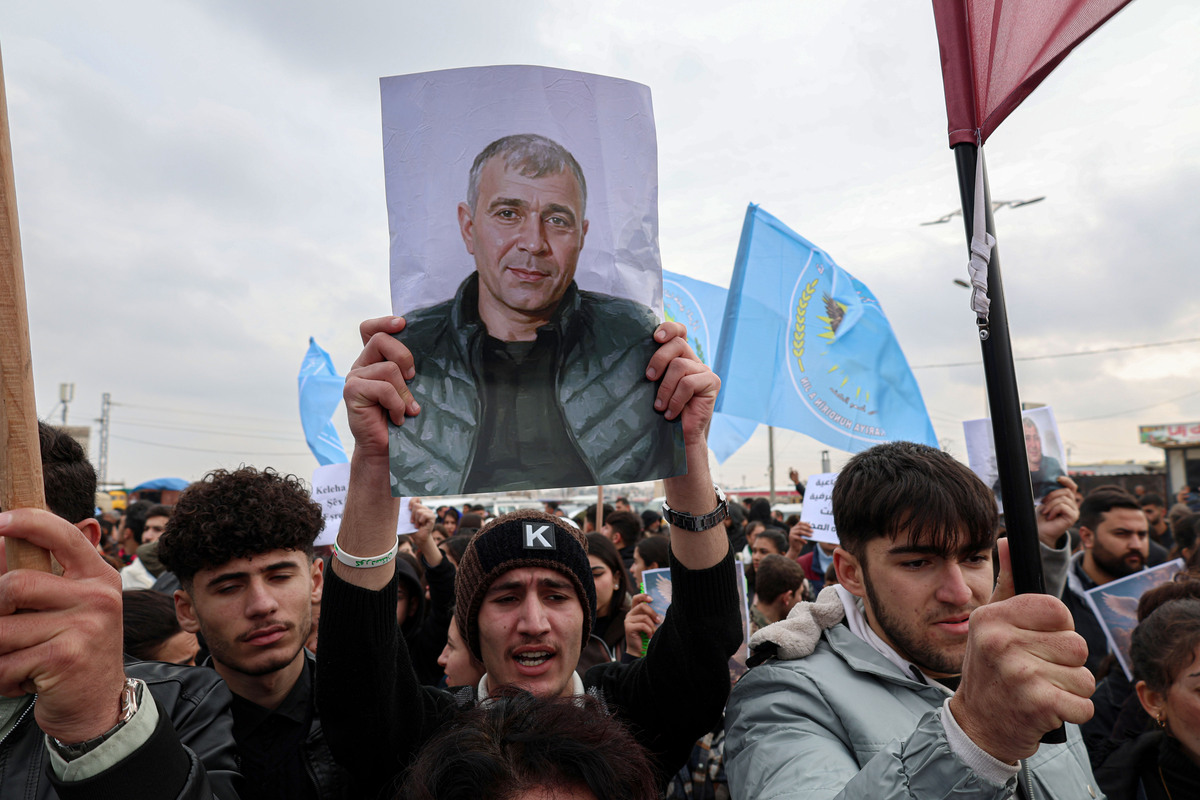
A boy holding the picture of Ziyad Heleb, commander of Asayish forces, killed during the attacks in Aleppo at a demonstration in Qamishlo condemning violence against Kurds and international silence | Picture Credits: Abbas Abbas
In mid-March 2025, a US military helicopter took off from the Syrian capital, Damascus, carrying the Syrian Democratic Forces (SDF) Commander-in-Chief, Mazloum Abdi. Also on board was a document unprecedented in the modern history of Syrian Kurds.
Yet, as is often the case in Syria, the challenge had never been the signing of agreements but their implementation.
Although the document did not constitutionally recognize Kurdish identity, it marked the first official acknowledgment—signed by a Syrian president—of the existence of Kurds in Syria since the country’s establishment in 1920. Symbolically and politically, it represented a historic break with a century-long policy of denial.
The agreement, signed at the People’s Palace of Syria, by its transitional President, Ahmad al-Sharaa, and Abdi, dominated media coverage at the time. Yet, as is often the case in Syria, the challenge had never been the signing of agreements but their implementation.
Far from the palace where the agreement was concluded, Syria witnessed two simultaneous confrontations. The first erupted along the Syrian coast, where remnants of the Assad regime launched attacks against al-Sharaa’s forces. These clashes later evolved into military operations that targeted Alawite civilians, leaving hundreds dead and raising serious concerns about collective punishment and sectarian violence.
The second confrontation took place near the Tishreen Dam, close to Kobani, when the Turkish-backed Syrian National Army attempted to advance into areas controlled by the SDF but failed. In this context, the March 10 agreement served both sides: it helped Damascus contain political fallout from the coastal violence, while obliging the government to curb further attacks by Turkish-backed factions against SDF-held areas.
Months later, the optimism that followed the agreement has largely evaporated. This is especially evident after the clashes in Sheikh Maqsoud, a predominantly Kurdish neighborhood in Aleppo, the forced displacement of Kurdish residents from other areas, documented violations, and the growing loss of life.
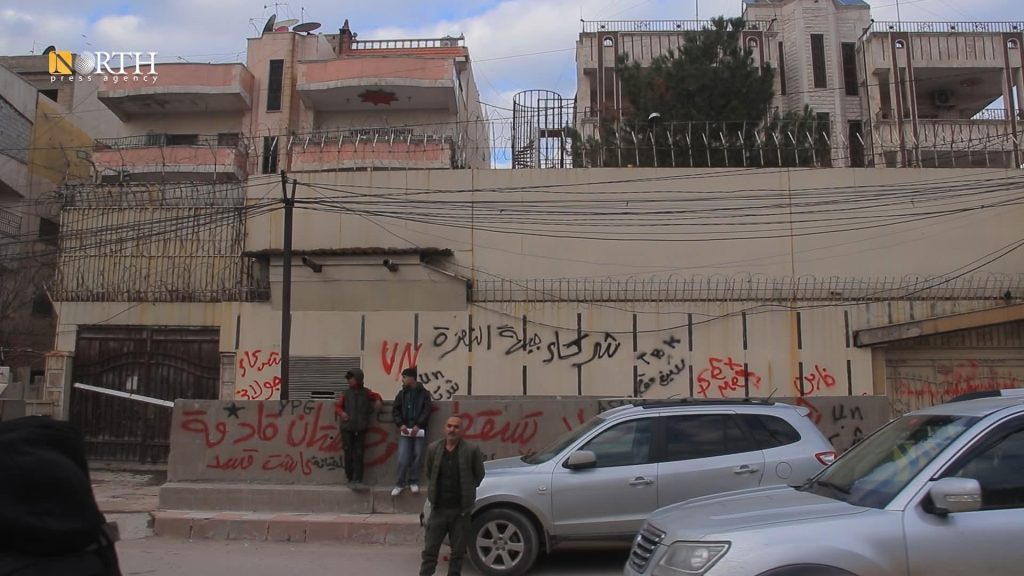
As this article is being written, angry Kurdish youths are protesting in front of the United Nations office in Qamishlo, a predominantly Kurdish city in northeastern Syria. One of the slogans written on the wall of the building reads: “Partners of al-Nusra Front,” referring to the former name of Hay’at Tahrir al-Sham (HTS), expressing their anger at what they see as international silence toward the events in Aleppo.
Shortly before the escalation in Aleppo’s Kurdish neighborhoods, Syrian officials met with an Israeli delegation in Paris. For the first time, both sides issued a joint statement affirming Israel’s continued influence in southern Syria and on Mount Hermon overlooking Damascus, as well as the demilitarization of southern Syria. Turkish Foreign Minister Hakan Fidan later joined the talks.
The outcome appears to reflect a broader regional trade-off. Ankara seems to have received a tacit green light to push Kurdish forces out of Aleppo in exchange for Israeli gains in southern Syria. Aleppo, Syria’s economic hub, is central to Turkey’s strategic vision in the country. This arrangement may explain the muted reaction of Washington, Tel Aviv, Paris, and London to what unfolded in the city. As shelling intensified in the Sheikh Maqsood neighborhood, European Commission President Ursula von der Leyen and European Council President António Costa paid a visit to the area. During the visit, the European Union announced a €620 million ($720 million) financial aid package for Syria.
This reality raises a critical question: Is Syria heading toward a major military confrontation between Damascus and the SDF, and the collapse of the March 10 agreement?
Significantly, the SDF refrained from participating in the clashes in Sheikh Maqsoud, despite public pressure and widespread Kurdish anger
Despite escalating anti-Kurdish rhetoric and repeated threats against the SDF, a full-scale war appears unlikely in the near term. Economically, renewed conflict in northeastern Syria would undermine al-Sharaa’s efforts to attract foreign investment. Few investors are willing to commit capital to a country sliding back into open war.
Strategically, a confrontation with the SDF would disrupt international efforts to combat ISIS and threaten the security of more than 10,000 jihadist detainees held in 27 detention facilities across northeastern Syria. Washington is unlikely to accept such risks, particularly after recent ISIS attacks near Palmyra and subsequent US military strikes.
Significantly, the SDF refrained from participating in the clashes in Sheikh Maqsoud, despite public pressure and widespread Kurdish anger following reports of arrests, abuses, and loss of contact with several families. This decision reflects a strategic calculation: Ankara sought to drag the SDF into the Aleppo battle, thereby undermining the March 10 agreement and portraying the SDF as an armed group outside the Syrian state—an outcome that would legitimize a broader war against it.
A key question now revolves around the future of communication between Damascus and Qamishlo in the aftermath of the Aleppo developments. Statements from officials in northeastern Syria suggest a continued commitment to the March 10 agreement, as well as to the understandings reached during the October 7 meeting. These include plans to restructure the Syrian Democratic Forces into three divisions and three specialized brigades: the Women’s Protection Units, Counterterrorism Forces, and Border Guards.
According to the report, the two sides were close to finalizing a military integration agreement before Foreign Minister Asaad al-Shaibani entered the meeting and abruptly ended it
Ilham Ahmed, head of foreign relations for the Autonomous Administration, reaffirmed this position in remarks to AFP, stressing her administration’s adherence to the March 10 agreement. At the same time, Al-Monitor reported a positive atmosphere during the latest round of talks between the SDF’s military delegation and Syria’s ministers of defense, intelligence, and interior. According to the report, the two sides were close to finalizing a military integration agreement before Foreign Minister Asaad al-Shaibani entered the meeting and abruptly ended it, postponing the signing.
Damascus has yet to officially declare its position on the future of the agreement. However, given the hostile media campaign against the SDF during the Aleppo clashes, a formal withdrawal would likely have been announced if that were the intention. Instead, Damascus appears constrained by its commitments.
These dynamics have renewed the significance of international mediation, particularly by the United States, which serves as the guarantor of the March 10 agreement, with France and the United Kingdom playing supporting roles. US Special Envoy Tom Barrack and US Central Command Commander Admiral Brad Cooper continue to closely follow developments on the ground and work to narrow the gaps between Damascus and Qamishlo.
At the core of the disagreement lies the question of Syria’s future system of governance. Damascus remains committed to a centralized state, allowing only limited flexibility in the authority of local governors. Qamishlo, by contrast, continues to advocate for political decentralization, the constitutional recognition of the rights of Kurdish and other communities, and guarantees for the formation of an inclusive government.
The upcoming round of negotiations will be a turning point in relations between Damascus and Qamishlo, with repercussions extending beyond Syria to affect the peace process in Turkey and the evolving relationship between Damascus and Erbil—highlighting that the Kurdish fate is ultimately shared, despite differences in place.

Hoshang Hassan
Hoshang Hasan is a Kurdish journalist based in Qamishlo. He has been covering the war in Syria since its outbreak, reporting extensively on battles in predominantly Kurdish areas and conflicts against ISIS. He currently works for North Press Agency and has contributed numerous reports and visual features to Kurdish and Arab media outlets.