About the “Right to Kill” in the Middle East
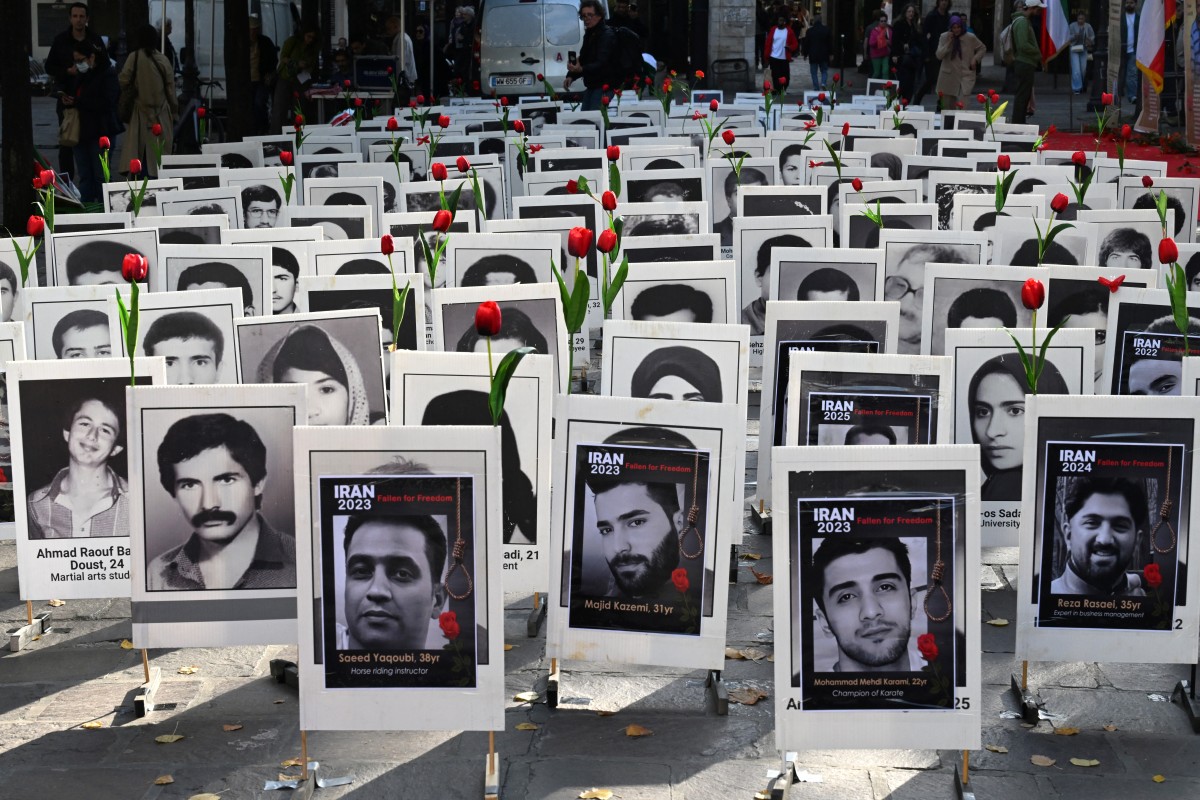
This photograph shows portrait placards of people executed by the government of Islamic Republic of Iran, displayed during a demonstration by Franco-Iranian associations, in central Paris on October 11, 2025. (Photo by Martin LELIEVRE / AFP)
This article was translated into English by Renwar Najm
One of the greatest achievements of Western civilization, which has been practiced in a very limited way, is the withdrawal of the state’s Right to kill. Admittedly, this right only covers those cases that come before the court and are decided through a legal process, leaving out the many crimes wherein armies kill thousands of civilians without accountability. Nevertheless, the existence of such a law, even at a limited level, is still worthy of praise. The question is: do state structures in the Middle East allow for such a thing, and could one seriously think about a Middle Eastern state relinquishing its right to kill? Or, more precisely, who in the Middle East is opposed to tabling this question and bringing it into mainstream discussions?
The discourse on the death penalty in Western Philosophy indicates that legal and philosophical questions about the Right to kill preceded political ones. Since the Enlightenment and especially from Immanuel Kant, the question, “Does the state have the right, in the punishment of killing, to become a killer itself and kill the criminal?” has been central, and continues to be fiercely debated to this day. The current widespread awareness of the “sanctity of life” is partly the product of that dialogue. Of course, different philosophers give different answers to this question, since the answer is tied to a series of other views about “human” and “state.” That is, from the greatest defenders of the death penalty, such as those in classical philosophy such as Kant and Hegel who considered the death penalty legitimate to the greatest modern opponents of this penalty, such as Albert Camus and Jacques Derrida, the arguments have always been philosophical, rational, and universal arguments, without political emotion directly playing a role in shaping the arguments. The question of the “right to kill” is a philosophical, legal, and ethical question, not a pure political question.
In the Middle East, however, those who defend a type of state that has monopolized the Right to kill in addition to the Right to use violence, use exclusively political arguments
In the Middle East, however, those who defend a type of state that has monopolized the Right to kill in addition to the Right to use violence, use exclusively political arguments. These arguments are along the lines of ‘protecting the homeland, ’ ‘cutting off the hand of the foreigner,’ ’eliminating the enemies of God,’ ’punishing traitors and sellouts,’ and ’intimidating enemies.’”
Does this difference have a religious root?
In Christianity, punishment is, to some extent, intended to bring about justice and equality. In the Old Testament, we read: “Life for life, eye for eye, tooth for tooth, hand for hand, foot for foot, burning for burning, wound for wound, stripe for stripe.” (Exodus 21:23-25).
But in Islam, punishment and killing have much more to do with punishing others for a lack of belief, for having a different religion, and for carrying a different identity than with bringing about justice. In Surah At-Tawbah, we read: “Fight those who do not believe in Allah or in the Last Day and who do not consider unlawful what Allah and His Messenger have made unlawful.” Similarly, in Surah Al Imran, it’s stated: “And whoever desires other than Islam as religion – never will it be accepted from him…” In Surah Muhammad, in the same way: “So when you meet those who disbelieve [in battle], strike [their] necks.”
The rational Western view of the death penalty is clearly embodied in Hegel’s perspective. In Hegel’s view, punishment is the restoration and affirmation of what is right. In Elements of the Philosophy of Right, Hegel devotes several important paragraphs of the book to formulating a rational justification for the death penalty. From Hegel’s perspective, punishing deeply expresses respect, as if we were saying to the criminal: we do not regard you as mad or as an animal; we regard you as a conscious human being who bears accountability. You are a human being responsible for your actions, and thus it is necessary that you accept the consequences of your own deed. For Hegel, killing is the negation of the other’s right to life; the death penalty is “the negation of the negation.” Hegel, in his thesis, considers the death penalty only in response to the crime of murdering someone as just, but he does not speak of it in other situations and cases. For Hegel, killing is not regarded as retribution or eye for an eye, as in Christianity, nor does it have a connection to religion or to the identity of the other; rather, it is a legal situation grounded in recognizing the human as a rational being. The concept of equality plays an important role here; only the death penalty can be a true punishment opposite a crime like murder and be equal to the magnitude of the crime.
I can say that many contemporary defenders of the death penalty still move within the orbit of Hegel’s arguments. One of the staunchest supporters of the death penalty is the contemporary American philosopher Robert Blecker, a professor at a New York law school. He considers the death penalty the only way to maintain “moral balance.” In his belief, “some must not live,” meaning a specific type of criminal: people who have participated in serial killing, torture, and genocide. Blecker believes the death penalty must exist, but it must be used in very specific cases. He also regards opposition to the death penalty as a kind of moral weakness in contemporary societies.
On the other side, we have some very radical opponents of the death penalty, with Camus and Derrida being the most prominent. Jacques Derrida traces the state’s use of killing and the death penalty back to a deeper root. In a profound critique of much of the Western philosophy before him that grants the Right to kill to the state and provides justifications for it, he believes that the desire to kill has neither connection to ’defending society itself’, as Jean-Jacques Rousseau puts it, nor is it respectful toward the punished person byregarding him as a conscious individual, as in Hegel’s view. Rather, it is to reveal the state’s desire to demonstrate its power over life and death. In Derrida’s belief, the death penalty is a structural desire within the state, so that it behaves directly as a substitute for God. Derrida does not even accept the view of someone like Cesare Beccaria, who is one of the staunchest opponents of the death penalty. Derrida looks at it from the perspective that the question is not whether the death penalty is good or bad, beneficial or useless, but rather that this punishment must be rejected without any evidence or excuse; merely asking “Does the state have the right to kill someone?” is a sign that we are still in doubt. The rejection of the death penalty by the state, for Derrida, must admit no doubt or hesitation.
As if a large part of the problems of the Middle East did not come from the fact that weapons were only in the hands of the state.
Here, my effort is not to discuss those debates that take place in the West regarding the issue of the state and the right to kill, but rather to raise a question about this situation in the Middle East. For some time, the slogan “weapons only in the hands of the state” has been put forward, as if it were regarded as an unarguable positive need. As if a large part of the problems of the Middle East did not come from the fact that weapons were only in the hands of the state. Those who view the problem through this logic regard the state as a universal form, thereby committing a grave error by likening the Middle-Eastern state to the structure, history, and infrastructure of the Western state.
If we look back over the past fifty years, we encounter a set of powerful Central and Middle-Eastern European states in which, in most cases, weapons were held exclusively by the state. The regime of Saddam Hussein, the regime of Bashar al-Assad, the military state of Turkey, and the religious state of Iran: these four gigantic Middle-Eastern states were examples of totalitarian fascist states, in which the structure and existence of the state were designed on the basis of monopolizing the right to kill. Killing became the state’s instrument for proving itself. Killing was not connected to establishing justice or fairness, but rather to the state’s self-realization. If the state were not to kill and not have absolute power over life, it could not regard itself as a true state. In the Middle East, contrary to the views of many Western philosophers toward the state, the state is not an extension of society, is not the product of a collective agreement, is not founded on a “social contract” that is clear and written, but rather is an extension of God and behaves as God’s representative. The only apparatus that has developed in these states is that of surveillance, punishment, and killing. The justifications for punishment and killing that Hegel provides are completely reversed in the Middle East. In the depth of Hegel’s thesis, when we kill someone for murdering another, it is to prove that the value of lives is equal, but in the Middle-East, punishment and genocide and mass killing were to tell the state’s enemies that it does not place them on the level of humans, to prove that the powerful and the powerless are not on the same level. Killing here is not for the defense or protection of society, but solely to demonstrate the state’s power and unlimited capacity. Derrida’s view of the state as an heir and substitute for God is evident in contemporary Middle Eastern states.
This does not mean that I say let weapons be in everyone’s hands; on the contrary, it is a call to design a clear mechanism for withdrawing the right to kill from everyone, above all from the state itself.
Today, in Syria and Iraq, the state is undergoing a process of restructuring and refoundation. The main slogan that we constantly hear in this process is that “weapons must be only in the hands of the state,” a rhetoric that, although some bring it forward with the intention of stability and establishing peace, is a rhetoric that has not observed the true nature of the state in the Middle East. The history of the past hundred years of the Middle East proves to us that the phrase “weapons only in the hands of the state” is a terrifying strategy that recreates a fascist central state. This does not mean that I say let weapons be in everyone’s hands; on the contrary, it is a call to design a clear mechanism for withdrawing the right to kill from everyone, above all from the state itself. A state whose powers are not clearly defined will repeat the history of Saddam Hussein’s state and Bashar Assad’s. What is needed before anything else is to talk about a social contract in which the right to kill is withdrawn even from the state.
Those who often support a central and strong state that monopolizes the right to use violence for the state have not understood the fact that the most terrifying weapon in the Middle East is the one in the hands of the state, and the most terrifying types of violence are those that come from the state. Viewing the Middle-Eastern state with the standards of the Western state is a terrifying misunderstanding in the Middle-East; in reality, true control of violence begins with withdrawing the Right to kill from the state. The Middle-Eastern states so far have all been sectarian, nationalist, and religious states; without a true and radical democratization of the state’s institutions, the army and weapons remain terrifying tools of repression in the hands of one sect and one ethnicity to exterminate the others. The true dialogue that brings calm to the Middle-East is not to ask “whose hands are the weapons in,” but to insist that withdrawing the right to kill from the state must be the main point of any dialogue that wants to bring democracy and peace to the Middle-East. Without moving this dialogue from the superficial, extremist, and emotion-filled political level to an ethical and philosophical question, it is difficult for us in the Middle East to confront this problem calmly, without war and without fanaticism. Political necessity always demands that the parties stand face to face with weapons in hand; only ethical and intellectual necessity can make people put down their weapons and speak with each other in another way.
Notes
- For more information about Hegel’s view on the death penalty, see Hegel. Principles of the Philosophy of Right. Translation: Imam Abdul Fattah Imam. Dar al-Tanwir. 3rd edition. Beirut. 2017. pp. 197 – pp. 204. You may also read the later appendix section in which Hegel responds to Beccaria.
- For information on the views of Robert Blecker, see his interview with the Standard newspaper. Der Standard. 28. September 2011. Robert Blecker “Moralische Pflicht zu töten”.
- For Derrida’s views on the right to kill and its monopolization by the state, refer to the second volume of the seminars on the death penalty, after page 200, Derrida, Jacques. Die Todesstrafe II. Seminar 2000-2001. Passagen Verlag-2023.

Bachtyar Ali
Bachtyar Ali, a leading novelist, poet, and essayist, is celebrated as one of the most influential contemporary Kurdish authors. Best known internationally for The Last Pomegranate Tree, he has published over 40 works of fiction, poetry, and criticism, including 12 novels. His writings have been translated into numerous languages, from Arabic and Persian to German, Italian, and English. In 2017, he became the first author writing in a non-European language to win the prestigious Nelly Sachs Prize.