Weapons, Steel, Oil: How Turkey Continues to Fuel Israel’s War Machine
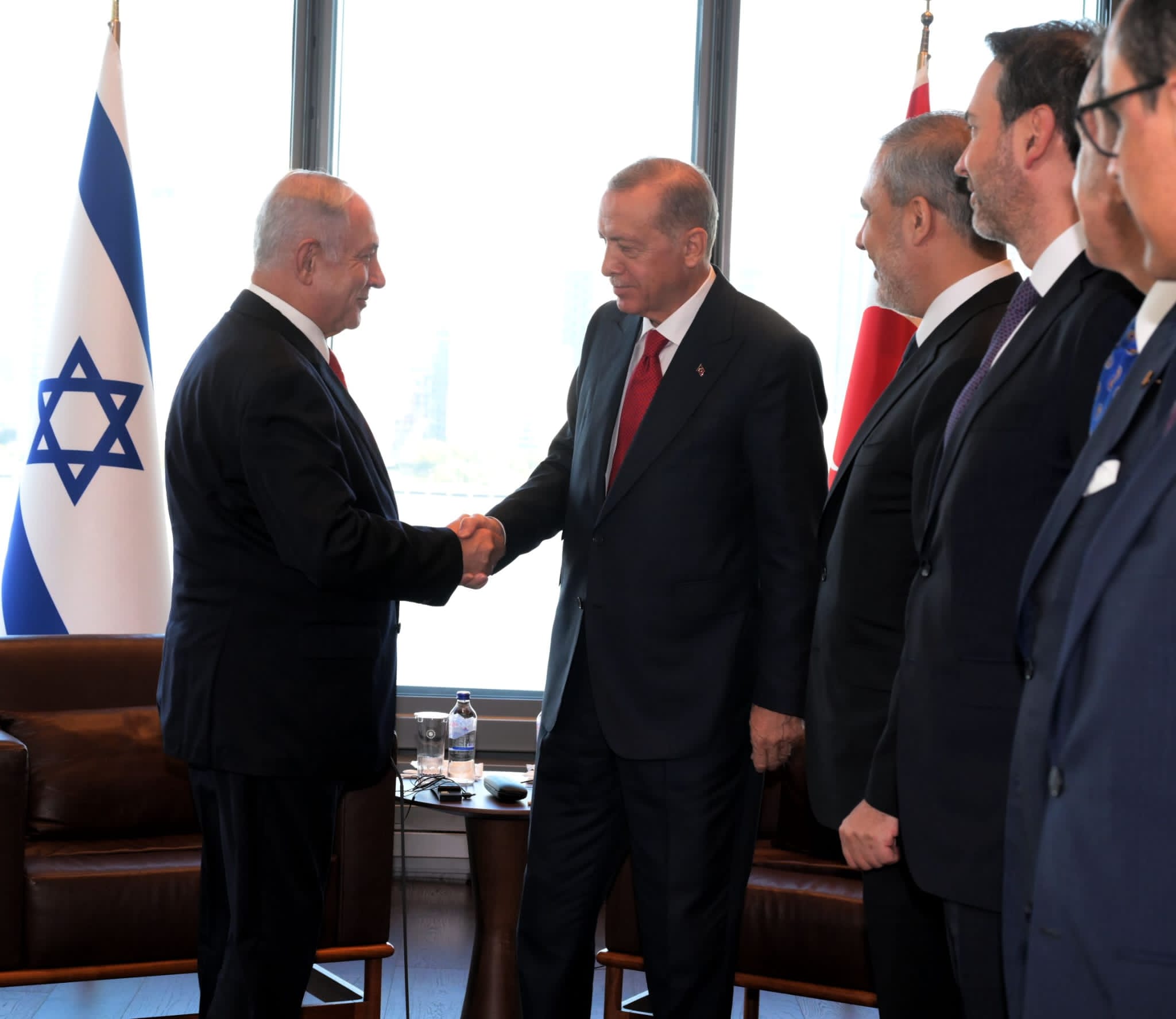
Prime Minister Benjamin Netanyahu (Tuesday, 19 September 2023), at Turkish House in New York, met with Turkish President Recep Tayyip Erdogan. Photo credit: Israeli Government website.
By William Duppel Alonso & Lucie Charbonneau
Writing from the West Bank in May 2024, journalist Amberin Zaman reported that effigies of Turkish President Recep Tayyip Erdoğan were coming down across Palestine. Throughout the 2010s, the Turkish leader had commanded great admiration for his diatribes against Israel, but Israel’s war on Gaza has poked holes in Erdoğan’s paper-thin veneer as a defender of Palestine.
Despite the theatrics, Turkey has remained crucial in abetting Israel’s war, which by November 2025 had killed over 70,000 Palestinians, though the real death toll may exceed that number. In May 2024, Ankara announced it had suspended all trade with Israel. Yet, over the past two years, Turkey has fed Israel’s arms industry with steel, its planes and tanks with fuel, and its army with weapons and explosives.
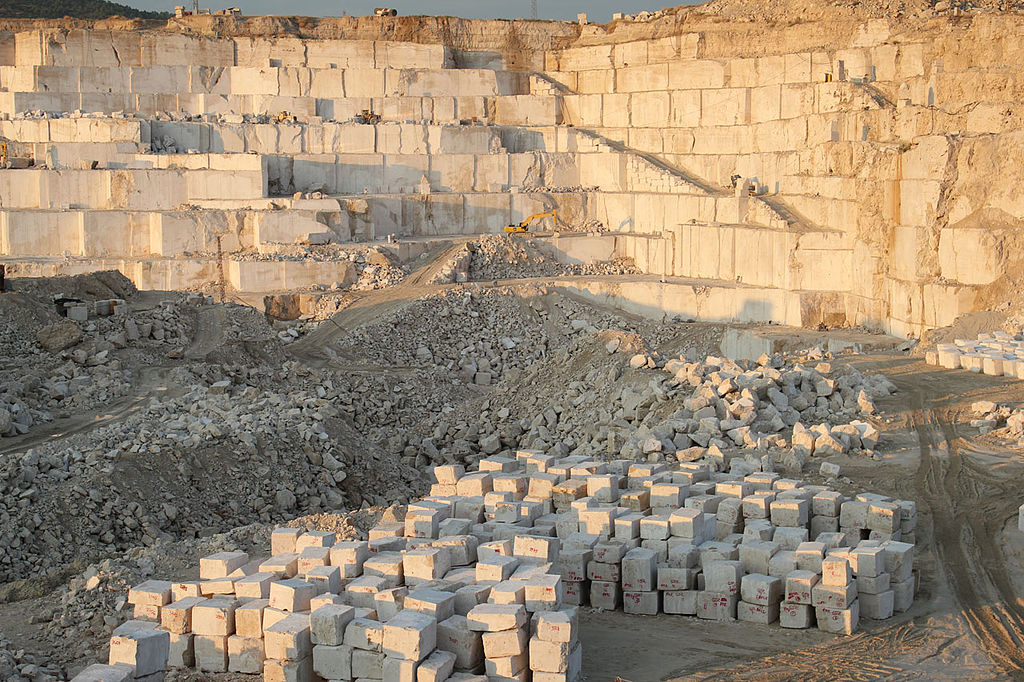
Turkey remains a key source of steel for Israel’s industrial sector, including its arms industry, providing over 80% of the necessary imports in 2022 and two-thirds in 2023. In 2022, Turkey exported $757 million worth of the stuff to Israel.
“Turkey has also continued operating as a stopover for weapons shipments to Israel. Pro-Palestinian groups have accused the Turkish government of letting ships carrying arms to Israel dock in its ports while it turned away at least two Gaza-bound ships carrying aid.”
Our analysis of Turkey’s exports submitted to the United Nations’ Comtrade database, which collates global trade data, reveals that in 2022 exports for “iron and steel” were valued at $1.19 billion. In 2023, these exports dropped to $716 million; still, in 2024, $92 million worth of iron and steel was exported to Israel. According to Israel’s import statistics, however, it bought $226.5 million worth of Turkish iron and steel in 2024, of which 41% was acquired after the May ban. Between January and September 2025, it bought $171.1 million worth of iron and steel. A Turkish opposition politician quipped that “Turkey sends the barbed wire surrounding al-Aqsa Mosque [in occupied East Jerusalem].”
Between 2000 and 2019, Turkey was Israel’s third-largest customer for weapons and other security products despite bilateral relations briefly souring in 2010. Turkey has used Israeli Heron drones purchased in 2005 and M60T tanks bought in 2002 to attack Kurds in Iraq and Syria, respectively.
Weapon purchases peaked in 2009, when Turkey became the Israeli weapons industry’s top client, buying $320 million worth of goods. Between October 2023 and April 2024, we found Turkish weapons exports to Israel worth over $608,000, consisting of firearms and parts thereof. According to Israel’s import data, Tel Aviv imported around $868,000 worth of weapons between October 2023 and September 2025. Turkey also recorded shipments of $436,000 worth of explosives to Israel, which can have civilian or military use, between October 2023 and April 2024. Israel’s import data, however, gives a more complete picture: between October 2023 and September 2025, Israel imported $877,000 worth of explosives from Turkey — over half of which was delivered after May 2024. Moreover, Otokar, an armored vehicle builder owned by the Turkish Koç conglomerate, has continued its partnership with Rafael Advanced Defense Systems, while the Turkish carmaker BMC Otomotiv has continued to partner with Carmor (Hatehof), an Israeli manufacturer.
“Relatedly, exports to the West Bank in Palestine surged 1,180% year-on-year in July 2024. According to Cihan, Israel-bound goods are now marked as destined for Palestine, and a select few Palestinian companies receive a 3-5% commission so that the trade can go on uninterrupted.”
Turkey has also continued operating as a stopover for weapons shipments to Israel. Pro-Palestinian groups have accused the Turkish government of letting ships carrying arms to Israel dock in its ports while it turned away at least two Gaza-bound ships carrying aid. Turkish activists stormed the MV Kathrin when it docked at Istanbul’s Hyderapaşa port on November 4, 2024, claiming it was carrying explosives to Israel. Declassified UK, a news website, tracked a US military cargo flight in November 2023 from US weapon stockpiles in Italy, through its base at Incirlik, Turkey, and on to the UK’s RAF Akrotiri, one of the central nodes for cargo planes carrying weapons to Israel. Neither Washington nor London has confirmed whether the flight was carrying military supplies to Israel.
“Between October 2023 and July 2024, a major portion of Israeli crude imports were passing through Turkey.”
Despite the announced embargo in May 2024, whistleblowers soon disclosed that trade continued to flourish, albeit through third countries. Ten days after the announced halt to all trade, Medkon Lines, a private Turkish shipping company, announced it was creating two new routes: the EMA line – between Haifa, Ashdod (Israel), Alexandria (Egypt), and Ravenna (Italy) – and the IEX line – between Alexandria, Haifa, Ashdod, and Damietta (Egypt). Analysts believe they were set up to circumvent the government-imposed ban.
In archived versions of the company’s website, the EMA line appears to be operational between September 2024 and January 2025. By May 2025, IEX, too, is visible on the site, in addition to two other lines: the EMX line, connecting Mersin, Iskenderun, (Turkey), Haifa, and Ashdod; and the Medkon Israel Shuttle Service (MIS), connecting the Mardaş Port at Ambarlı, the Yilport at Gebze and Gemlik, and the TCEEGE Container Terminal at Aliağa with the Israeli port cities of Ashdod and Haifa. These three lines appear on the Medkon website until as late as August 2025, but are wiped by the end of that year.
Direct cargo shipments between Turkey and Israel have also continued. On November 21, 2024, Yemen’s Houthis targeted the Anadolu S, a Turkish-owned ship, off its coast. Turkey refused to say whether the ship was heading to Israel, but the Houthis said their attack had been “accurate and direct.”[1]
Shipping routes between the ports of Iskenderun in Turkey and Haifa in Israel had also remained in use as late as March 2025. While in June 2025, footage emerged of containers of the Israeli shipping company ZIM being loaded at the Turkish port of Derince. According to an independent investigation by Turkish journalist Metin Cihan, the trade with Israel may even have been carried out by members of Turkey’s elite, such as President Erdoğan’s son, Burak, and Erkam Yıldırım, son of former Turkish Prime Minister Binali Yıldırım. In 2024, Turkey still placed as Israel’s fifth-largest source of imports.
Relatedly, exports to the West Bank in Palestine surged 1,180% year-on-year in July 2024. According to Cihan, Israel-bound goods are now marked as destined for Palestine, and a select few Palestinian companies receive a 3-5% commission so that the trade can go on uninterrupted. Another investigation found that in July 2024 Palestine was importing $20 million worth of goods and Israel was importing none, whereas in January 2024 Turkey had exported $27 million worth of steel to Israel and $0 to Palestine. We found Turkey had even sent $45,527 worth of explosives to ‘the State of Palestine’ in July 2024 — something Turkey had never exported to Gaza or the West Bank in the decade before October 7. In December 2024, Turkey exported a further $126,490 worth of explosives to ‘Palestine’.
Furthermore, according to an investigation conducted by the research group Data Desk for Oil Change International, the vast majority of Israel’s oil imports pass through Turkey. These include Russian/Kazakh oil, which is shipped through the Bosphorus Strait, often transiting through Rumelifeneri or Istanbul, as well as oil from Iraqi Kurdistan, which until spring 2023 was being pumped through Turkey under an informal agreement. US fuel shipments to Israel have also made use of the Turkish port at Bozcaada (Tenedos).
By far the most crucial relationship, however, is the triangle Israel and Turkey form with Azerbaijan. Oil delivered by SOCAR, Azerbaijan’s state oil company, from Baku’s oil fields, finds its way through the Baku-Tbilisi-Ceyhan (BTC) pipeline onto Turkish tankers and thereon to Israeli ports. In return, Israel provides Azerbaijan with military hardware, while Turkey reaps the transit fees. Israel also trades Azeri crude for refined petroleum, which is re-exported to Turkey to the tune of over $1 billion per year.
Between October 2023 and July 2024, a major portion of Israeli crude imports were passing through Turkey. An updated Data Desk investigation found that of 17.9 million tons of oil shipped to Israel between November 1, 2023 and October 1, 2025, 7.1 million tons (or just under 40%) had originated from Turkish ports. An additional 29% of all crude and 44% of all petroleum products shipped to Israel throughout the two years of war passed through Turkish territorial waters, including docking at its ports. Research by two activist groups, the Palestinian Youth Movement and No Harbour for Genocide, revealed that in October 2025 oil tankers were still stopping over in Turkish ports on their way to deliver crude oil from Russia’s Novorossiysk port, as well as delivering oil directly from Turkey’s Ceyhan terminal, and that the ships turned their trackers off before reaching Israel.
The Ankara-Tel Aviv-Baku axis also appears to be nursing an unpublicized alliance of its military industries. In late August 2024, Turkey’s flagship drone manufacturer Baykar, owned by Erdoğan’s son-in-law Selcuk Bayraktar, came out in favor of cooperation with Israeli arms manufacturers. Baykar had co-sponsored the ADEX arms exhibition in Baku with Israel Aerospace Industries (as well as the Qatari defense contractor Barzan Holdings). The fair also featured Israeli companies Elbit Systems, Rafael and Uvision UAV. Faced with criticism by Turkish citizens, Baykar General Manager Haluk Bayraktar retorted, “We are determined not to let our country’s national gains be sacrificed to social media operations. We can only be proud of this development.”
Both states remain essential for Washington’s security architecture in the region. Throughout the past two years, Ankara has shown its worth by aiding Azerbaijan in escaping Russia’s orbit, raising the Azeri army to NATO standards, and by signing a memorandum of understanding to train Syria’s new army. While some analysts have predicted a coming war between Turkey and Israel, particularly over post-Baathist Syria, it is more likely their rivalry manifests in competition for drone exports and regional trade corridors.
In fact, if a “New Middle East” is in the making, it is largely thanks to implicit consensus between the two states on the Caucasus, Syria, and Gaza.
The new Sharaa government in Damascus, while receiving significant backing from Ankara, is seeking to normalize relations with Israel, too. In a sign of growing convergence, on September 11, 2025, President Erdoğan signed on to the US-backed ‘Abraham Shield’ peace plan for Gaza in return for strategic civil nuclear cooperation and liquified natural gas exports. Turkish soldiers may soon patrol Gaza’s rubble in coordination with the IDF. In November 2025, Tom Barrack, the US Ambassador to Turkey and Syria, prophesied that Israel and Turkey would renew their trade agreements after his government reached a final settlement in Gaza. “Turkey and Israel will not be at war with each other,” he predicted, “and you are going to get alignment from the Caspian Sea to the Mediterranean.”
This article is an advanced copy of a chapter from ‘Supply-Side Genocide: Gaza, Israel’s International Arsenal, and the Making of the New Middle East’, a long-form report about international weapons shipments to Israel since October 7, 2023.

The Amargi
Amargi Columnist