Syria’s minorities in united call for European action
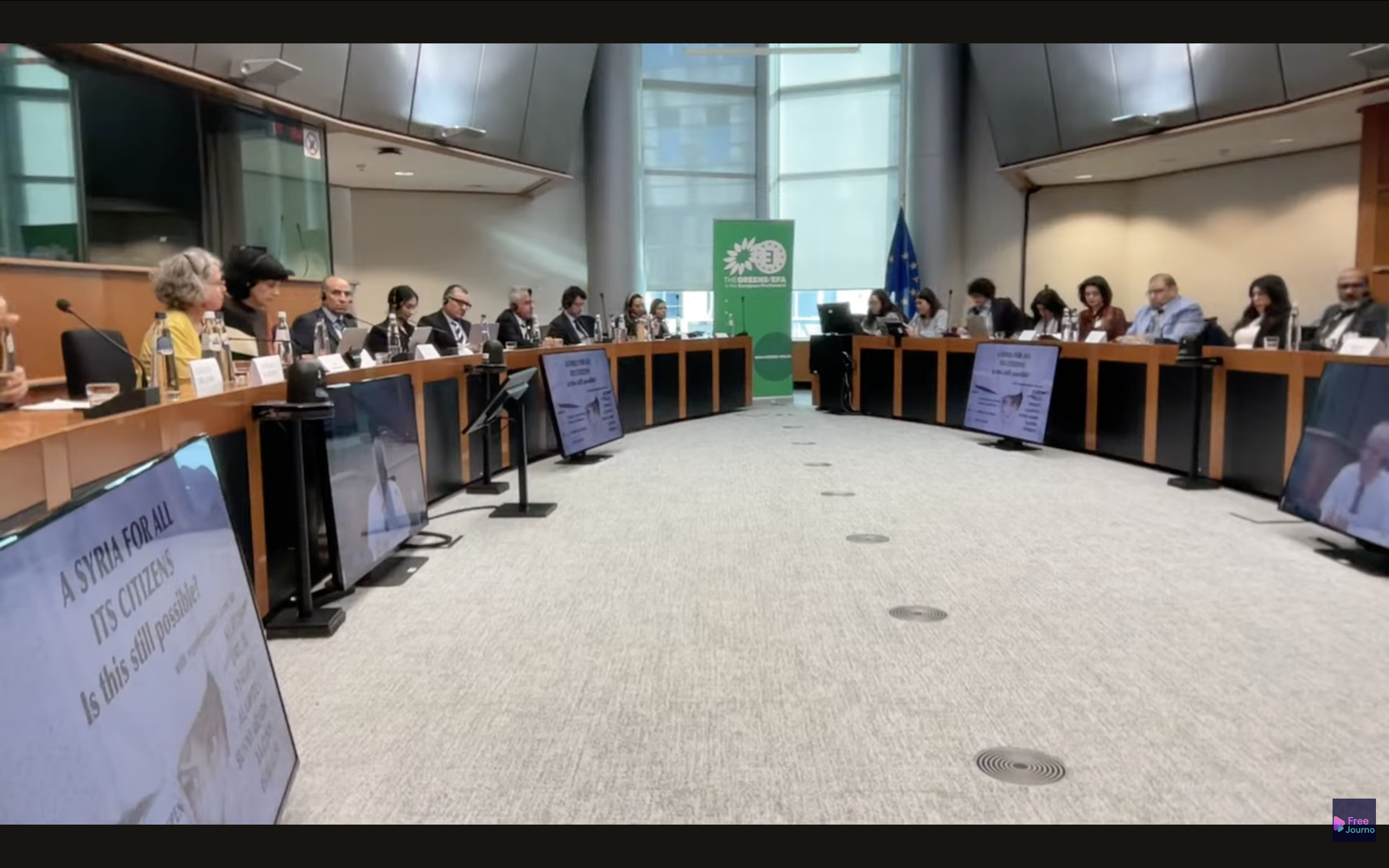
A still from the YouTube live feed of the conference. Picture Credits: Erem Kansoy
Under the auspices of cross-party MEPs, representatives of the different communities that make up Syria’s multicultural society came together at the European Parliament in Brussels on Wednesday. Their conference on “A Syria for all its citizens” had been long planned, but in January it gained urgency.
However, while the Syrian Arab Army was bombarding civilians in the Kurdish neighbourhoods of Aleppo, the EU’s highest representatives were sitting down with al-Sharaa
When the conference was first discussed, Ahmed al-Sharaa’s Syrian transitional government (STG) forces had already carried out devastating attacks targeting the Alawites and the Druze. But, although everyone knew that the Kurds would be targeted next, the lull before the storm provided an excuse for international complacency. January’s attacks on Kurdish areas in Syria forced the world’s attention onto the Kurds, and the European Parliament has finally accepted the need for an emergency debate on Syria next week, having rejected this for last month’s session.
However, while the Syrian Arab Army was bombarding civilians in the Kurdish neighbourhoods of Aleppo, the EU’s highest representatives were sitting down with al-Sharaa in the presidential palace in Damascus, offering him €620 million and political partnership. Syria’s beleaguered minorities are acutely aware that European countries and the European Union remain deeply implicated in Syria’s political trajectory, and they are determined that EU politicians should listen to them.
As Wednesday’s conference demonstrated, these diverse peoples in Syria, across ethnicities and geographies, share a united and clear message. They want to be able to live in peace and security, with guaranteed cultural and religious rights, in a democratic, decentralised, and secular country that respects the right to self-determination. And, crucially, they believe that the European Union, which claims to stand for all these things, can and must act.
The sponsoring MEPs opened the meeting: – Katrin Langensiepen and Leoluca Orlando from the Greens and Andreas Schieder from the Social Democrats, who all emphasised the need for the EU to play a constructive role. Per Clausen of the Left Group was unable to attend, but Left Group member Nikolaos Farantouris spoke later.
The Kurds
Representatives of the different Syrian component groups who are currently exiled in Europe have organised themselves into a committee, whose core conviction is that, “Syria cannot regain stability or build a viable state without a new political contract based on equal citizenship, equitable distribution of powers, inclusive participation, and the institutional recognition of diversity as a source of strength and resilience rather than threat,” said the committee co-ordinator, Sheruan Hassan, a Kurd.
Hassan warned of a “systemic drift toward identity-based, collective violence,” and the risk of “normalising violence.”
Committee member Barazani Muhamad, also Kurdish, recalled the Kurds’ long history of struggle, which has been constantly met with broken promises and massacres. He concluded, “These experiences have demonstrated that any solution that doesn’t include specific international recognition of a Kurdish entity remains fragile and potentially doomed.” He called for “constitutional guarantees for the rights of all Syrian components,” for effective representation of the different components in negotiations, and for making European legitimisation and support for Syria conditional on pluralism and human rights.
The Druze
Aysar Awilli and Haytham Hmeidan from the Druze community spoke of the existential threat and genocidal attacks that the Druze face. They highlighted the necessity for the EU to work directly and in partnership with local communities and not only through Damascus; the need for accountability and justice, which Hmeidan called “the prerequisite for stability”; and of the right to self-determination, which has been supported in Suwayda by a petition signed by over 120,000 people.
Awilli explained:
“Here, the principle of self-determination acquires its defensive legal character. International law does not only recognise this right in cases of traditional colonialism, but also when a human group is subjected to systematic persecution, sustained deprivation of protection, and a de facto breakdown of trust between it and the authority that is supposed to provide security and basic rights.”
Hmeidan has been a Syrian diplomat, but resigned in 2013 in protest against his country’s failure to protect minorities. He pointed out that al-Sharaa regards Syrian people as subjects rather than citizens, and reported that ISIS-like ideologies are spreading within the state. He recalled last year’s attack on Suwayda, in which 4000 were massacred and 200,000 displaced, and described the ongoing “suffocating siege” of Suwayda, which has led to Druze opting for a strategic partnership with Israel as a “shield” for survival. He explained that the Druze can only “choose Syria” if Syria changes, and added that “the security of Suwayda and al-Hasakah [where many Kurds live] is the first line of defence for Brussels.” Hmeidan asked that Europe not let the manufactured fear of “partition” drive them to “the strategic error of supporting a new autocratic centralism in Damascus.”
The Syriacs
On behalf of the Syriac population, Isaa Hana reminded the attendees of his community’s historic role in the development of Syrian identity. He described how targeted anti-Syriac violence – including killings, kidnappings, expulsions, threats, and attacks on churches – is leading to emigration and destroying both local communities and Syrian diversity. He called for international support for minorities to have full constitutional recognition and full participation in a secular and decentralised Syria, and stressed the importance of officially recognizing the Syriac language.
The Alawites
more than 4000 civilians massacred in identity-based violence, hundreds of cases of abduction and human trafficking, and mass graves not yet uncovered
For the Alawites, Mazen Mohamad introduced his speech as an “existential cry”. He described how his community is facing collective punishment, which has included field executions, kidnappings, systematic job dismissals, forced displacements, and confiscation of property. Alawites are commonly portrayed as associated with the deposed dictator Bashar al-Assad, who was an Alawite, but Mazen explained that Assad worked with all sects and committed atrocities against all sects. (In fact, he told me after the meeting that many of his family members – including his father and grandfather – were imprisoned for their resistance to Assad’s government.)
Mazen also reminded his European listeners of Europe’s shared history and geographical proximity with Syria: “We are this close, yet we are far apart in terms of security and stability.”
Rana Amran, from the Alawite community, added some statistics: more than 4000 civilians massacred in identity-based violence, hundreds of cases of abduction and human trafficking, and mass graves not yet uncovered; systematic dismissal of 90,000 government employees, most of whom have not been able to find alternative work; tens of thousands of former military personnel denied the documents they need to find other work; families with no money and at risk of losing their homes; 200 civilians and many more military detained and disappeared; 18,000 people who have had their property seized and have fled to Lebanon or the Russian airbase on the Syrian coast for safety; and multiple shrines burned and destroyed.
The Youth
In her speech, Hanan Ahnad, a young Sunni Arab woman, said that it isn’t only ethnic minorities that are excluded by al-Sharaa’s regime. She argued that exclusion is pushing young people, who make up more than half of Syria’s population, towards violence and withdrawal from public life again. She quoted a young man she had interviewed who told her, “When the killing intensifies, you don’t really have a choice: either you leave everything and flee, or you join Ahmed al-Sharaa.” Hanan also emphasised the increase in gender-based violence, arguing that in al-Sharaa’s war, women’s bodies are regarded as a battleground.
The Yazidis
Aram Aqil from the Yazidi community reported that the persecution of his ancient community has continued without remission, demonstrating that “when violations are ignored, they are repeated.” He castigated EU member states for “continuing to provide political or financial direct or indirect support to forces rooted in jihadi ideology,” even as massacres were unfolding. He emphasized that this support fuels cycles of violence and sends “a devastating message to the victims that their lives are negotiable.” He urged the EU to align its policies with its values.
The meeting ended with a draft statement and recommendations, which will be finalised in the upcoming days, to give to MEPs before next week’s debate.
Postscript
…in case of the arrival of al-Sharaa’s forces, which she [Melek] equates with ISIS, she has prepared poison for herself and her two children.
After the conference, I spoke with Rhodi Melek, a representative of the Autonomous Administration of North and East Syria in Brussels, and asked her for her thoughts on what we had just heard. She told me that the most important thing was that they had managed to bring together representatives of all the Syrian population, and everybody demanded the same thing: a democratic, decentralised Syria that represented its people, where they could sleep peacefully without fear of being killed.
Rhodi told me a story that illustrates quite how much is at stake: She regularly phones an old friend in Qamishlo, and recently she was shocked when her friend said to her that, in case of the arrival of al-Sharaa’s forces, which she equates with ISIS, she has prepared poison for herself and her two children.
Rhodi’s friend is afraid that if they fall into the enemy’s hands, her daughter will be made into a sex slave and her son into a killer, and she won’t let that happen. How many MEPs, I wonder, could begin to imagine themselves in that woman’s shoes?

Sarah Glynn
Sarah Glynn is a writer and political activist based in Strasbourg. She has previously worked as a university lecturer in Scotland and as an architect, and has published books and articles on immigrant political mobilisation, identity politics, Islamism, low-cost housing, unemployment, and ecosocialism. Her writing on Kurdish issues has included a regular column for Medya News and articles for Green Left and Bella Caledonia. www.sarahglynn.net