Syria in 2025: Negotiations Abroad, Violence at Home
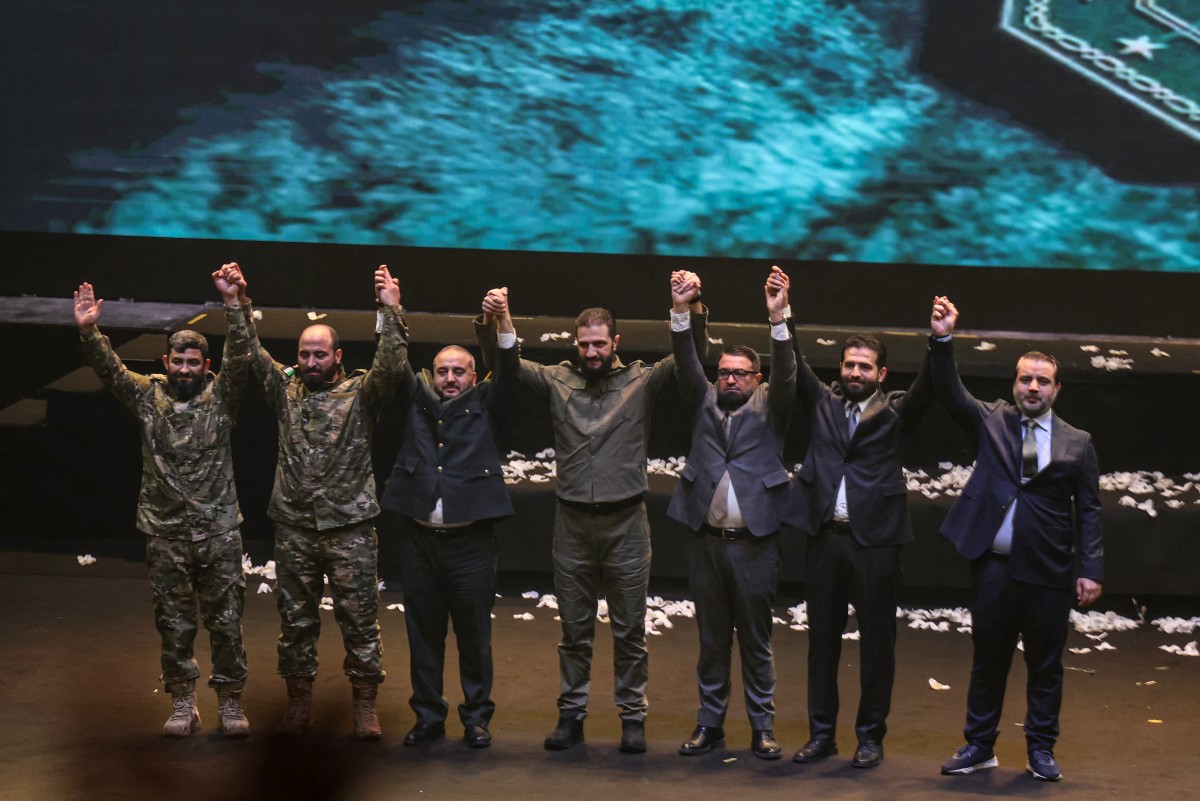
Syrian President Ahmed al-Sharaa (C) and members of his government celebrate during a ceremony at the Convention Center as Syrians celebrate the first anniverasy of the fall of the Assad regime, in the Syrian capital Damascus on December 8, 2025. (Photo by OMAR HAJ KADOUR / AFP)
This report was co-authored by Soha Ezzi and Abbas Abbas
Syria broke its international isolation in 2025, though this diplomatic opening stands in stark contrast to the country’s domestic divisions.
The country has experienced significant international re-engagement, securing sanctions relief and billions in investment pledges. However, a year after Ahmad al-Sharaa took power following Bashar al-Assad’s fall in December 2024, Syria’s transformation presents stark contradictions, marked by persistent sectarian violence, the continued presence of extremist militias, and a fragile political transition that has failed to deliver on promises of inclusive governance and security.
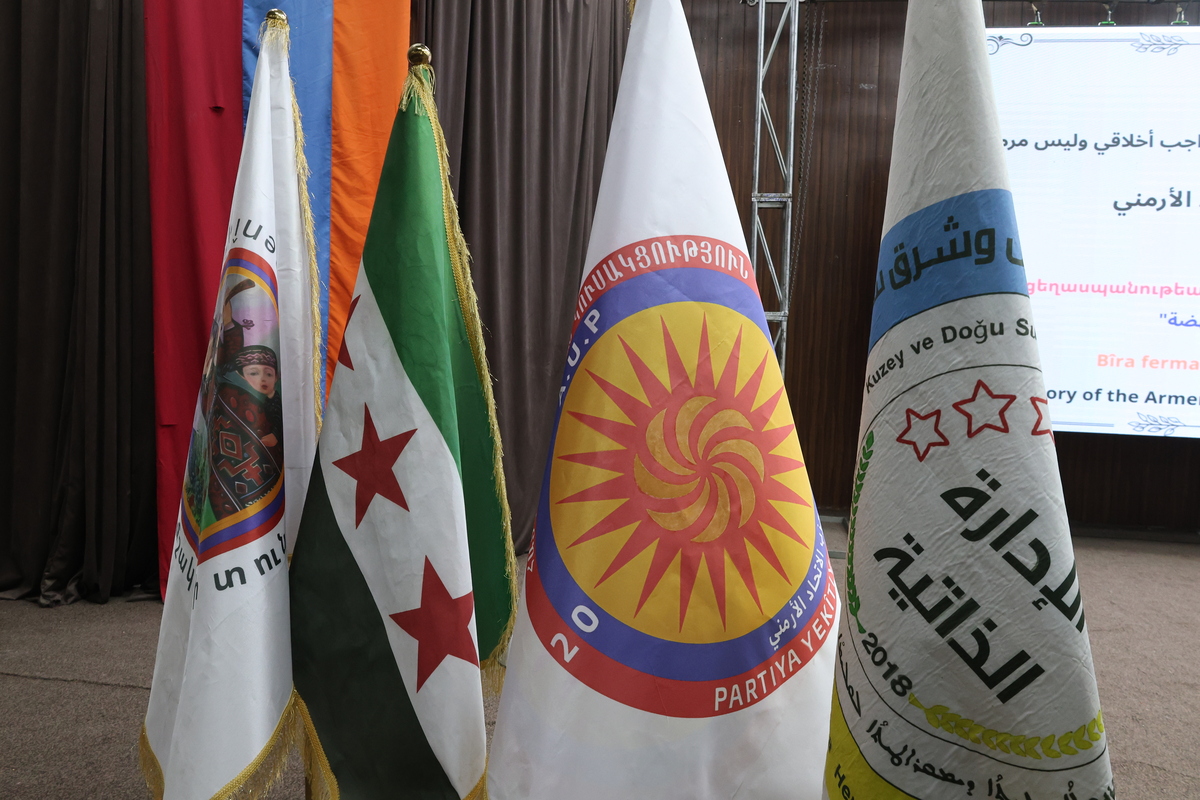
Although Ahmed al-Sharaa has been welcomed in Western capitals, his domestic power is highly contested by increasing demands for federalism and democratic autonomy, stalling an agreement with the Kurdish-led Autonomous Administration in the northeast.
The gap between international optimism and the deteriorating reality on the ground underscores the bittersweet year for Syria. Six million refugees remain abroad, 7.4 million are internally displaced, and the living conditions of Syrians have not significantly improved. The economy remains fragile, and basic services are still inadequate.
Breaking Isolation: Looking Westward
Syria’s most significant achievement in 2025 was ending years of political and economic isolation. In May, the United States began lifting sanctions, and by mid-December, it had removed the stringent Caesar Act restrictions that had crippled Syria’s economy. The European Union followed with partial sanctions relief, though both the EU and the UK maintained sanctions on Turkish-backed Syrian National Army (SNA) factions, now integrated into Syria’s security apparatus, despite reports of war crimes against ethnic and religious minorities.
This diplomatic shift unlocked major investment commitments. Regional actors, like the Qatar-led UCC consortium, signed a $7 billion deal for large-scale power generation projects, and Saudi Arabia pledged $6.4 billion for infrastructure, energy, finance, telecommunications, real estate, trade, and tourism. Syria also signed a 30-year harbor deal with French shipping giant CMA CGM, and companies from the UAE (Dana Gas), the United States (GE Vernova and Chevron), and Germany (Siemens Energy) entered negotiations to rebuild Syria’s energy sector.
Al-Sharaa, who started the year as a designated terrorist wanted by the United States, launched a campaign to present himself as a Western-oriented moderate and wash away his jihadist past with terrorist organizations like Al-Nusra and Al-Qaeda. Some of his immediate interests coincided with those of both Israel and the U.S., who were keen to see Al-Sharaa prevent Iranian weapons from being smuggled to Hezbollah-controlled areas in Lebanon. He further doubled down on his new image by joining the US-led coalition against ISIS; however, the first joint patrol ended with the death of American soldiers at the hands of ISIS-affiliated and alleged Syrian Security Force members.
By contrast, the SDF and the international coalition continue counter-terrorism operations – facing significant challenges in managing ISIS prisoners and their families. The presence of former ISIS fighters and their families in detention centers, many of whom are women and children, has created a humanitarian and security dilemma.
Despite Syria’s shift towards the Western camp, contradictions quickly emerged. According to Reuters, Syria received oil from Russian vessels despite international sanctions. The transitional government also maintained ties with Russia and has not acted against the presence of Russian military bases in Tartus and Latakia.
Additionally, Israel repeatedly ventured into southern Syria and has since occupied the entirety of the Golan Heights and effectively controls large swathes of southern Syria. Israel continues to justify its occupation by referencing the jihadist, Islamist makeup of the new Syrian Army and al-Sharaa’s own extremist past. Al-Sharaa’s army only strengthened Israel’s argument when forces under his control massacred Druze civilians in Suwayda.
Centralized Power and Limited Pluralism
Despite international diplomatic progress, the new regime’s rule led to minorities being massacred and political power being concentrated in the hands of a few HTS and SNA elites.
In October 2025, Syria held its first parliamentary elections since the fall of Assad. Rather than holding general and direct elections, however, an electoral college system was employed, and only 0.0003% of Syrians were able to vote.
32 seats intended for Suwayda and Rojava (North and North East Syria) were left empty, with the Syrian transitional government citing “security concerns.” No law on independent political parties was announced, and most of the previously elected local councils were dissolved, which weakened individuals’ ability to represent local communities.
Furthermore, the newly-created, highest-ranking Ministry of Justice position – Chief Judicial Director, who has authority over “judicial appointments, transfers, salaries, leave and dismissal from service” – was established with no legal basis in Syrian law.
Sectarian violence escalated throughout the year. Massacres against Alawites in Syria’s coastal regions left thousands dead, and targeting the vulnerable community continues to this day. Attacks were also carried out against Christians, particularly in the form of a terrorist attack on the Mar Elias church in Damascus, as well as against the Druze community in Suwayda. These events revealed deep hostilities that the government struggles to contain.
Turkey’s Grip on Syria’s Military Integration
Turkey has maintained significant influence over Syria’s political decisions, particularly those regarding the Syrian National Army (SNA) factions formally integrated into the Defense Ministry. Entire units have been kept intact and simply reflagged, including Western-sanctioned factions that are notorious for human rights violations, particularly against Kurds, Alawites, and Druze. This contrasts sharply with Damascus’s demands that the Syrian Democratic Forces (SDF) in North and East Syria be disbanded and their members be integrated into the Defense Ministry as individuals or in small units, which serves Turkish interests more than Syria’s.
As the first country to reestablish diplomatic relations with post-Assad Syria, and as a major source of promised investments and energy supplies, Turkey has leveraged its partnership with Ahmed al-Sharaa to pursue its strategic objective of neutralizing the Kurdish-led SDF. Beyond military interference, Ankara has intervened to obstruct negotiations that do not align with its interests. Notably, it blocked a planned Paris meeting between Damascus and the Autonomous Administration in August 2025.
Turkish interference has contributed to what the Autonomous Administration representatives refer to as a “political freeze” in the implementation of the March 10 ceasefire agreement.
The Northeast Stalemate
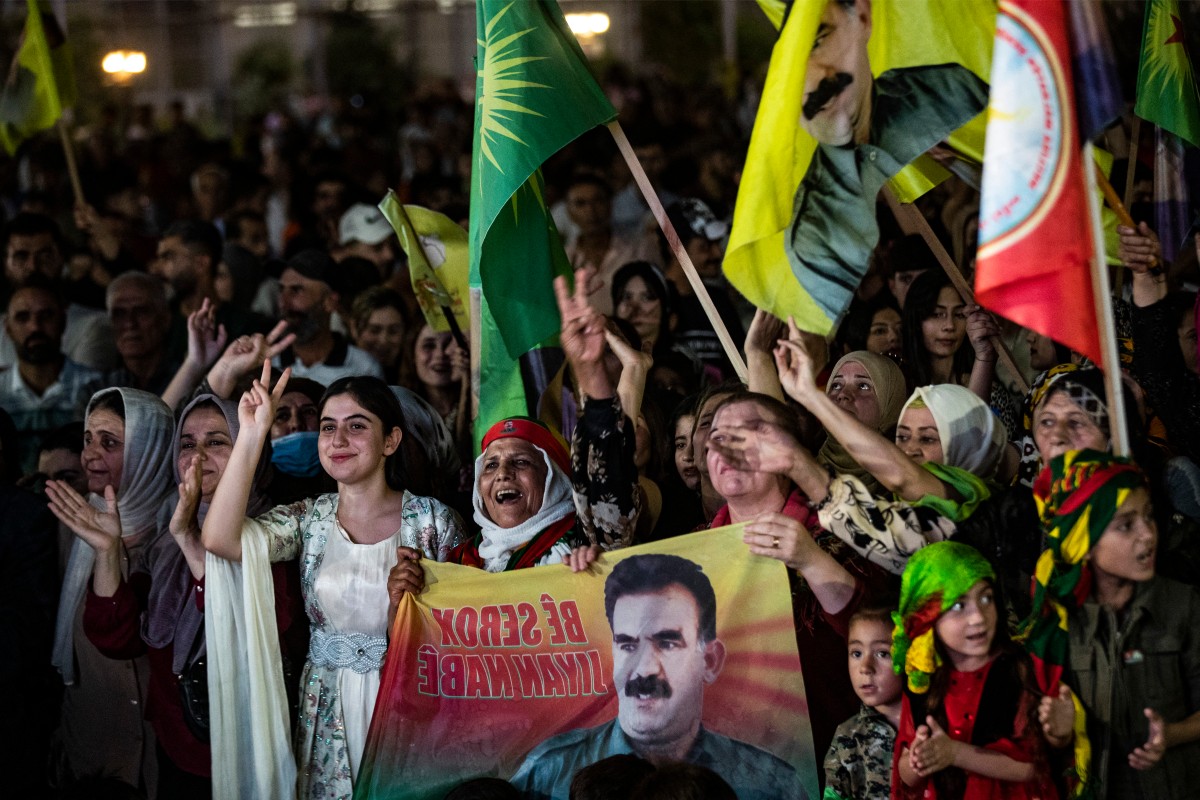
The status of Rojava and the Kurdish-led Autonomous Administration in northeastern Syria was the most contentious political question of 2025. In late November 2024, when Hayat Tahrir al-Sham launched its operation against Assad’s forces, Syrians across the country celebrated the end of five decades of dictatorship. However, as Hayat Tahrir al-Sham advanced toward Damascus, Turkish-backed SNA factions seized the opportunity to attack Kurdish-held areas.
While Assad fell and Al-Sharaa took power, SNA forces captured Til Rifaat and Manbij, which the SDF and the international coalition had liberated from ISIS in 2016, effectively occupying the region for Turkish interests.
The assault was especially devastating. Thousands of Kurds, already displaced after Turkish attacks on Afrin in 2018 and living in camps for years, were forced to flee again, this time to more stable areas under the Autonomous Administration in northeast Syria.
The SNA’s attempt to seize the Tishreen Dam in December became a turning point. The dam, a critical source of water and power for the region, came under heavy attack. The SDF’s successful defense, supported by thousands of civilians who rallied at the dam, demonstrated their military capability and determination to protect vital infrastructure. The battle became a symbol of resilience that resonated beyond the battlefield. It showed that the SDF could not be eliminated militarily and ultimately pushed both sides toward negotiations. This reality led to an agreement in March 2025 between Mazloum Abdi and Ahmad al-Sharaa, acknowledging that Syria’s future required political solutions, not just military victories.
The March 10 Agreement affirmed Syrian unity and guaranteed citizenship and constitutional rights of the Kurdish people. The agreement called for the integration of civil and military institutions in the northeast, such as border crossings, airports, and oil and gas fields, into the national framework. The agreement also stipulated the return and protection of internally displaced persons (IDPs), enforcing a nationwide ceasefire, and establishing joint committees to implement the agreement by the end of 2025.
But despite initial progress, momentum stalled. According to the Autonomous Administration, the committees in Damascus were unprepared, and the government delayed the process. Meanwhile, voices in Damascus spread hostile rhetoric against northeastern residents and the SDF, threatening attacks and massacres.
A positive development occurred in April when the Kurdish National Council (ENKS) and the Democratic Union Party (PYD) announced a joint political vision, outlining a comprehensive approach to Kurdish issues within Syrian unity and decentralized governance. Kurdish unity offered the potential for a stronger negotiating position.
Post-War Reconstruction
Since the fall of the Assad regime, 1,208,000 refugees, mostly from neighboring countries, have returned according to a recent UN report. However, only 1,900 repatriated Syrians are from EU countries. Another 2 million IDPs returned home only to find destroyed houses with limited electricity, water, and healthcare, and no jobs. Over 6 million Syrian refugees remain abroad, and 7.4 million people remain displaced inside Syria. Of those still in the country, 90% live in poverty, 65% are unemployed, while only 37% of the healthcare system functions, and 65% schools are operational.
While EU states hope for rapid repatriations, the reality is that Syria currently lacks the capacity to absorb such numbers. Reconstruction has barely begun and appears driven by private initiatives rather than the state.
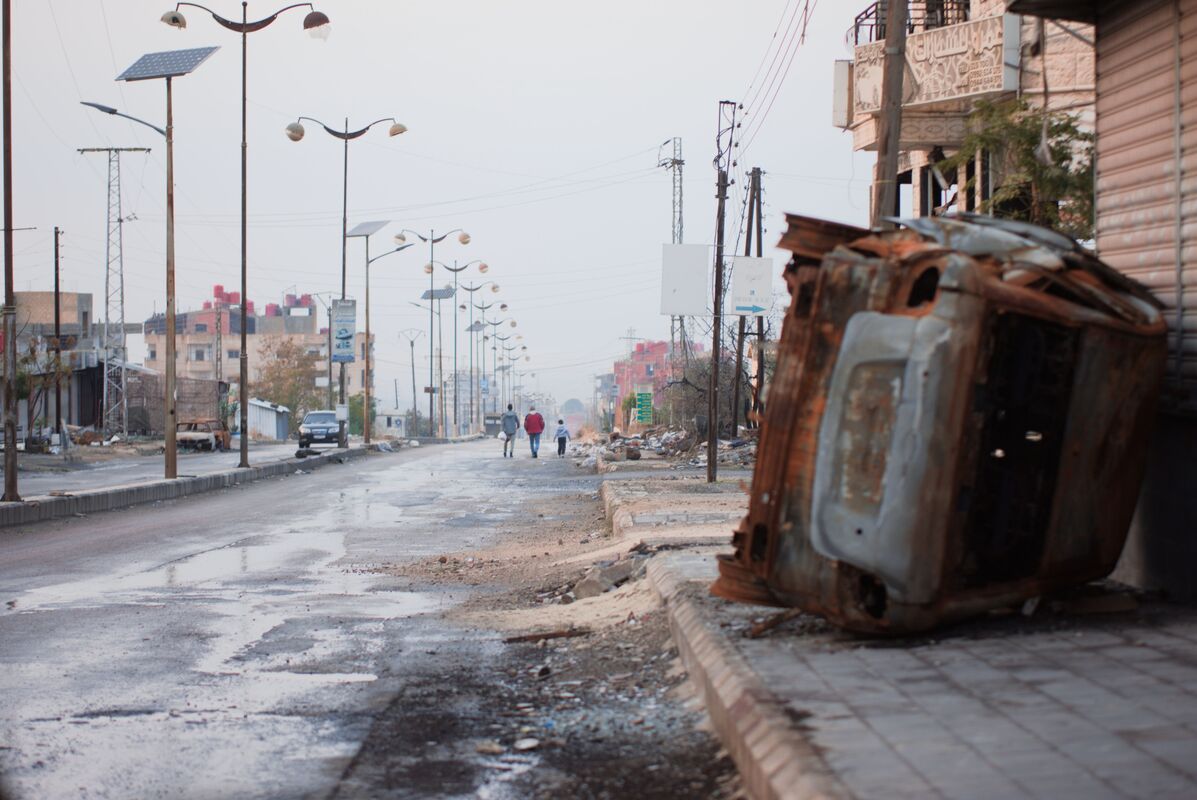
According to a World Bank report, reconstruction costs are projected to range between US$140 billion and US$345 billion, with a conservative best estimate of US$216 billion. The years of civil war devastated Syria’s civilian infrastructure: roads, power infrastructure, water systems, residential buildings, public facilities, schools, hospitals, and government buildings all need rebuilding.
What Remains Unresolved
In 2025, Syria broke its isolation and attained some economic opportunities. Yet, fundamental questions regarding the governance model, the March 10 agreement, sectarian violence, and refugee repatriation and reconstruction remain unanswered.
This past year has shown that breaking isolation is easier than building inclusive governance. Ultimately, Syria’s political future depends less on international investment pledges and more on whether its new leadership can bridge the gap between diplomatic success abroad and political legitimacy at home.

Soha Ezzi
A filmmaker, civil activist, and independent journalist based in Damascus, Syria