Iran’s Hostage Diplomacy is Vicious, Frightening, and Effective
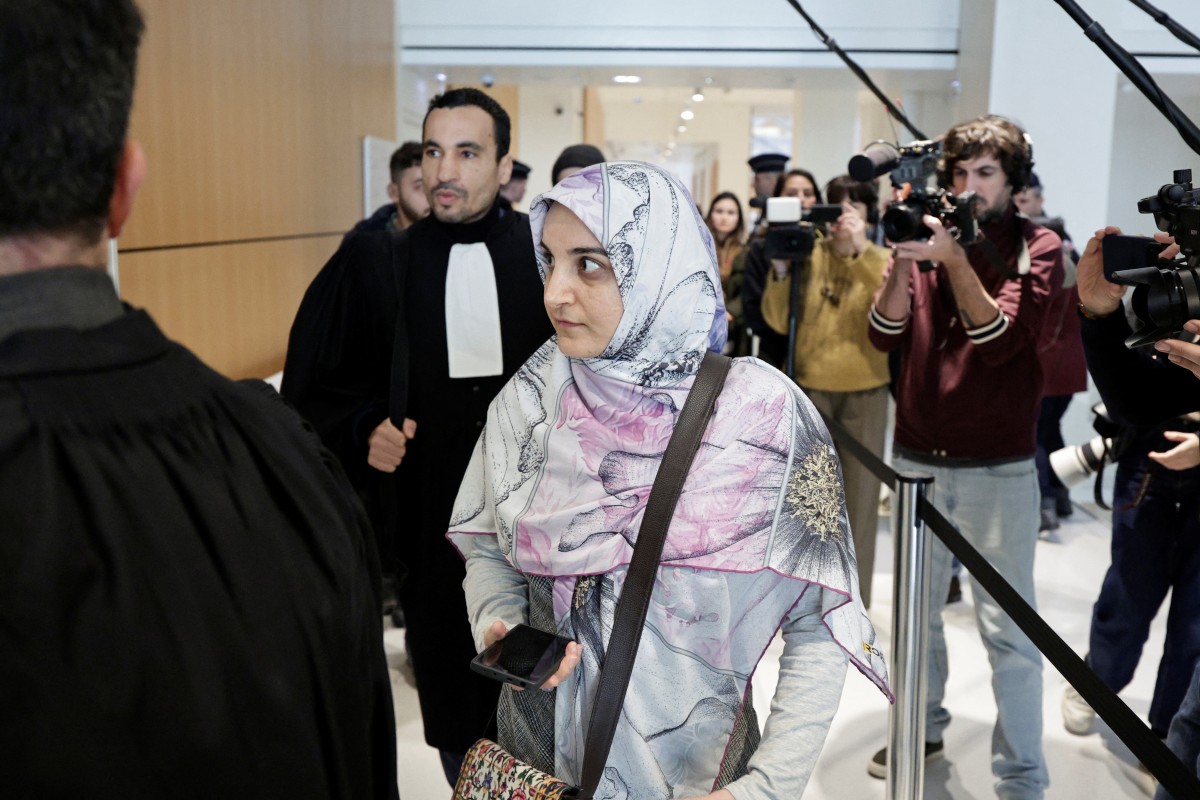
Iranian national Mahdieh Esfandiari (C) arrives with her lawyer Nabil Boudi (L) for her trial on charges of promoting terrorism on social media at Paris courthouse on January 13, 2026. (Photo by STEPHANE DE SAKUTIN / AFP)
Iran has increasingly used aggressive tactics to coerce the international community, most notably by arresting foreign nationals or dual citizens to force concessions. Behind the relief of freed hostages, Tehran turns detainees into leverage, while European governments risk rewarding hostage-taking and undermining judicial independence.
The most imminent case involves Mahdieh Esfandiari, an Iranian national on trial in France under terrorism charges, whose release is set to be exchanged for two French citizens, Cécile Kohler and Jacques Paris. They remain confined at the French embassy in Tehran following 1,277 days of imprisonment on espionage charges, highlighting Tehran’s continued use of foreigners as bargaining chips.
Context and Examples
Taking foreign nationals hostage in Iran dates back to the early days of the 1979 revolution, when the US embassy was stormed, and 52 diplomats were held hostage for 444 days. The difference between then and now is that today’s arrests are calculated acts carried out by the Iranian state itself, targeting foreign nationals with specific political objectives, rather than the reckless actions of a group of short-tempered young revolutionaries.
As Iran’s overseas operations have expanded, more of its agents have been caught in the act. Asadollah Asadi, an Iranian diplomat posted to Austria, was arrested in 2018 on German soil. He was later sentenced to 20 years in prison after being convicted of plotting a failed bomb attack at an Iranian opposition rally in Paris. Iran subsequently exerted pressure on Europe and, in May 2023, finalised a prisoner swap, exchanging Asadi for the release of Olivier Vandecasteele, a Belgian aid worker. As part of the deal, a Danish tourist and two Iranian-Austrian dual citizens were also released from Iranian prisons.
In 2019, Iranian national Hamid Nouri was detained upon arrival in Sweden. In 2022, he was sentenced to life behind bars for murder and war crimes related to his role in the execution of political prisoners in Iran in the 1980s. Just two years later, Nouri was sent home in exchange for Swedish citizen Johan Floderus, who had been seized whilst travelling in the country, and Saeed Azizi, a dual Iranian-Swedish national, who had been detained in Iran for five years on anti-establishment charges. The list of similar cases goes on.
Judicial System’s Independence in Question
The World Justice Project identifies judicial independence as “the last line of defence against executive overreach”. WJP’s 2025 Rule of Law Index shows a global decline in “whether the judiciary limits executive power and whether civil and criminal justice are free from improper government influence.”
Nordic countries remain top-ranked in the Rule of Law Index. In Sweden, the constitution clearly states that “…no public authority, including the Riksdag [parliament], may determine how a court of law is to adjudicate an individual case or otherwise apply a rule of law in a particular case.”
Concessions to regimes like Iran not only undermine the rule of law but also risk setting a precedent that encourages future hostage-taking and coercion
France, while ranking lower at 22 out of 143 countries on the same index, also asserts judicial independence in its constitution, stating that “The President of the Republic shall be the guarantor of the independence of the judicial authority.” However, recent concessions to Iran’s demands raise questions about how this principle is upheld in practice.
In January, the Islamic Revolutionary Guards Corps (IRGC) was designated a terrorist organisation by the European Union, making hostage exchanges more complex for the bloc. The IRGC’s Quds Force is responsible for overseas covert operations, including the assassination of dissidents, espionage, and weapons smuggling. Any such exchanges would involve releasing individuals formally designated as terrorists, with serious legal and ethical implications.
Judicial independence cannot be maintained when cases are selectively influenced for political ends. Concessions to regimes like Iran not only undermine the rule of law but also risk setting a precedent that encourages future hostage-taking and coercion.
Ethical Dilemma
Many Westerners detained by Iran face charges widely seen as fabricated, often accompanied by forced confessions and false allegations, used to gain political leverage. Vandecasteele, for example, was sentenced to 40 years on spying, money laundering, and other charges described by the Belgian government as fabricated. Thomas Kjems, a Danish vlogger, was among many others caught up in such cases.
The Islamic Republic prioritises citizens who serve the regime, while those perceived as opponents face detention, coercion, or worse.
Although Western citizens may be advised against travel to Iran, they retain the right to freedom of movement. This creates opportunities for the Islamic Republic to exploit foreign travellers for political leverage.
Western governments, however, will act decisively to secure the return of their citizens for two reasons. First, the principle that all citizens are equally protected under the law. Second, the pressure that the public can exert on its governments to act.
For Iran, none of these considerations apply. The Islamic Republic prioritises citizens who serve the regime, while those perceived as opponents face detention, coercion, or worse.
For Ayatollah Khamenei and the IRGC, there are two types of Iranian citizens: those with the regime and those against it. The first group is protected and provided for, in exchange for loyalty to those in power. Those who challenge the regime face disappearance, torture, or death. Public pressure, even on matters of basic rights, is met with the same harsh response, as seen in the recent crackdown on protesters.
Kjems told the BBC that he “felt a lot of guilt” when he found out his release was part of a prisoner swap that freed Asadollah Asadi, an Iranian diplomat who had plotted a bomb attack on European soil. Beyond his personal moral discomfort, the case raises a wider ethical issue: when officials override court verdicts for political ends, the integrity of the justice system is compromised.
Does the ethical and moral responsibility lie with Western travellers and dual nationals, or with the states that negotiate their release? Before crossing Iranian borders, individuals must consider the risks. A deeper question concerns the implications of governments exchanging hostages and potentially enabling the release of assassins and saboteurs, or exposing communities abroad to coercion.
Islamic Republic’s Victory
Whichever way you look at it, Iran comes out victorious from these prisoner exchanges. European states are, of course, obliged to secure the release of citizens held by interrogators and torturers. Yet the outcome ultimately favours the Islamic Republic on three levels.
yielding to Iran’s demands at this level sends an unsettling signal to dissidents in exile that they remain vulnerable to persecution
First, Iranians in exile cannot feel secure, knowing that Tehran may at any moment target them, while the agents involved are likely to be returned in future exchanges.
Second, successful swaps strengthen the Islamic Republic’s ability to recruit agents for operations on European soil. The message is clear: Tehran supports its operatives and will secure their return, regardless of the severity of their convictions.
Third, yielding to Iran’s demands at this level sends an unsettling signal to dissidents in exile that they remain vulnerable to persecution, even while living in free and democratic countries. There is no guarantee that future demands will stop at exchanges; the extradition of dissidents is likely to follow.

Ramyar Hassani
Ramyar Hassani is a commentator and analyst on Middle Eastern affairs. He has conducted academic research on the Iran-Israel conflict and holds a master’s degree in Middle East Studies, in addition to two BAs from the University of Oslo, Norway. He has appeared on renowned outlets like CNN, France24, Skynews, CBC, i24News, Fairobserver, The Jerusalem Post, and more.