Iran: Teaching Semnani, A Small Step or a Safe Experiment?
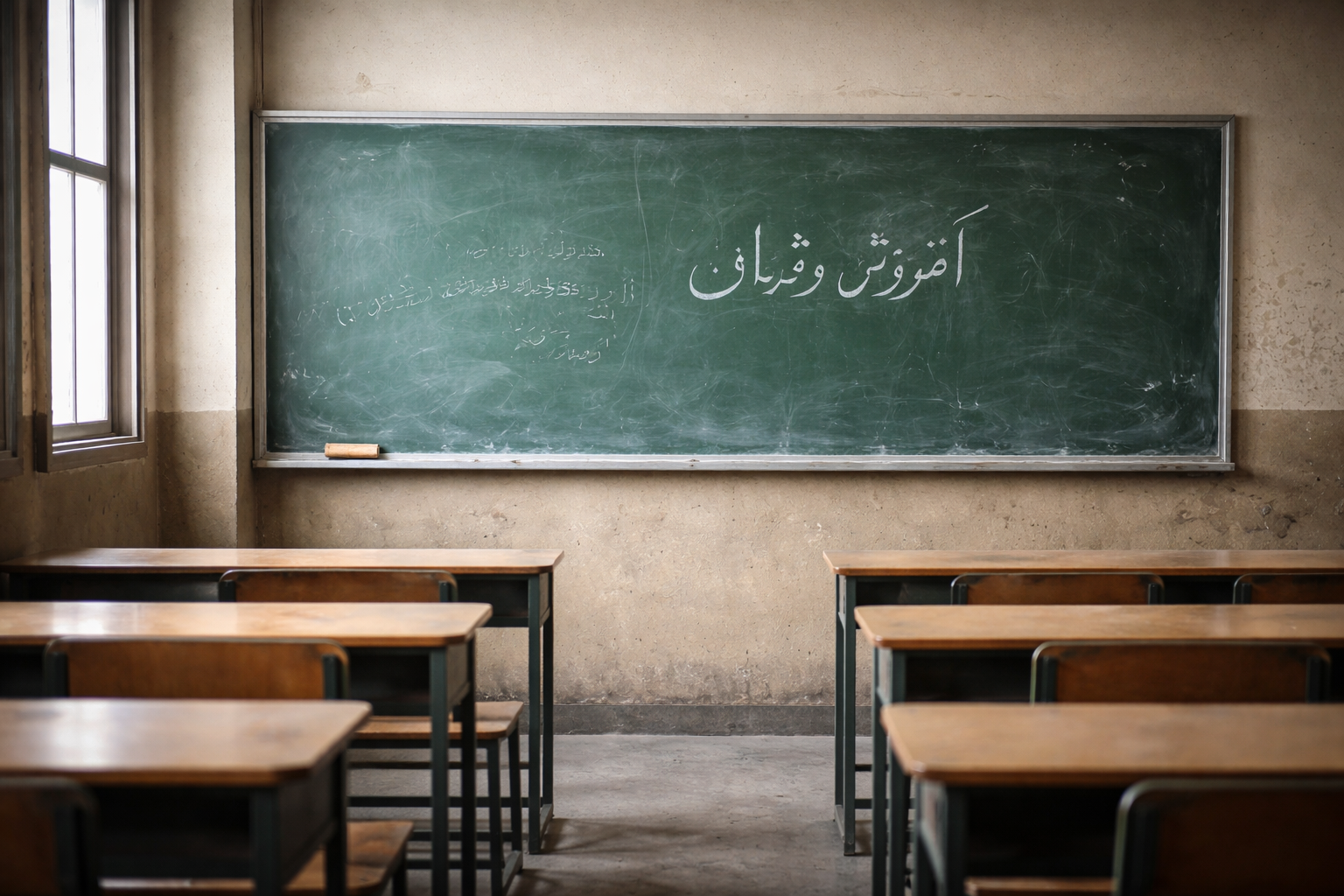
In Iran’s Semnan, a province with only a few hundred thousand remaining speakers of the nearly forgotten Semnani language, several elementary schools have begun teaching Semnani to children for the first time. The move has sparked hope in strengthening linguistic rights in Iran, but observers say this is a calculated political concession rather than a cultural, democratic opening.
The first official promise to put the Semnani language in local schools’ curriculum was made in late 2018. The provincial governor, Seyed Abbas Danaei, said Semnani would be taught in elementary schools starting in 2019. However, the plan was never carried out and soon disappeared from public attention.
Now, the current governor, Mehdi Samimian, has revived the proposal, stating classes and textbooks will be introduced for students in grades one through six in for the 2025-2026 school year. Just under 15,000 students across the province are expected to join the program.
Samimian said a local advisory council will soon be formed to include community and media representatives. He called the plan essential for protecting the region’s fading Semnani identity. Yet public engagement appears limited, and no formal surveys have been published.
Revival of Semnani
Semnani is one of the ancient Northwestern Iranian languages. It is distinct from Persian and is spoken fluently by approximately 50,000 people – many of whom are elderly. Experts warn that without institutional support, the language could disappear within a generation. The new program, they say, may just be enough to slow that decline.
In daily life, nearly all Semnani speakers are bilingual, speaking Persian, which is Iran’s dominant language of administration, higher education, and most media.
The new classes, then, do not respond to a communication gap so much as they offer symbolic recognition. For many observers, that fact alone suggests the policy is less about pedagogy and more about the politics of what kinds of diversity the state is willing to accept.
Semnan, with few speakers and a small geography, launched the program locally using county cultural funds. The Education Ministry has shown no official reaction, no endorsement, nor any mention.
The Constitutional Promise, Unevenly Applied
Across Iran, the decision to teach Semnani has sparked debate. In multi-ethnic regions like Kurdistan, Azerbaijan, Lorestan, and Baluchistan, millions wait for the same linguistic rights, which were promised by Article 15 of Iran’s constitution over 40 years ago. The article declares Persian the official language but allows for the teaching of “regional and tribal languages” in schools alongside Persian.
Analysts point out that the plan’s limited scale, relatively low cost, and low political temperature have made it possible in Semnan. Similar conditions do not exist in larger provinces with millions of non-Persian speakers and longstanding political grievances, where any move toward mother-tongue education is quickly entangled in wider debates about autonomy, cultural discrimination, and security.
In higher education, some precedents exist. Kurdish language and literature is taught at the University of Kurdistan, Azeri language and literature at the University of Tabriz, and Balochi is offered in limited forms at the University of Sistan and Baluchistan. While Article 16 of the constitution requires Arabic to be taught in all classes and subjects from after elementary school through the end of high school.
Culturally Quaint, Politically Safe
Many observers argue that Semnan’s quiet initiative, marking the beginning of a more systematic approach, or its remaining a singular exception, is a matter of political calculation rather than cultural policy.
the Semnani project is “a concession of convenience” rather than a turning point in language rights.
Dr. Behrooz Chamanara, former professor at the University of Kurdistan in Sanandaj (Sine) and founder of the International Institute for the Study of Kurdish Societies, told The Amargi, the Semnani project is “a concession of convenience” rather than a turning point in language rights.
“Languages like Semnani are deemed culturally quaint and politically benign,” he said. Unlike other minority group’ languages, Semnani lacks “large-scale organized movements, territorial leverage, or cross-border ties” which would tie Semnani into “competing national identities.”
Chamanara contrasts this treatment with that of major minority languages such as Kurdish, Azeri, Balochi, and Arabic, which, he argues “anchor communities with deep historical memory, sustained grievances and robust collective identities.” Concentrated in sensitive border regions and connected to transnational ethnic groups, these languages are seen by the state as potential platforms for opposition. Semnani’s inclusion, on the other hand, allows the state “to showcase a façade of diversity,” without addressing grievances or enacting structural or meaningful change.
According to Chamanarra, Iranian officials often cite issues regarding social “sensitivities” as one of the barriers to implementing Article 15 for larger groups. However, the Islamic Regime is not concerned about social harmony; rather, usage of words like “sensitivities “is a coded acknowledgment of the state’s foundational anxieties regarding power, sovereignty, and national unity.”
From this perspective, the line between languages that are “safe” to teach and those that remain excluded is drawn not by linguistics or pedagogy, but by perceived security risk.
Efforts to get a comment from officials at Iran’s Ministry of Education and the Semnan provincial government on the broader implications of the program were unsuccessful.
Preservation, Performance, and Power
When a language is small and territorially contained, the state can safely frame its teaching as cultural preservation…But when a language underpins a strong ethnic identity, making space for it in the classroom becomes a challenge to the existing order.
For language activists, the Semnani classes are nonetheless a real, if limited, victory. In some families, grandparents who long feared their mother tongue would vanish from public life now watch their grandchildren learn it in formal lessons. For the children holding the slim new textbooks, the change is concrete and personal, not theoretical.
Chamanara cautioned that the symbolic power of such programs should not obscure their political context: “Seen in this broader landscape, the Semnani initiative is not a structural reform but a strategic token,” he said.
In his view, when a language is small and territorially contained, the state can safely frame its teaching as cultural preservation – something akin to protecting local crafts or folklore. But when a language underpins a strong ethnic identity and an alternative narrative of history, making space for it in the classroom becomes a challenge to the existing order.
“Semnani is allowed because it does not disturb the Persian-centered, Romantic-national conception of Iran,” Chamnara said; unlike major minority languages like Kurdish, Azeri, and Baluchi. Across Iran, millions of children still study exclusively in Persian, in regions where their families’ languages remain largely absent from the official curriculum despite decades of advocacy.
When viewed in this context, the teaching of Semnani in a handful of schools looks less like the beginning of a structural reform and more like a carefully managed exception; a reminder that, in Iran, the right to mother tongue education remains bound up with questions of power and state control, not only culture or heritage.

Kawe Fatehi
Kawe Fatehi is a journalist and translator, based in Berlin, with a Master's degree in English Literature and Language. He has written for multiple Kurdish and Persian media outlets, covering topics related to the Kurdish community in Iran, Iraq, Turkey, and Syria. In addition to his journalism work, he is a social worker.