Deq: A Mesopotamian Tattoo Tradition Revived in Istanbul
Picture Credits: Archives of Sunya Deq Studio
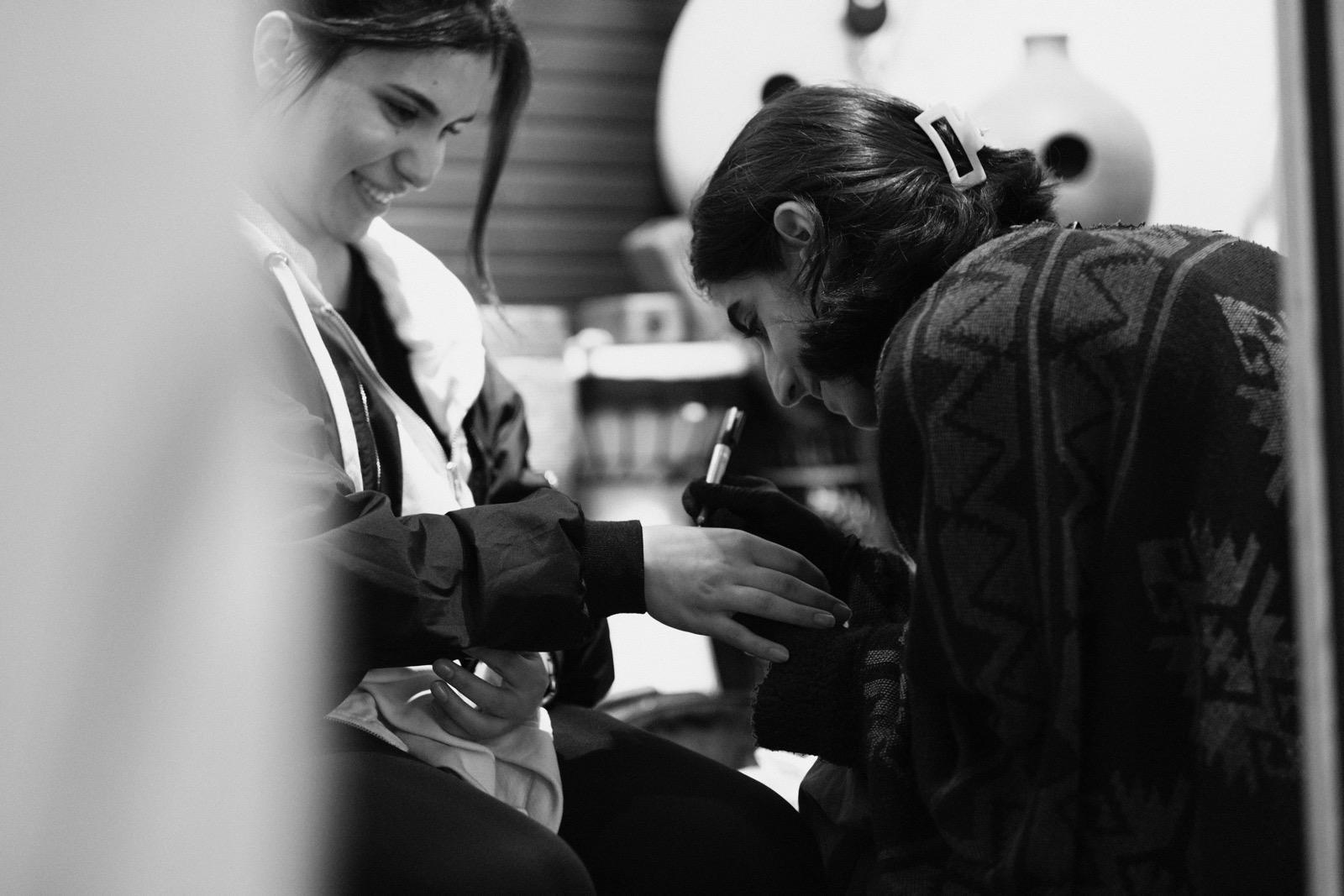
On an ordinary street in Istanbul, inside a studio quite unlike the city’s flashy tattoo studios, a young woman artistically places careful dots with a needle; dots that symbolize a tradition that has resisted migration, war, and erasure for thousands of years: deq.
In the dissonant emptiness they felt within the chaotic modernity of Istanbul, Arjin Emektar and her friends have embarked on an exploration for their roots and in many ways, themselves. Through practicing deq, they invite young people to join them. By inscribing symbols laden with meaning on bodies, they sustain an ancient form of cultural resistance and transform bodies into sites of remembrance.
Deq symbolized much more than aesthetic decoration: protection, beauty, healing, belonging, luck – values held dear by those who practiced it.
On the day we visit the studio, Arjin is performing a deq on a young woman from Istanbul named Xezal (meaning Gazelle). The gazelle holds an important place in Deq culture, associated with grace, spirituality, and feminine wisdom. In Yazidism, the gazelle is associated with purity, while in Kurdish dengbêj narratives, it often symbolizes womanhood and vulnerability.
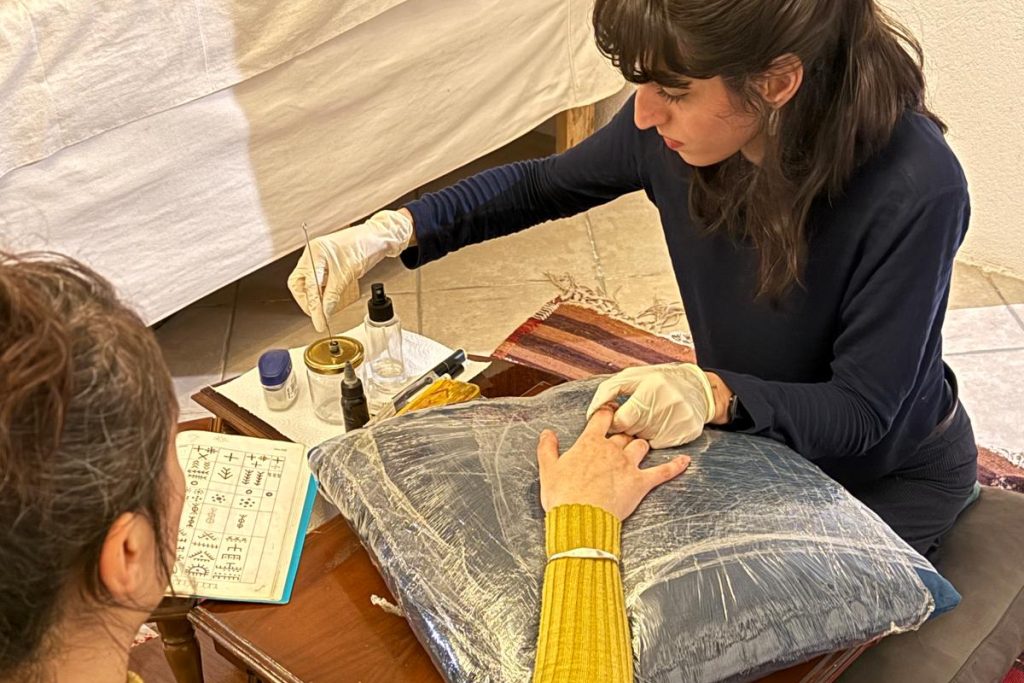
Xezal chooses this symbol both for its name and for its layered meanings. In that moment, both Arjin and Xezal share something beyond the act of tattooing – keeping a culture alive, together.
We set out on a brief journey with Arjin to discuss deq, weaving her story with the art form’s history.
An Ancient Practice in a Contemporary Metropolis
Deq is an ancient tattoo tradition practiced, largely by women, for generations across Mesopotamia. The ink is traditionally prepared with a mixture of soot and breast milk from the mothers of newborn girls. Deq symbolized much more than aesthetic decoration: protection, beauty, healing, belonging, luck – values held dear by those who practiced it. Today, it survives mostly on the bodies of elderly women in Kurdistan; faint dots on chins, hands, or cheeks that tell stories rarely written down.
Arjin shares the stories her mother told her about deq in their village – the arrival of the Romani people, women from the village getting their deq tattoos, and the excitement it sparked among them.
These stories, along with the declining visibility of Deq culture, led Arjin and her friends to open Sunya Deq, a small studio in Istanbul, three years ago. The name Sunya, meaning “emptiness” or “nothingness” in Sanskrit, reflects how they define their work: searching for roots and identity in the void of modern life.
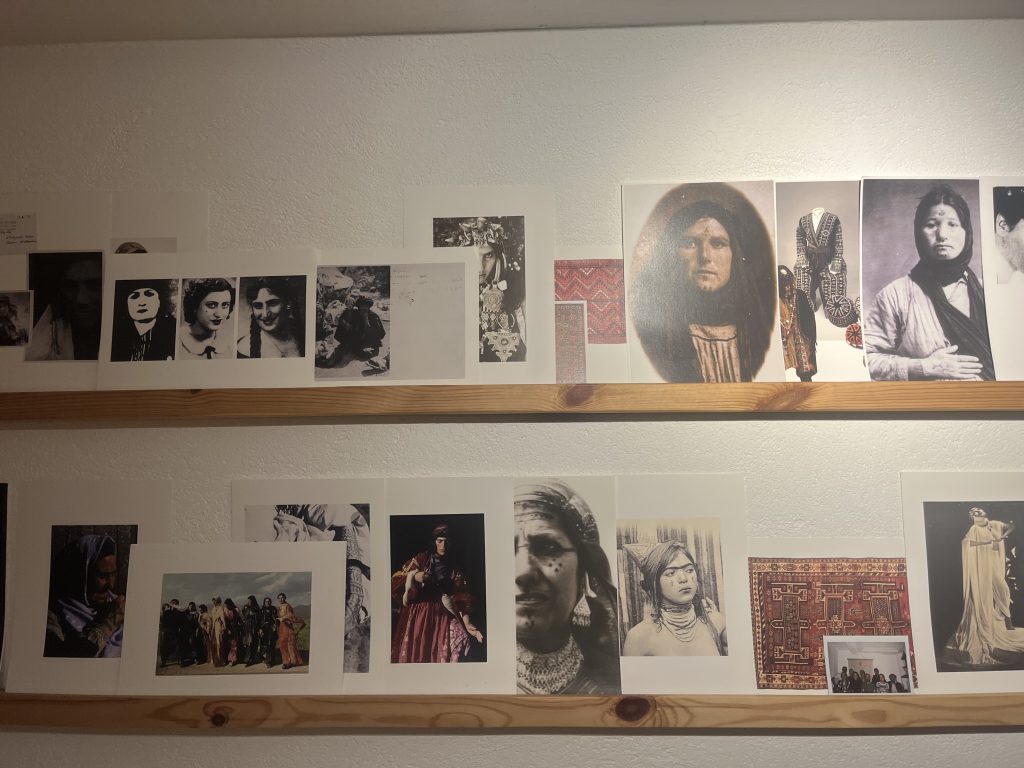
“Our primary goal was to create a living space,” Arjin explains, “a place where we could realize ourselves culturally, and at the same time reveal deq, a culture surrounded by many question marks.”
Symbols Carried on the Body
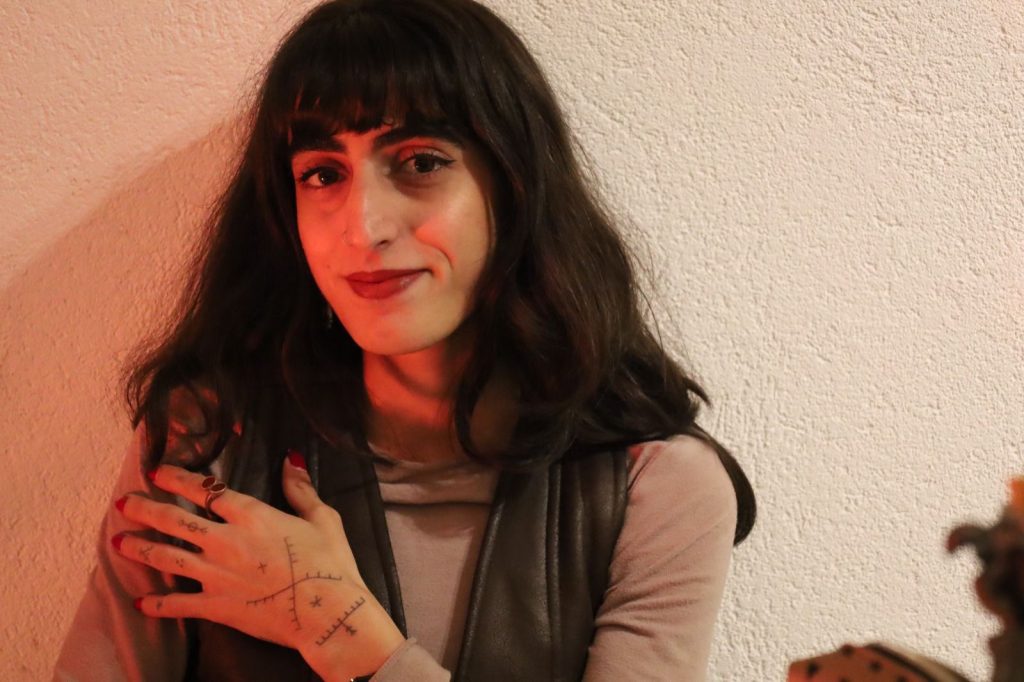
A comb with five lines, Arjin explains, symbolized a “second hand” – extra power for women who needed it. Arjin also wears a comb-shaped symbol on her wrist, and she says it was made for the same purpose: to give her strength and power.
As Arjin speaks, she gestures toward her own face. A small symbol rests quietly at the center of her lip. “This motif is said to symbolize women’s rebellion and solidarity,” she explains. “It is believed that during the time of Fatima, women used this as a mark of their support for her.” “The mirror motif on my hand is a talisman to ward off the evil eye; the human figure on my index finger represents waiting for news from someone far away,” she continues. “I had this done as a way of discovering myself. I chose the rebab to bring peace, the crown for nobility and leadership, and the three dots as a symbol for protection. This flower represents spring and renewal.’’ It was clear that she had chosen the spot for each tattoo on her body with great care and attention to what the symbol meant – not just to the world, but also to herself.
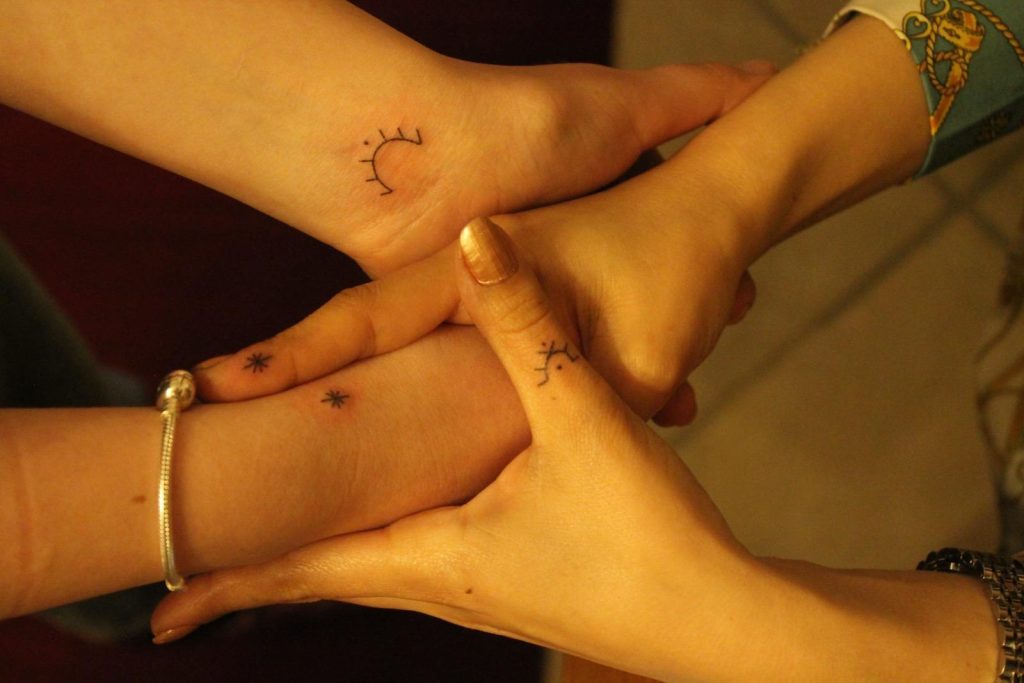
As on Arjin’s body, deq symbols vary across Mesopotamia: suns, combs, mirrors, moons, stars, dots, scissors, and trees are among those used in this art form. The sun, common in ancient Mesopotamian civilizations, evokes life, fertility, and divine order. The comb, often tattooed on hands or feet, was believed to give strength to women who labored endlessly in homes and fields. A comb with five lines, Arjin explains, symbolized a “second hand” – extra power for women who needed it. Arjin also wears a comb-shaped symbol on her wrist, and she says it was made for the same purpose: to give her strength and power.
In general, women have deq tattoos for many purposes: to protect their children; for beauty and health; to express their beliefs; and to show loyalty. For example, three dots marked on their left palms symbolize breaking ties with the men they were married to, and three dots on their right palms to ensure their husbands remained loyal and faithful. According to research, women in Kurdistan got deq to prevent violence from their husbands, to make them value their wives, or to prevent them from entering a second marriage.
Arjin emphasizes that in the Deq culture, symbols have become purposeful over time. Once associated with healing, they have transformed into markers of rebellion, identity, and memory.
Deq, Memory, and Survival
In Kurdistan, Arjin notes, Romani nomads who practiced deq professionally had a strong influence on how symbols spread and intertwined. “They caused identities and symbols to mix,” she says. “Deq became a shared language.”
Deq has never belonged to one people alone. Kurds, Yazidis, Arabs, Syriacs, Armenians, and many others carried and transformed its symbols. Practitioners of deq -known as deqqars- played a crucial role in this circulation, many of whom were nomadic. From India to Pakistan, from North Africa to Mesopotamia, deq traveled with bodies on the move.
In Kurdistan, Arjin notes, Romani nomads who practiced deq professionally had a strong influence on how symbols spread and intertwined. “They caused identities and symbols to mix,” she says. “Deq became a shared language.”
That language, however, was often shaped by violence. Migration, war, and forced displacement marked women’s bodies in profound ways. During periods of conflict, women who were kidnapped or forcibly displaced had symbols tattooed on visible parts of their bodies, like their faces, hands, and chests, to signal lineage and identity.
A story that Arjin shares is one she often returns to. A client from Meletî discovered a symbol tattooed on her grandmother’s chest. While researching it together, they realized it was a sun symbol associated with Armenians. During the Armenian Genocide, many Armenian women had their identities marked by deq; others were forcibly subjected to deq in order to conceal who they were. “During the Armenian forced deportation, some women did this to protect themselves,” Arjin says. “Others were forced to get deq as a means of assimilation and conversion to Islam.” For some, deq became a shield; for others, a scar.
Young People, Old Symbols
Today, in Bakur, deq is rarely practiced. It appears mostly on the bodies of older women, remnants of a silenced past. Yet in Istanbul, demand is growing, especially among younger Kurds.
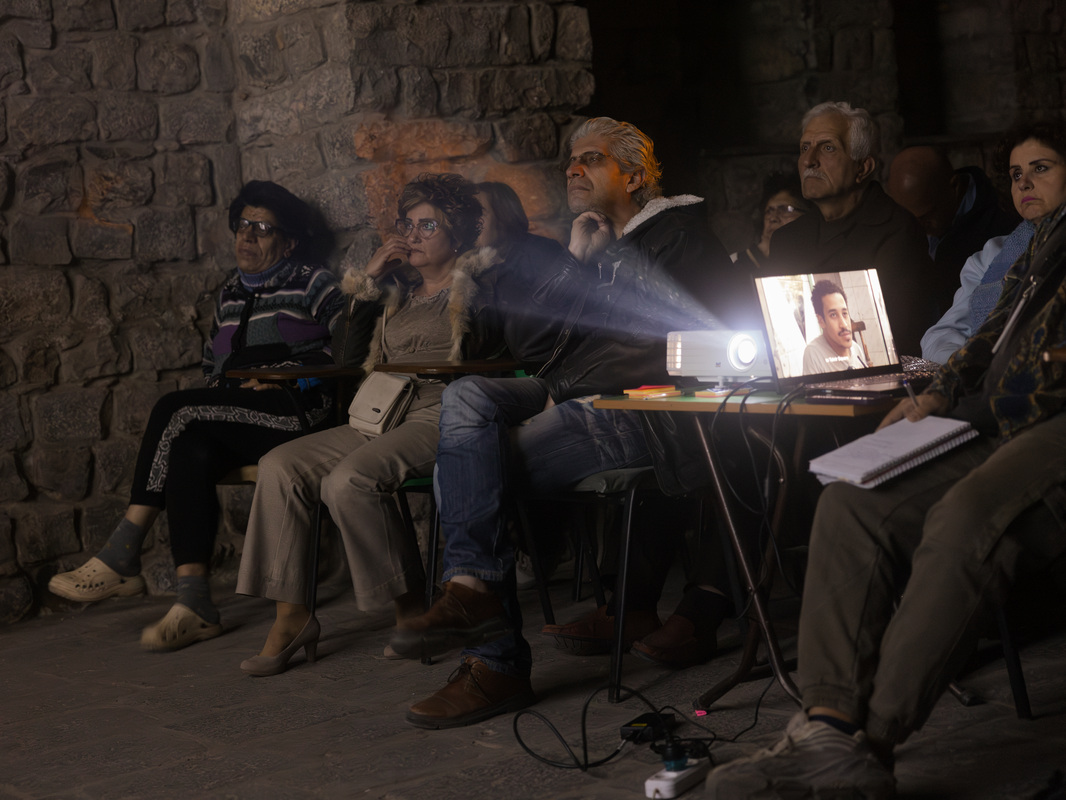
“They want to express and reclaim their identity,” Arjin says. Sunya Deq is more than a tattoo studio. Alongside deq sessions, the space hosts storytelling gatherings, alternative art projects, and film nights. Each activity circles back to the same question: how to carry memory forward.
In a city defined by speed and forgetting, deq reappears slowly, dot by dot, on new bodies, insisting on remembrance.

Şilan Bingöl
Şilan Bingöl is an independent researcher who studied sociology at Galatasaray University and Ecole Normale Supérieure de Lyon. Her master's thesis is on media sociology.